The government of China said on Wednesday that it has the right to take countermeasures to the new tariffs Mexico imposed on a wide range of Chinese goods at the start of the year.
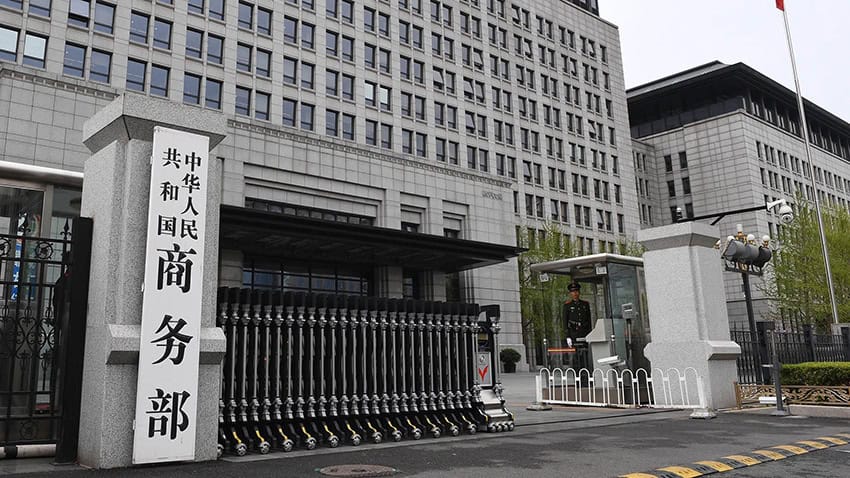
That declaration came from a spokesman for China’s Ministry of Commerce (MOFCOM), which conducted an investigation into Mexico’s tariffs and other trade measures and determined that they constitute trade and investment barriers.
In late 2025, the Mexican Congress approved tariffs of up to 50% on more than 1,400 products from China and other countries with which Mexico doesn’t have free trade agreements.
The new tariffs — widely seen as an attempt to appease the United States ahead of this year’s review of the USMCA free trade pact — took effect on Jan. 1.
After Congress’ approval of the duties, the Chinese government promptly urged Mexico to “correct its wrong practices of unilateralism and protectionism at an early date.” It has taken the view that Mexico yielded to U.S. coercion in imposing the higher tariffs, including 50% duties on Chinese cars.
On Wednesday, MOFCOM said that Mexico’s new and increased tariffs affect more than US $30 billion of Chinese exports to Mexico. The ministry’s probe found that Mexico’s duties could lead to losses of some $9.4 billion for China’s mechanical and electrical sectors.
MOFCOM said that around $9 billion of those losses would be borne by China’s automobile and auto parts sectors as Mexico was the biggest export destination for Chinese vehicles in 2025.

The Ministry also said that Mexico’s higher tariffs would have a negative impact on Chinese exports of some metal and chemical products as well as textiles and light industrial products.
In addition, MOFCOM said that some non-tariff trade measures Mexico has implemented in recent years, including complex customs inspection requirements, could hurt or restrict the investments and operations of Chinese companies in Mexico. Onerous customs inspection requirements can hold goods up at ports for lengthy periods, increasing costs for the companies exporting and importing the products.
What will happen now?
According to Xinhua — China’s official state news agency — a MOFCOM spokesman said on Wednesday that the Commerce Ministry “is authorized to implement corresponding measures to resolutely safeguard the interests of Chinese industries.”
China could impose retaliatory tariffs on Mexican goods, but the value of Mexico’s exports to China is dwarfed by the value of Chinese products entering Mexico, making it impossible for Beijing to inflict comparable damage on Mexican exporters. The Chinese government hasn’t announced a timeframe for when it might enact countermeasures targeting Mexican exports.
In 2025, Mexico’s exports to China were worth $10.2 billion, whereas Chinese goods worth more than $133 billion entered Mexico.
Before retaliating against Mexico, China could first seek additional dialogue or mediation.
According to the South China Morning Post, “Beijing is now positioned to pursue further bilateral talks” with Mexico “or escalate the case to a multilateral dispute resolution body, such as the World Trade Organization.”
Economy minister: ‘We don’t have anything against China’
The Mexican government has asserted that it implemented new and higher tariffs on goods from China and countries such as India, South Korea and Thailand to protect domestic industries and some 350,000 jobs.
On Wednesday, Economy Minister Marcelo Ebrard said that those industries include textiles, footwear and steel.
Speaking at an event in Monterrey, Ebrard said that another reason for the implementation of higher tariffs on Chinese goods was because “we believe [Chinese companies] are seeking to increase their markets with the help of their government” — i.e. shipping subsidized goods to Mexico, where they are sold at cheaper prices than comparable Mexican-made products.
Offering one example, he said that Chinese government assistance for producers of steel that is exported to Mexico has hurt Mexican manufacturers of the alloy.

Ebrard also said that Mexico has the “right” to impose tariffs, but promptly added:
“We don’t have anything against China or any other country.”
While the Mexican government has denied that pressure from Washington forced it to implement higher tariffs on Chinese goods, the fact that it did so could certainly help it during USMCA talks with the U.S. government, which have already commenced ahead of the formal review of the trade pact.
The Chinese Communist Party-controlled Global Times said in a report on Wednesday that it was told by Shi Xiaoli, director of the WTO Law Research Center at the China University of Political Science and Law, that “Mexico’s imposition of high tariffs on non-FTA partners, including China, was primarily aimed at taking actions favorable to U.S. interests before the U.S.-Mexico-Canada Agreement joint review, in order to avoid unfavorable outcomes.”
Before the implementation of the higher duties, U.S. President Donald Trump had accused Mexico of being a transshipment hub for Chinese goods — i.e., a tariff-free or low-tariff backdoor to the United States market.
Canada has also critically questioned Mexico’s economic ties with China, which is Mexico’s second largest trade partner after the U.S. However, Canadian Prime Minister Mark Carney forged a new partnership with China earlier this year, which reduced, rather than increased, tariffs on a quota of 49,000 Chinese electric vehicles.
With reports from Reuters, El País, El Economista, South China Morning Post and Xinhua