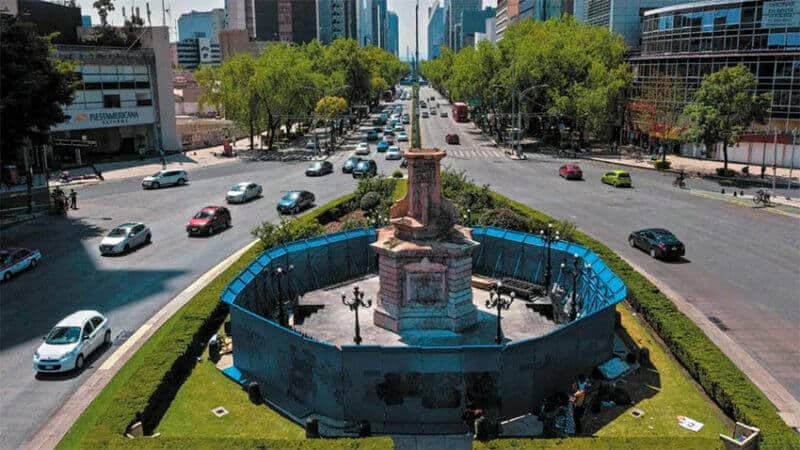
An empty plinth on Mexico City’s Reforma Avenue, which once exhibited a statue of Christopher Columbus, continues to cause controversy. In the artistic community, the debate centers on not what should stand on the plinth, but who should be given the right to create it.
Mexico City Mayor Claudia Sheinbaum announced Sunday that a sculpture of an indigenous Olmec woman would stand, and that the Columbus sculpture — removed in October amid threats it would be knocked down — would be relocated to Parque América, a park in the affluent Polanco district.
Writer Guillermo Sheridan and Twitter users have argued that the choice of the new statue should be decided by a public vote, but it is the city government’s choice of sculptor that has sparked the most intense debate. Pedro Reyes has been selected to create a figure he said would be called Tlalli.
Artists collective Moccam said he was the wrong person. “The tribute to 500 years of the resistance of indigenous women must be created by a woman, identified as part of an original peoples and sculptor. Enough of neocolonialism,” it said.
The chief curator of the Museum of Contemporary Art, Cuauhtémoc Medina, called the process into question. “For decades, artists, historians and critics have expressed our disagreement with the arbitrariness with the way in which the elected authorities … perpetuate the idea of the artist as an ideological servant,” he said.
“I am very sorry that an artist of some importance, such as Pedro Reyes, has fallen into the trap of operating as an official sculptor,” he added.
Sheinbaum explained her reasoning for the new symbolic Olmec effigy, but did not address the choice of sculptor. “The most important thing is that indigenous women are recognized on the main avenue of the capital of all Mexicans. It is something extremely profound, it goes far beyond a single sculpture. It recognizes the place of classism and racism in the history of Mexico and how colonialism not only left different legacies, but ones that we have to put at the center: the discrimination that exists toward different cultures and particularly the recognition not only of the original peoples but of women,” she said.

She added that Columbus would not be banished from the city. “It’s not about [the Columbus statue] not existing in the city, but that it has an adequate, dignified location.”
Reyes, meanwhile, said he appreciated the weight of his duty .”It is a responsibility that I take with great seriousness and with a deep sense of love for our country … if anyone can teach us how to take care of this planet, it is our native peoples,” he said.
With reports from El Economista