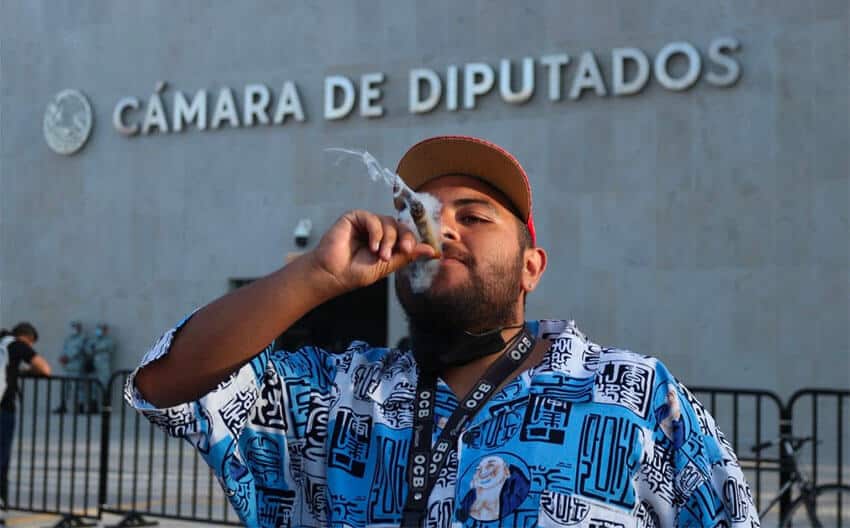
Lighting up a marijuana cigarette for recreational purposes or taking a hit from a bong should be legal in Mexico by now, but the last congressional period of 2021 ended without the Senate passing a cannabis regulation law that was approved by the lower house last March.
Senators didn’t vote on the Federal Law for the Regulation of Cannabis in the sitting period that ended December 15 because a Senate analysis concluded there are at least 17 “inconsistencies” in it.
Among them: an alleged loophole that would allow marijuana to be sold in unlimited quantities and problems related to the National Commission Against Addictions’ regulation of the legal pot market.
“We’re concerned about the substitution of the Mexican Cannabis Institute by the National Commission Against Addictions [Conadic],” said Institutional Revolutionary Party Senator Claudia Ruiz Massieu.
“… You can’t give regulation powers to a body that is in charge of combatting addictions because that transgresses the right to [free] development of personality and promotes the stigmatization of cannabis users,” she said.
The Supreme Court (SCJN) ruled in 2019 that prohibition of marijuana was unconstitutional because criminalization violates the right to free development of personality.
The news agency Europa Press reported that Conadic could block people aged between 18 and 25 from purchasing and possessing marijuana as a health protection measure. According to the Senate, such a move would be unconstitutional because it would violate the right to equality and non-discrimination.

Zara Snapp, a pro-pot activist, said it was disappointing that the Senate had failed to act to legalize recreational marijuana.
“Once again we see that political calculations, or a lack of capacity [on the part of senators], are stopping the law from coming out,” she said.
The SCJN has ordered the Congress to pass legislation legalizing the drug but it has failed to do so despite being given repeated extensions. In that context, the court struck down laws banning the use of recreational marijuana last June.
The court’s ruling – a “general declaration of unconstitutionality” with regard to laws banning recreational marijuana – ordered the federal Health Ministry to issue permits to adults who ask to be allowed to use and grow cannabis. However, it remained illegal to possess more than five grams of marijuana and sell the drug.
“There are a lot of young people in jail because they had a little more than five grams,” said Fernando Belaunzarán, a former federal deputy who has long advocated the legalization of marijuana. “I regret the delay and the irresponsibility of the Mexican Congress,” he said.
The Senate won’t sit again until February, meaning that the use of marijuana for recreational purposes by adults without Health Ministry permits will not be legal until the second month of 2022 at the earliest, provided the “inconsistencies” can be ironed out and the proposed law is put to a vote. Given the delays to date, pot smokers would be best advised not to hold their breath.
Nevertheless, the SCJN’s directive for marijuana to be legalized means that the legislation’s eventual passage through Congress is all but assured.
The legislation legalizes possession of up to 28 grams of marijuana for personal use and the cultivation of up to six plants in one’s home. Bricks and mortar stores with the appropriate licenses would be permitted to sell marijuana for recreational purposes, but the sale via vending machines, over the phone, online, or in any other way that is not face-to-face would be prohibited.
With reports from Infobae, Europa Press and Cuestione