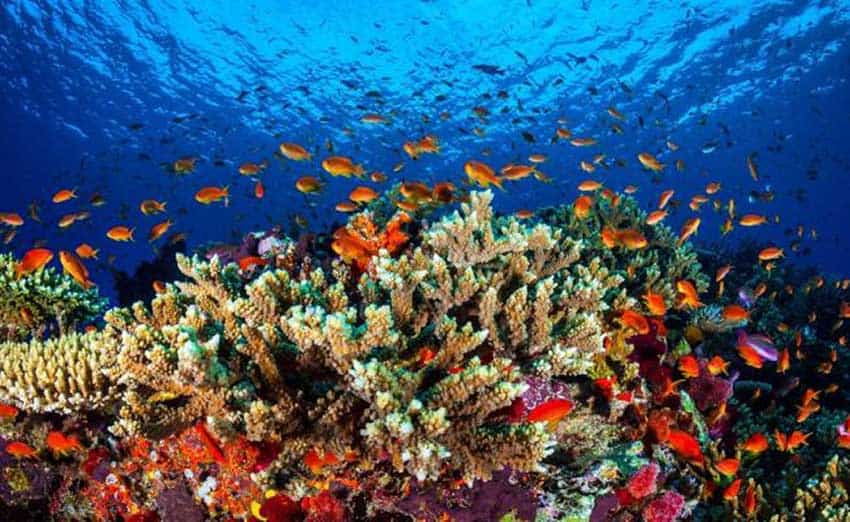
Coral reefs off the coast of Quintana Roo are under threat from an aggressive bleaching phenomenon and sargassum, experts warn.
María del Carmen García Rivas, director of the Puerto Morelos National Reef Park, said that 30% of coral colonies in the park have died over the past four months due to bleaching, a phenomenon that occurs when water is too warm.
However, she warned that the expected invasion of sargassum later this year will also pose a threat to the reef’s health, explaining that when the seaweed decomposes it emits sulfuric acid which could have a catastrophic effect on the marine ecosystem.
García said that she hoped that all three levels of government will take strong action to combat the arrival of sargassum and avoid what could be an environmental disaster.
Lorenzo Álvarez Phillips, head researcher at the Institute of Marine Sciences and Limnology at the National Autonomous University (UNAM), said that coral bleaching and sargassum are affecting the entire reef system from Isla Contoy, located off the north coast of Quintana Roo, to Sian Ka’an, a biosphere reserve in the municipality of Tulum.
Reefs located off the coast of Cozumel as well as Mahahual and Xcalac in the south of Quintana Roo have also been affected by the bleaching disease.
Álvarez said the bleaching phenomenon off the coast of Quintana Roo is so aggressive that an entire coral colony which took thousands of years to form can be killed in a single month.

The phenomenon has spread quickly, he added, explaining that reefs in “practically the whole state” have been affected.
The reefs are part of the Mesoamerican Barrier Reef System that stretches over 1,000 kilometers from Isla Contoy to the Bay Islands in Honduras.
Source: El Economista (sp)