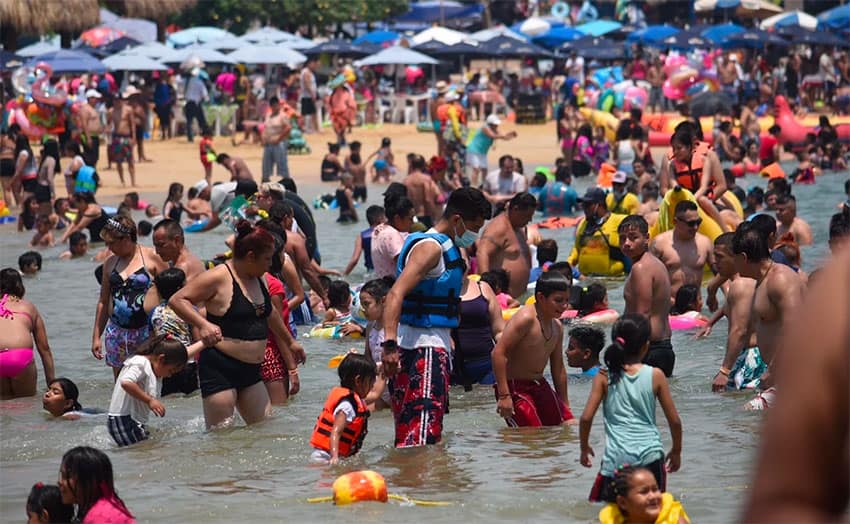
Aguascalientes and Guerrero will switch to low risk green on the federal stoplight map on Monday, according to their respective governors.
Both states are medium risk yellow on the map currently in force. The federal Health Ministry will present a new map for the two-week period between May 24 and June 6 at Friday night’s coronavirus press briefing.
Martín Orozco of Aguascalientes said the switch to green will pave the way for the reopening of schools. Primary schools are slated to reopen on June 6 and middle and high schools could offer in-person classes starting June 13, the governor said.
Orozco said it will be up to parents to decide whether they want their children to return to classes. He stressed that schools will have to follow strict protocols to prevent the spread of the virus.
Schools across Mexico closed in March 2020 due to the pandemic, and with the exception of some rural schools in Campeche, remain shut. Students switched to online and television learning, which has been especially challenging in parts of the country where internet connectivity and TV reception is unreliable.
Aguascalientes, one of Mexico’s smallest states, has recorded more than 26,000 confirmed coronavirus cases and 2,460 Covid-19 deaths, according to federal data. It has been yellow on the stoplight map since early March.
Governor Héctor Astudillo announced Friday that Guerrero will also switch to green on Monday but stressed that the risk downgrade doesn’t mean the pandemic is over.

“The pandemic continues, it exists. That’s why we have to take care and we have to get vaccinated,” he said.
“… The green light doesn’t mean that we can all go out and party, … that we can go to work and walk around without face masks; we have to maintain the preventative measures.”
Astudillo noted that the pandemic has caused severe economic damage to the Pacific coast state but acknowledged that the loss of human life has been even more painful.
“We’ve had ups and downs, … the two national peaks [of the pandemic] reached us; we had 35 to 36 deaths a day during the first [peak] between May and June last year. The second came in January and February, during which we had up to 26 deaths a day,” he said.
The governor said Guerrero is now recording an average of seven Covid deaths per day and the hospital occupancy rate is not above 20% in the various regions of the state.
Astudillo also said that the switch to green will pave the way for the reopening of schools but unlike Orozco, he didn’t offer any dates for students to return to classrooms.
Guerrero, which was maximum risk red on the stoplight map less than three months ago, has recorded more than 40,000 confirmed cases since the start of the pandemic and 4,295 Covid-19 deaths.
Mexico City, Mexico’s coronavirus epicenter since the start of the pandemic, continues to lead the country for cases and deaths with more than 652,000 of the former and 42,661 of the latter. The capital switched to yellow at the start of last week and will remain that color next week, the Mexico City government said Friday.
The national tally of confirmed cases rose to 2.39 million on Thursday with 2,628 new cases reported while the official death toll rose by 230 to 221,080, a total considered a vast undercount.
As of Thursday night, just under 25 million Covid-19 vaccine doses had been administered, a figure equivalent to 20 shots per 100 people.
Source: Milenio (sp)