Mexican health workers face higher risk of dying from Covid-19

Mexican health workers are more likely to die from Covid-19 than their counterparts in countries such as the United States, China, Peru and Brazil, data shows.

In a new report, the non-governmental organization Signos Vitales (Vital Signs) said that 2.6% of all Covid-19 fatalities in Mexico between May 22 and June 9 were medical personnel.

The figure is more than six times higher than the United Kingdom’s rate of 0.4% and more than five times higher than China’s rate of 0.5%.

The deaths of health workers in the United States from Covid-19 account for 0.54% of all fatalities from the disease in that country, Signos Vitales said, while the rates in Peru and Brazil are 0.86% and 1.22%, respectively.

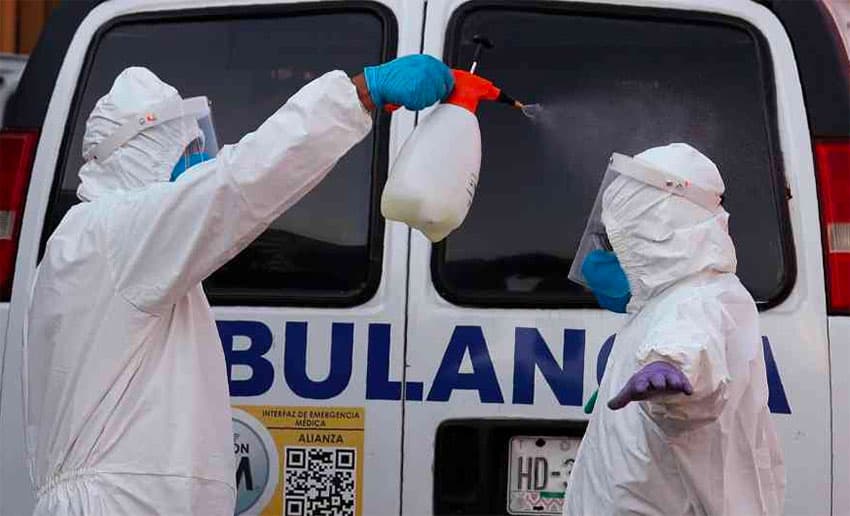
The report said that health workers in Mexico have had greater exposure to the coronavirus than those in other countries due to a lack of personal protective equipment (PPE) and training in the treatment of infectious diseases.

Signos Vitales also said that 71.3% of 1,915 health workers it surveyed were afraid of dying from Covid-19. Just under three-quarters rated the government poorly for its response to the pandemic.

The NGO also reported that 32,388 of 154,863 people confirmed to have been infected with the coronavirus to June 16 were health workers. In other words, two or every 10 infections detected were among medical personnel.

Speaking at the presentation of the report on Thursday, former federal health minister and Signos Vitales member Salomón Chertorivski said the government was too late in providing sufficient PPE to health workers, increasing their risk of contracting the coronavirus.

“It took a long time to arrive even though we had 2 1/2 months to prepare and learn what other countries did. … The first equipment … [came from] private donations,” he said.

The Signos Vitales report also apportioned blame to the government for the high rates of coronavirus infections and deaths among health workers.

“The first victims of the tardy and inefficient response of the authorities were health personnel,” the report said.

Source: Reforma (sp), El Universal (sp) 

Have something to say? Paid Subscribers get all access to make & read comments.
Manzanillo, Colima, México, 13 de marzo de 2026. La doctora Claudia Sheinbaum Pardo, presidenta Constitucional de los Estados Unidos Mexicanos en conferencia de prensa matutina, “Conferencia del Pueblo” desde Colima. La acompañan Indira Vizcaíno Silva, gobernadora Constitucional del Estado de Colima; Omar García Harfuch, secretario de Seguridad y Protección Ciudadana (SSPC); Raymundo Pedro Morales Ángeles, secretario de Marina (Semar); Bulmaro Juárez Pérez, divulgador de lenguas originarias, presentador de la sección “Suave Patria”; Ricardo Trevilla Trejo, secretario de la Defensa Nacional (Sedena); Jesús Antonio Esteva Medina, secretario de Infraestructura, Comunicaciones y Transportes; Bryant Alejandro García Ramírez, fiscal general del Estado de Colima; Fabián Ricardo Gómez Calcáneo; Rocío Bárcena Molina, subsecretaria de Desarrollo Democrático, Participación Social y Asuntos Religiosos de la Secretaría de Gobernación; Efraín Morales López, director general de la Comisión Nacional del Agua (Conagua); Marcela Figueroa Franco, secretaria ejecutiva del Sistema Nacional de Seguridad Pública (SESNSP) y Guillermo Briseño Lobera, comandante de la Guardia Nacional (GN). Foto: Saúl López / Presidencia

Mexico’s week in review: Congress deals Sheinbaum her first legislative defeat

0
The week of March 9 in Mexico was marked by standoffs between allies in Congress and adversaries at the airport. Here's what you missed.
A soldier displays seized handguns

The US and Mexico, growing together and growing apart: A perspective from our CEO

1
From a historic drop in homicides to opposite bets on electric vehicles, Mexico News Daily's CEO breaks down where the U.S. and Mexico are converging — and where they're not.
Veracruz Gov.

Veracruz governor blames private vessel for 200-kilometer Gulf Coast oil spill

1
The spill, which has spread to over 200 kilometers of Mexico's Gulf Coast beaches, has been traced to a private oil tanker off the coast of Tabasco.
BETA Version - Powered by Perplexity