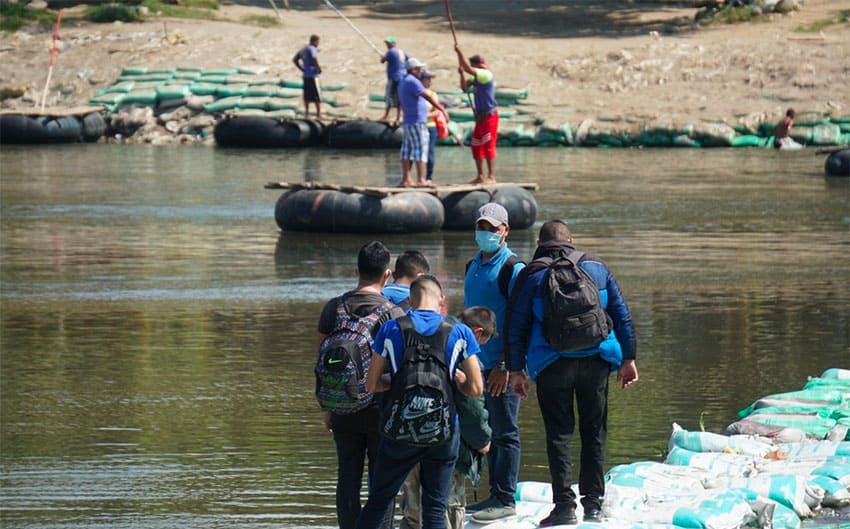
The federal government announced Thursday that the southern border with Guatemala and Belize would close on Friday to nonessential traffic as part of measures to combat the coronavirus pandemic. It also said the closure of the Mexico-U.S. border was extended for another month.
“To prevent the spread of Covid-19, Mexico will impose restrictions on land travel for nonessential activities at its northern and southern border starting March 19, 2021,” the Foreign Affairs Ministry (SRE) said on Twitter.
“In addition, the government of Mexico will implement sanitary control measures in the north and south of the country. The restrictions on nonessential travel and the health measures will remain in force until 23:59 on April 21, 2021.”
The closure of the southern border comes as a growing number of Central American migrants – encouraged by United States President Joe Biden’s arrival in the White House – attempt to travel to the U.S. via Mexico to seek asylum. More than 100,000 migrants were apprehended by United States border agents in February, an increase of 28% over January numbers.
Deputy Health Minister Hugo López-Gatell said Thursday night that the closure of the southern border to nonessential traffic was related to the increase in migrant flows from Central America.
Speaking at the Health Ministry’s coronavirus press briefing, the government’s coronavirus czar stressed that the border was not closing completely.
“It’s simply a collaboration with … Guatemala, Belize and other Central American nations … to have a reduction in mobility for nonessential activities,” he said.

Although restrictions on travel across the northern border have been in place for the past year, Mexico had not previously limited travel across the border with Guatemala and Belize.
The SRE’s announcement came the same day as the United States announced that it plans to share 2.5 million AstraZeneca vaccines with Mexico.
The federal government ramped up enforcement against migrants when former United States president Donald Trump threatened to impose blanket tariffs on Mexican goods if it didn’t do more to stop flows of people to the Mexico-U.S. border.
But Mexican and U.S officials denied that there was any migration deal included in the vaccine agreement.
Before the SRE made its announcement, the United States said it was extending restrictions on travel across its its land borders.
“To prevent the further spread of Covid-19, and in coordination with our partners in Canada and Mexico, the United States is extending the restrictions on non-essential travel at our land borders through April 21, while ensuring continued flows of essential trade and travel,” the Department of Homeland Security said.
Source: El Universal (sp), Infobae (sp)