The number of new coronavirus cases reported by the Health Ministry has trended downwards in recent days but Mexico does not appear to have reached the peak of its pandemic, according to Johns Hopkins University.
In a Covid-19 situation report published Monday, the Johns Hopkins Center for Health Security noted that Mexico had reported a decreasing daily incidence for three consecutive days. (Daily case numbers have now declined for four consecutive days.)
“However, Mexico does not yet appear to have reached its peak,” the report said.
“Based on recent trends, we expect Mexico to report increasing daily incidence over the coming days. Mexico is currently No. 6 globally in terms of daily incidence,” it added.
Indeed, data shows that the Health Ministry has generally reported fewer cases on Saturdays, Sundays and Mondays compared to preceding days, seemingly indicating that there is a delay in registering cases over the weekend.
However, Deputy Health Minister Hugo López-Gatell, the government’s coronavirus point man, asserted on Sunday that the speed at which Mexico’s coronavirus pandemic is growing has slowed.
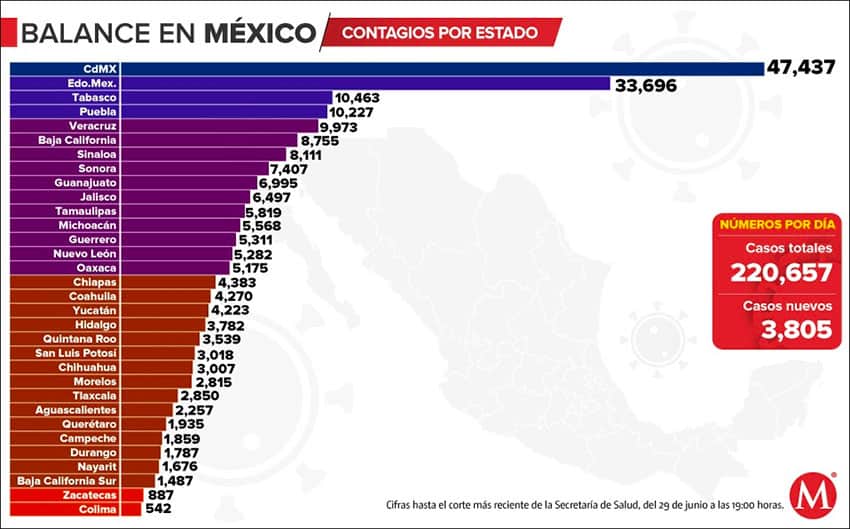
At Monday night’s coronavirus press briefing, the Health Ministry reported 3,805 additional Covid-19 cases, increasing Mexico’s accumulated case tally to 220,657. It was the first time that fewer than 4,000 cases were reported since June 15.

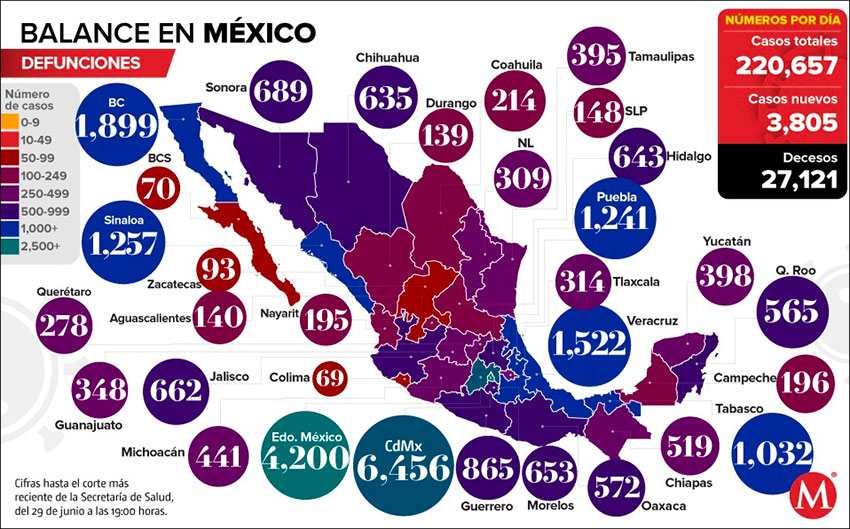
The ministry also reported 473 additional Covid-19 fatalities, lifting the death toll to 27,121.
Almost two-thirds of all confirmed Covid-19 deaths were reported this month, although health officials have stressed that some of the fatalities reported on any given day occurred days, weeks or even months prior.
Based on confirmed coronavirus cases and deaths, Mexico’s fatality rate is currently 12.3, well above the global rate of 4.9.
In addition to Mexico’s confirmed Covid-19 fatalities, 2,055 deaths are suspected of having been caused by the disease.
Health Ministry Director of Epidemiology José Luis Alomía said that 23,389 of the confirmed cases are considered active, a decrease of 2,169 cases compared to Sunday. He also said that there are 66,910 suspected cases and that 566,602 people have been tested for Covid-19.
Mexico City, which switched from “red light” to “orange light” coronavirus restrictions this week, continues to lead the country for accumulated cases, active cases and deaths.
The capital has recorded a total of 47,437 cases, of which 3,431 are currently active. It has also recorded 6,456 confirmed Covid-19 fatalities.
México state ranks second for accumulated and active cases, with 33,696 of the former and 2,039 of the latter. It also has the second highest coronavirus death toll in the country, with 4,200 confirmed fatalities as of Monday.
Tabasco and Puebla are the only other states to have recorded more than 10,000 confirmed cases since the start of the pandemic.
Apart from Mexico City and México state, six states currently have more than 1,000 active cases. They are Puebla, Guanajuato, Tabasco, Tamaulipas, Veracruz and Yucatán.
Five states excluding the capital and México state have Covid-19 death tolls above 1,000. They are Baja California, Veracruz, Sinaloa, Puebla and Tabasco.
The Health Ministry presented data Monday night that showed that the average age of those who have died was 61 and 66% of deceased coronavirus patients were men.
Hypertension was the most common existing health problem among those who died followed by diabetes, obesity, tobacco addiction, chronic kidney disease, chronic obstructive pulmonary disease, cardiovascular disease, immunodeficiency disorders and asthma.
About seven in 10 patients who died from Covid-19 in Mexico had at least one existing identified health problem while three in 10 did not.
National data showed that 44% of general care hospital beds set aside for coronavirus patients are currently occupied while 39% of those with ventilators are in use. Every state in the country has at least 35% availability of both general care and critical care beds.