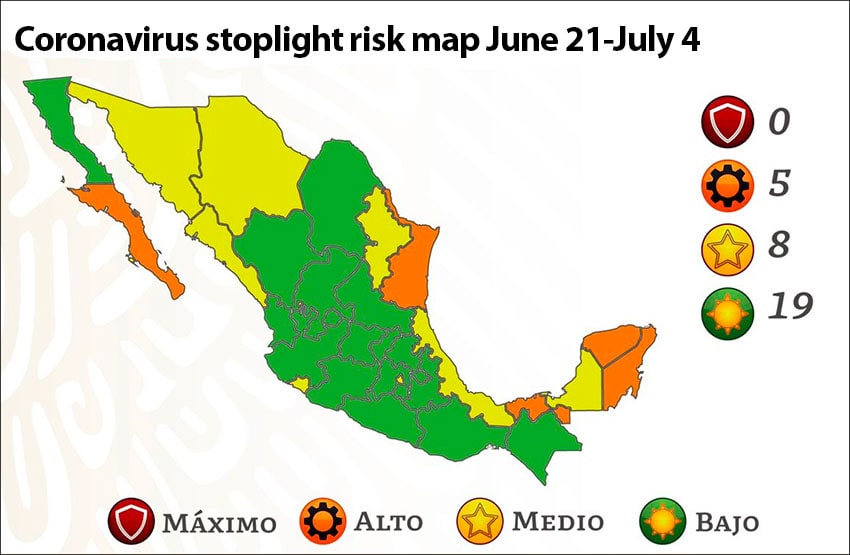
The intensity of the coronavirus pandemic is increasing in eight states, the federal Health Ministry said Friday as it announced a new stoplight map on which Mexico City lost its green light low risk status.
New case numbers are on the rise in Baja California Sur, Campeche, Quintana Roo, Sinaloa, Tabasco, Tamualipas, Veracruz and Yucatán, the ministry said in a statement.
Estimated case numbers across the country increased 14% in epidemiological week 22 – May 30 to June 5 – compared to the week prior.
Deputy Health Minister Hugo López-Gatell said earlier this week that Quintana Roo and Yucatán had recorded the most signifiant recent increase in case numbers. Both states are high risk orange on the new stoplight map, which will take effect Monday and remain in force until July 4.
There will be three other orange light states for the next two weeks: Baja California Sur, Tabasco and Tamaulipas.
Four of the five orange states are already that color while Tamaulipas, where there are more than 1,500 active cases, will switch from medium risk yellow.
There are eight yellow light states and 19 green ones on the updated map, which is once again devoid of maximum risk red.

The yellow states for the next two weeks will be Campeche, Chihuahua, Mexico City, Colima, Nuevo León, Sinaloa, Sonora and Veracruz. Seven of the states are already yellow while Mexico City will switch from green just two weeks after reaching the low risk level.
The Mexico City government said in a statement that the capital’s “Covid score,” according to a federal Health Ministry system that takes 10 different indicators including case numbers and hospital occupancy levels into account, had increased one point to nine, pushing it out of the green light range.
“According to the guidelines established by the government of Mexico, the cutoff to be at the green light level is eight points,” it said.
“It’s important to highlight that all the indicators assessed by the government of Mexico, including Covid-19 cases, hospitalizations and deaths, as well as their trends, are still in the same range as those obtained on June 3 when the change to green was determined,” the Mexico City government said, adding that the only indicator that increased was that which measures the virus reproduction rate (the number of people each infected person infects on average).
Even with a higher reproduction rate, case numbers, new hospitalizations and Covid-19 deaths are all more than 90% below their respective maximums, the government said. Restrictions will not be tightened in the capital despite the increased risk level.
The 19 green light states for the next two weeks will be Aguascalientes, Baja California, Chiapas, Coahuila, Durango, México state, Guanajuato, Guerrero, Hidalgo, Jalisco, Michoacán, Morelos, Nayarit, Oaxaca, Puebla, Querétaro, San Luis Potosí, Tlaxcala and Zacatecas. All of those states are already green with the exception of Baja California, which will switch from yellow.
The Health Ministry said the national hospital occupancy rate for beds set aside for coronavirus patients is 86% lower than the peak recorded in January when Mexico was amid its second and worst wave of the pandemic. More than 80% of both general care and beds with ventilators are currently available, it said.
More than 27.2 million Mexicans, or 30% of the adult population, have received at least one vaccine dose, among whom are 15.8 million people who are fully vaccinated, the Health Ministry said.
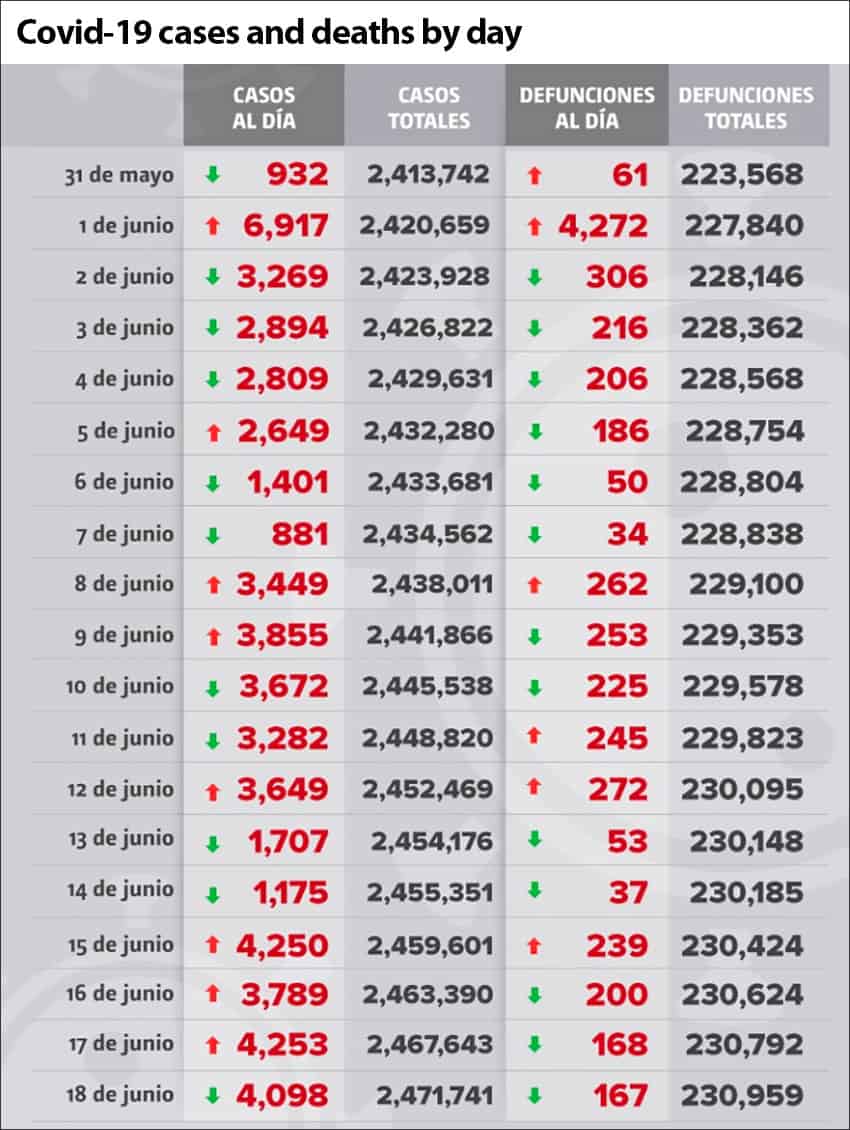
The accumulated case tally currently stands at 2.47 million while the official Covid-19 death toll is 230,959, the fourth highest total in the world after those of the United States, Brazil and India.
With reports from Milenio