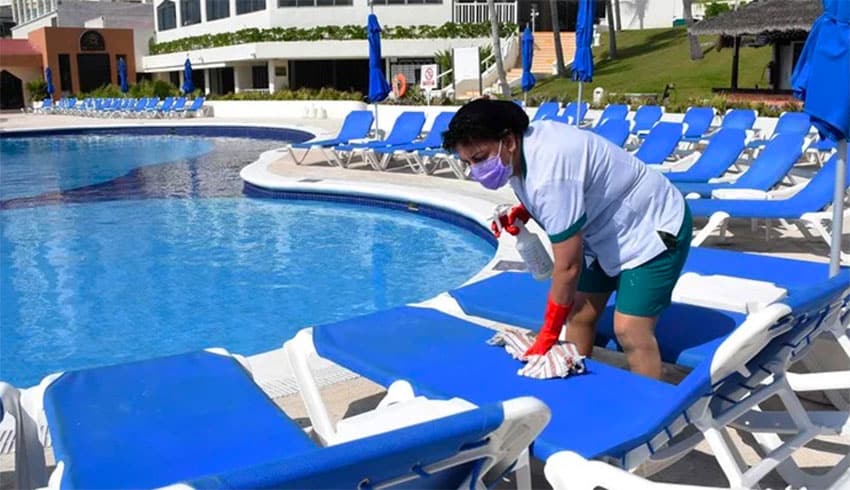
The Ministry of Tourism (Sectur) has developed a new sanitary certification system to draw foreign visitors back to Mexican tourist destinations.
The “Punto Limpio” (Clean Point) designation, which is an update to a similar program implemented during the swine flu pandemic of 2009, is earned by establishments that meet government hygiene standards after taking a free two-month course, Tourism Minister Miguel Torruco announced at a virtual press conference on Monday.
To create the new program, guidelines were reviewed and revised, new protocols were introduced and feedback was sought from several agencies. The new certification has the endorsement of the ministries of health, labor and social welfare as well as Mexico’s coronavirus czar, Deputy Health Minister Hugo López-Gatell.
The program is designed for a variety of tourism-related businesses, Torruco said, including hotels, cafés, car rental agencies and travel agencies. “With this model, tourist agencies will be able to provide tourists with a model of safety and hygiene, and greater confidence is generated among travelers,” he said.
Businesses adopting the measures defined in the Clean Point guidelines will have to incur costs, warned the president of the National Tourism Business Council (CNET), Braulio Arsuaga.
“The seal and the processes that are being established will give us an important differentiation, and without a doubt we will have to apply them. This will imply certain costs for the industry; however, there is no intention of transferring this to the final consumer,” he stated.
In May, the World Travel and Tourism Council (WTTC) launched the Safe Travels program for tourism destinations that comply with hygiene and sanitization standards based on recommendations by the U.S. Centers for Disease Control and the World Health Organization.

Thus far Quintana Roo, Baja California Sur, Yucatán, the Riviera Nayarit, Jalisco, Campeche, Tabasco, Tamaulipas, Sinaloa, Oaxaca, Michoacán and Guanajuato have qualified for the global health designation.
Currently, 1,250 establishments have obtained Mexico’s Punto Limpio certification, which is valid for two years. Participation in the program is voluntary, and businesses that do not choose to participate can operate normally.
Source: Milenio (sp), La Silla Rota (sp)