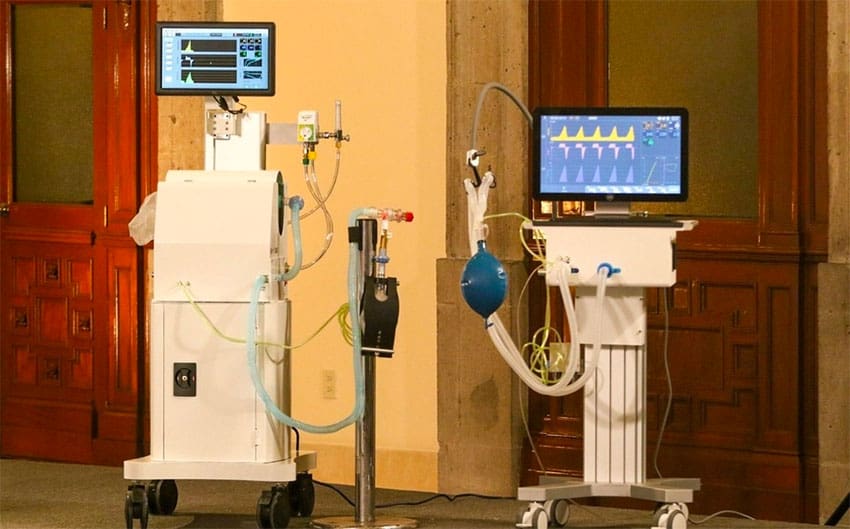
President López Obrador today presented two new ventilator models designed for seriously ill coronavirus patients.
The National Council of Science and Technology (Conacyt) built the devices with help from private organizations and universities. Speaking at his morning press conference, the president applauded Mexican innovation as a way for the country to avoid depending on “international solidarity” in its fight against the coronavirus pandemic.
Health Minister Jorge Alcocer was also upbeat.
“It has been possible to build two types of highly specialized ventilators, accessible to everyone, in response to the most urgent needs in this scenario of the pandemic. While reducing expenses and increasing efficiency we strengthen our technological presence and gain national sovereignty,” he said.
One ventilator model is called Gätsi, which means “sigh” in the indigenous language Otomí, and the other has been dubbed Ehécatl 4T or “God of the Wind” in Náhuatl, the president said.
The latter costs 70% less than the current market price of such ventilators, and 500 more units have been ordered. The device has a microcontroller capable of calculating and applying the necessary pressure during patient ventilation cycles.
The Gätsi ventilator, made in conjunction with Dydetec, a private software and hardware design company, is 60% cheaper than commercially available models and has a microprocessor control system that allows it to be adapted for adult or pediatric patients. Five hundred units of this model will also be produced.

Both ventilators are designed with control, pressure and volume sensors, are easy to clean, were tested on artificial lungs and biological systems and meet international specifications.
The cost for 1,000 ventilators will be 259 million pesos, around US $11.5 million, a unit cost of $11,500.
“In five months we achieved what usually takes between three and five years to develop,” said María Elena Álvarez-Buylla, director of Conacyt. “Scientific sovereignty and technological independence are how this government responds to challenges. We are seeing the birth of a national industry to save lives.”
Another made-in-Mexico respirator was announced in May by the National Institute of Health Sciences and Nutrition. It designed and built a product, in partnership with private sector partners in Nuevo León, with a cost of $10,000, the first of which were expected to be delivered this month.