A partial closure of the northern border on Saturday did not sit well among some citizens of Sonora.
In 2019, the states of Arizona and Sonora saw 16.3 million people cross their shared border by vehicle. That’s not counting pedestrian border crossings, which tacks on an additional 6.9 million crossings at the least, according to the United States Bureau of Transportation Statistics.
But that’s changed recently because travelers are no longer just travelers: they’re potential carriers of the coronavirus.
The border closure applies to “non-essential travel” and allows a number of exemptions. For example, U.S. citizens can technically still cross into Sonora for medical appointments, a common practice in Mexican border towns, where medical services are offered at a cheaper rate than in the U.S.
But for some Sonora residents, the partial closure is not enough.
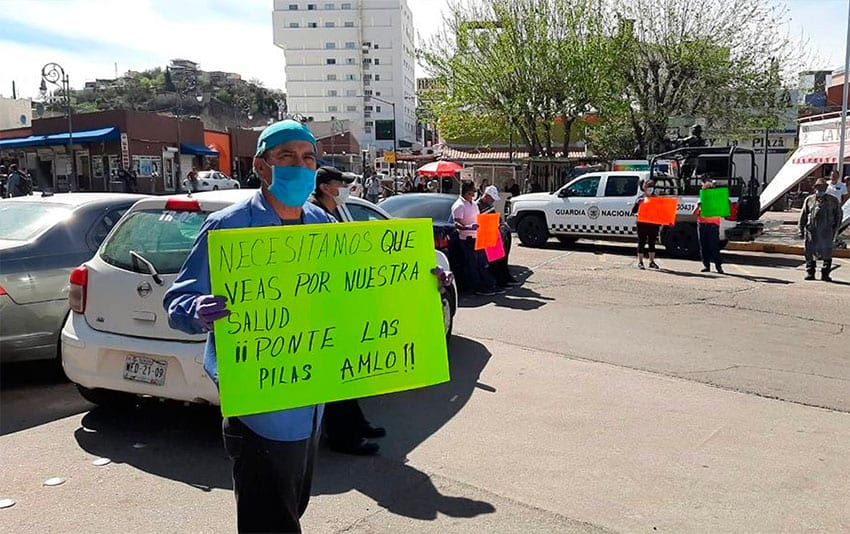
On Wednesday, a small group of protesters demanded tighter border restrictions by Mexico’s federal government. Swathed in protective masks, the protesters rallied near a major port of entry between Nogales, Sonora, and Nogales, Arizona, the city that sits just north of the border. They held neon-colored signs demanding action from President López Obrador.
Hailing from a group known as Sonorenses por la Salud y la Vida (Sonorans for Health and Life), the protesters demanded health screenings for all travelers entering Mexico, according to The Arizona Republic.

José Luiz Hernández, one of the protesters, expressed frustration at what he sees as a lack of response from the government to the coronavirus.
“The federal government isn’t doing anything to control the crossing,” he told Tribuna in a video.
He gestured toward the DeConcini port of entry: a few squat buildings and vehicle lanes that stand between Sonora and Arizona.
The protest mirrors a mounting frustration that’s been coursing through Mexico. Mexican citizens from singer Thalia to soccer star Nico Sánchez have publicly criticized López Obrador for a perceived lack of response to the pandemic.
On Sunday, a day after implementing the partial closure of the border, the president released a video from a restaurant in Oaxaca urging viewers to continue patronizing restaurants, supporting Mexican businesses and not to stop going out.
“I am going to tell you when not to go out,” he told viewers.
As protesters in Nogales gathered several days later, one brightly colored sign stood out in particular: “We need you to look out for our health. Get your act together, AMLO!” it read in Spanish, referring to the president by a popularly used acronym.
Sources: Tribuna (sp), AZ Central (en)