What would a government infrastructure project be without cost overruns?
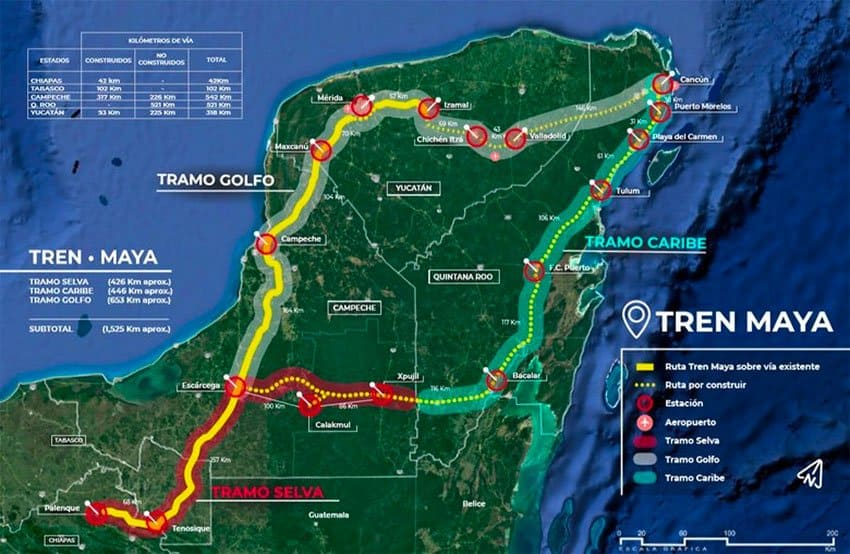
According to new statistics provided by the tourism development fund Fonatur, the cost of initial studies for the construction of the Maya Train, including a master plan and environmental impact study, have shot up 710%.
The projected cost of 120 million pesos (US $6.2 million) five months ago is now 972 million pesos (US $50.8 million).
Government documents reveal that initial estimates overlooked 14 of 24 necessary studies, which represents a significant increase in cost.
There was also an environmental cost despite claims that the project would not have any serious effect on the environment.
In April, a payment of 48.2 million pesos was made to the Mexican Forestry Fund for environmental compensation for the removal of approximately 750 hectares of forest, an area slightly larger than Mexico City’s Chapultepec park.
Total costs related to feasibility studies have shot up by 1,200% from 14 million pesos to 184 million, while the master plan has risen six times, from 20 million pesos to 120 million.

Among several other studies that ballooned in cost were a legal analysis, from 11 million to 55 million pesos; a financial analysis, from 11 million to 52 million pesos; a social impact study, from 15 million to 81 million pesos; an evaluation of obtaining a right-of-way, from 12 million to 110 million pesos; a market study, from 11 million to 40 million pesos; and an archaeological preservation study, from 7 million to 95 million pesos.
Three new studies were also added to the total, including a 90-million-peso mobility study, a 30-million-peso social sensitivity study and a 40-million-peso study of soil mechanics.
Source: Milenio (sp)