A federal court has suspended environmental permits issued for the first three sections of the Maya Train railroad, ruling that all work approved by that authorization must stop.
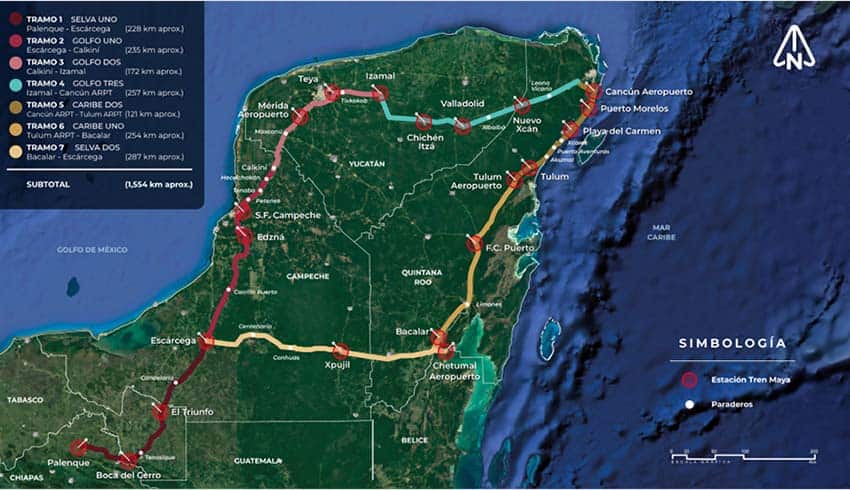
The decision, which the newspaper Reforma reported as “unappealable,” affects the sections between Palenque, Chiapas, and Escárcega, Campeche; Escárcega and Calkiní, Campeche; and Calkiní and Izamal, Yucatán.
Three judges voted unanimously to suspend Environment Ministry (Semarnat) permits granted to the National Tourism Promotion Fund (Fonatur) that allowed the alteration of 800 hectares of forest land across 25 municipalities in Chiapas, Tabasco, Campeche and Yucatán. They didn’t specify the length of the suspension.
Fonatur is managing the construction of the US $8 billion, 1,500-kilometer railroad, one of the government’s most important infrastructure projects.
The court’s ruling, which was handed down two weeks ago but not made public at the time, came in response to a legal challenge filed by residents of the four states through which sections 1, 2 and 3 are slated to run.
“The suspension entails the cessation of all work derived from” the Semarnat authorization “that involves deforestation or places native animals and vegetation at risk,” its decision said.
“The responsible authority [Semarnat] must take appropriate measures so that … [Fonatur] stops” such work on sections 1, 2 and 3 of the railroad, the court said.

Fonatur awarded four contracts worth 48.95 billion pesos (US $2.3 billion) to build the sections. A consortium controlled by billionaire businessman Carlos Slim secured one of the contracts.
Other courts have issued injunctions against the Maya Train project, but the government has challenged them and succeeded in having them revoked. It says the railroad is on schedule to begin operations in late 2023.
Given that the latest ruling is not open to appeal, it is unclear how the government will seek to overcome it so that work on the first three sections of the project can proceed in a timely fashion. Fonatur has asked the federal court for clarification on whether all work, or just some of it, must stop, Reforma reported.
The government is also facing opposition to work on section 5 of the railroad, which will run between Cancún and Tulum in Quintana Roo. A protest was held Sunday at a site near Playa del Carmen where trees have been cut down to make way for the tracks, while a petition against the project on change.org had attracted almost 69,000 signatures by early Tuesday afternoon.
A group of citizens and civil society organizations has filed complaints against Fonatur with environmental protection agency Profepa over environmental damage caused by work on section 5, which allegedly occurred before an environmental impact study had been completed.
“Profepa is asked to exercise its actions of inspection and verification in the affected area, due to the clearing of Mayan forest with heavy machinery,” the group said in a statement.
“Said inspections and verifications must demonstrate the existence of environmental impact authorizations and change of land use authorizations … issued by Semarnat. … We emphasize that the Maya Train mega-project requires studies and authorizations before … construction,” it said, adding that in their absence, Profepa should suspend work on section 5.
With reports from Reforma