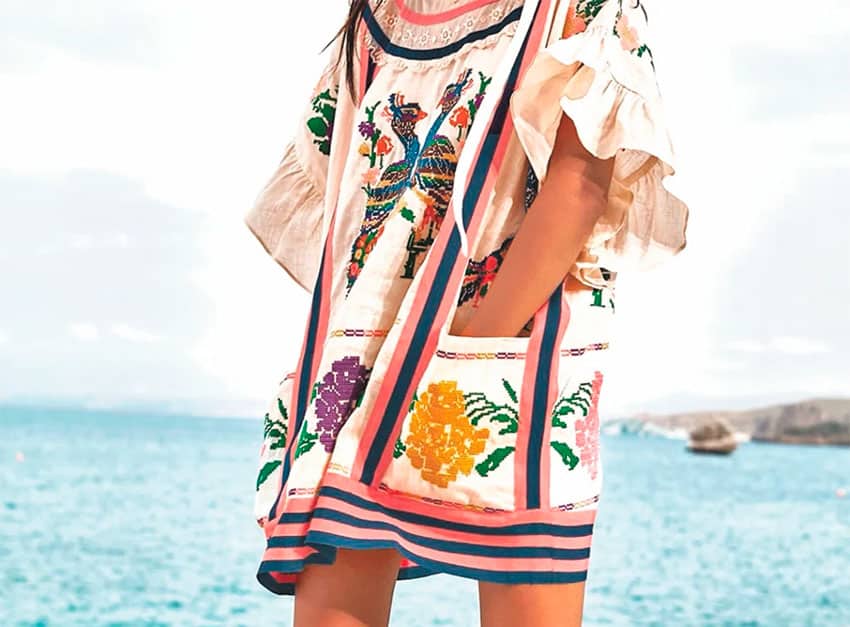
An Australian fashion brand has offered to pay compensation to indigenous artisans whose designs it was accused of plagiarizing and proposed negotiating an agreement to allow it to sell its culturally “inspired” garments.
Zimmermann, a fashion house that has stores around the world, withdrew a dress from its 2021 collection last month after facing accusations by members of the Mazatec community in the Cañada region of Oaxaca that it plagiarized the design of a traditional huipil, a loose-fitting tunic commonly worn by both indigenous and non-indigenous women in Mexico.
The cut of the company’s Riders Paneled tunic dress, the birds and flowers embroidered on it and its colors all resemble a traditional Mazatec huipil.
Zimmermann apologized for using the design “without [giving] appropriate credit to the cultural owners of this form of dress and for the offense this has caused.”
“Although the error was unintentional, when it was brought to our attention …, the item was immediately withdrawn from all Zimmermann stores and our website. We have taken steps to ensure this does not happen again in future,” it said in a social media post.
Days after the company issued its apology, members of the Oaxaca Institute of Crafts (IOA), a state government organization, spoke with Malcolm Carfrae, a fashion consultant hired by Zimmermann to liaise with Mexican artisans.
“He told us that his intention is to offer a direct apology to the artisans and the community of Huautla de Jiménez because they recognized that [the dress design] was plagiarized,” IOA director Nadia Clímaco said Monday.

“And they want to provide some economic compensation,” she said, adding that the IOA was asked to determine an appropriate amount.
“We let him know that we can’t take that decision,” Clímaco said, explaining that the institute would need to consult with the Mazatec artisans.
She said that Zimmermann subsequently sent a letter to the IOA in which the company raised the possibility of the Mazatec community granting permission for its tunic dress to be sold. (It was advertised for US $850 before being withdrawn.)
Clímaco said the fashion brand proposed commercialization “under the terms that the members of the community consider appropriate.”
The IOA chief said the proposal was taken to artisans in Huautla de Jiménez, located near the border with Puebla, because only they can decide if they want to effectively license their traditional designs. A decision could take some time because there are different opinions in the town, Clímaco said.
Some people say “my identity is priceless,” she said, while others, acknowledging the difficult economic situation they currently face, were more open to the idea of negotiating an agreement to allow Zimmermann to sell its dress.
To date there is no agreement, Clímaco said, adding that the IOA is providing legal advice to the artisans.
Source: El Universal (sp)