These eco-shoes are made with sargassum seaweed and plastic bottles

In Quintana Roo, sargassum seaweed is a curse, but for a Guanajuato inventor it has the potential to become environmentally friendly footwear.

A new line of eco-shoes — made with recycled plastic and sargassum — has been designed by the firm Renovare, which had already spent several years experimenting with PET plastic.

Renovare founder Jorge Castro Ramos told the newspaper El Financiero that it took the company five years of trial and error to reach the stage where it could obtain clothing-grade textile fibers out of recycled plastic bottles.

The resulting polyester, he explained, has been patented as a Mexican product and can also be used to manufacture handbags, backpacks and sportswear.

Last year the company began working with sargassum, and about eight months ago came up with a shoe whose sole was made with 100 grams of sargassum and the rest with five recycled plastic bottles.
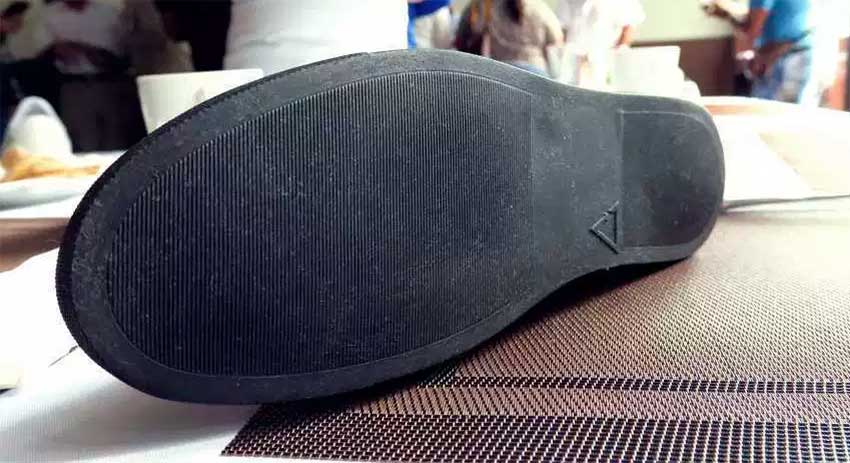
Recycled seaweed forms the sole of the eco-shoe.

Along with being an environmentally-friendly product, the shoe is also water-resistant. Renovare estimates that a pair can last up to two years, after which the shoes can be returned to Renovare for recycling.

The manufacturing process has been certified by several research centers, including the Center for Innovation Applied to Competitive Technologies (Ciatec), an agency that operates under the National Science and Technology Council (Conacyt).

While the sargassum and recycled plastic shoe has yet to hit the market, Renovare has been working to build demand. The next step is to hire up to 150 people and turn out 20,000 shoes a month.

In the meantime, the company has to work out the means of collecting and processing the seaweed.

Renovare is not alone in having found something useful to do with the unwanted weed, hundreds of tonnes of which have arrived on Quintana Roo beaches in recent years, threatening tourism and the environment.

A Puerto Morelos businessman has built a house with it and is now planning a sargassum-brick hotel in Tulum.

Source: El Financiero (sp)

Have something to say? Paid Subscribers get all access to make & read comments.
Manzanillo, Colima, México, 13 de marzo de 2026. La doctora Claudia Sheinbaum Pardo, presidenta Constitucional de los Estados Unidos Mexicanos en conferencia de prensa matutina, “Conferencia del Pueblo” desde Colima. La acompañan Indira Vizcaíno Silva, gobernadora Constitucional del Estado de Colima; Omar García Harfuch, secretario de Seguridad y Protección Ciudadana (SSPC); Raymundo Pedro Morales Ángeles, secretario de Marina (Semar); Bulmaro Juárez Pérez, divulgador de lenguas originarias, presentador de la sección “Suave Patria”; Ricardo Trevilla Trejo, secretario de la Defensa Nacional (Sedena); Jesús Antonio Esteva Medina, secretario de Infraestructura, Comunicaciones y Transportes; Bryant Alejandro García Ramírez, fiscal general del Estado de Colima; Fabián Ricardo Gómez Calcáneo; Rocío Bárcena Molina, subsecretaria de Desarrollo Democrático, Participación Social y Asuntos Religiosos de la Secretaría de Gobernación; Efraín Morales López, director general de la Comisión Nacional del Agua (Conagua); Marcela Figueroa Franco, secretaria ejecutiva del Sistema Nacional de Seguridad Pública (SESNSP) y Guillermo Briseño Lobera, comandante de la Guardia Nacional (GN). Foto: Saúl López / Presidencia

Mexico’s week in review: Congress deals Sheinbaum her first legislative defeat

0
The week of March 9 in Mexico was marked by standoffs between allies in Congress and adversaries at the airport. Here's what you missed.
A soldier displays seized handguns

The US and Mexico, growing together and growing apart: A perspective from our CEO

1
From a historic drop in homicides to opposite bets on electric vehicles, Mexico News Daily's CEO breaks down where the U.S. and Mexico are converging — and where they're not.
Veracruz Gov.

Veracruz governor blames private vessel for 200-kilometer Gulf Coast oil spill

1
The spill, which has spread to over 200 kilometers of Mexico's Gulf Coast beaches, has been traced to a private oil tanker off the coast of Tabasco.
BETA Version - Powered by Perplexity