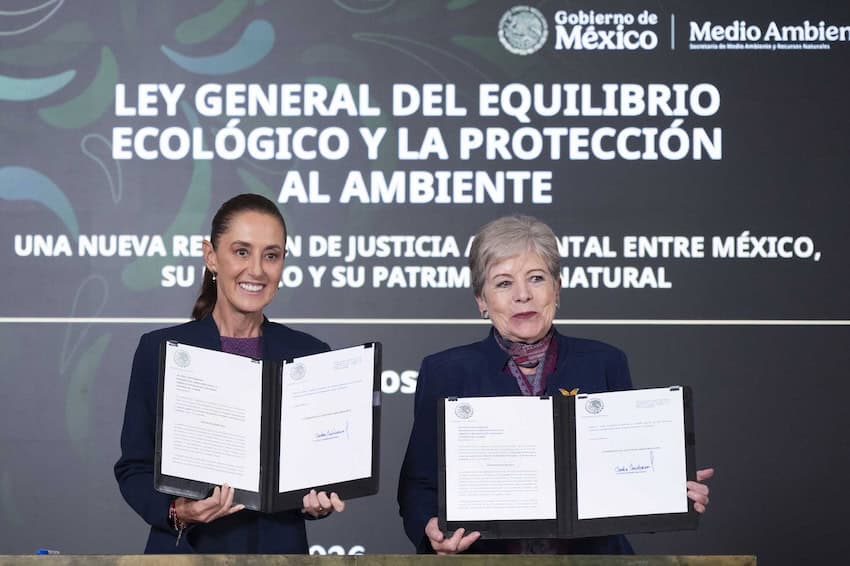
The Ministry of Environment and Natural Resources (Semarnat) presented an initiative today to reform the General Law of Ecological Balance and Environmental Protection (LGEEPA), which is Mexico’s main environmental legal framework.
The proposal, spearheaded by Minister Alicia Bárcena, aims to update a regulation created in 1988 in response to new challenges such as climate change, biodiversity loss, pollution, pressure on water resources and conflicts arising from infrastructure, industry and urban development projects.
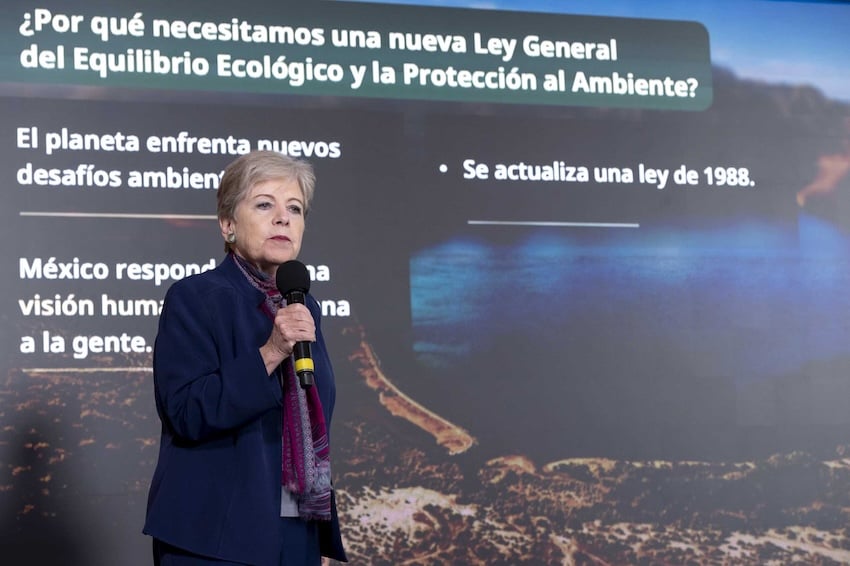
Presented at President Claudia Sheinbaum’s Wednesday morning press conference, the bill includes 10 policy principles that seek to prevent and repair ecological damage, protect communities and make economic development compatible with environmental justice and nature conservation.
According to Sheinbaum, the objective is “to strengthen the capacities of the Mexican state to protect, care for, conserve and restore the environment and natural resources.”
What are the new principles?
With environmental justice as the bill’s central focus, Semarnat aims to deepen the link between the protection of ecosystems and natural resources with social well-being, citizen participation and respect for the rights of Mexico’s Indigenous, Afro-Mexican, rural and urban communities.
It also proposes that authorities, in collaboration with private companies, assess the possible ecological consequences of works and productive activities further in advance (currently, a company can request an Environmental Impact Assessment (MIA) at any time prior to the onset of construction), and assume partial responsibility if and when the work causes eventual deterioration.
Bárcena explained that the reform takes a “proactive” approach by requiring developers of large-scale projects to carry out a strategic environmental assessment over a longer time frame and prohibiting them from fragmenting projects to avoid a comprehensive assessment of their regional impact.

The bill incorporates new tools to address current environmental challenges, including an ecological restoration program, new mechanisms to address climate change and provisions to strengthen the prevention, repair and remediation of environmental damage.
The plan also includes promoting ecological restoration programs, focusing on rivers, mangroves, coastlines, forest ecosystems and other degraded areas.

Bárcena said that the enhanced protection of native species will be paramount, including the Mexican wolf, the condor, the blue whale and dolphins.
Moreover, the law proposes a specific chapter dedicated to those who defend the environment and public goods, incorporating a new platform for “payment for environmental services” (PSA) and facilitating compensation for communities that protect their natural resources.
Bárcena added that the bill incorporates scientific advances, innovation and new technologies, as well as the recognition of the ancestral knowledge of Indigenous peoples as tools for the protection of biodiversity.
“We cannot do science without recognizing the wisdom of our Indigenous peoples,” Bárcena said.
Overall, the bill proposes that economic development must honor nature’s limits while promoting shared well-being.
Mexico News Daily