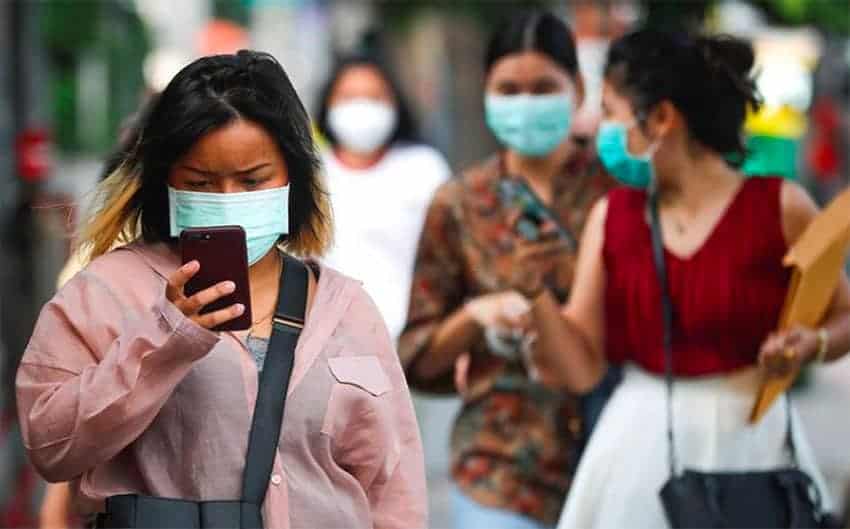
The widespread use of face masks can play an important role in slowing the spread of Covid-19 but the federal government must guarantee a supply for health workers before obliging members of the general public to wear them, say two academics.
Jorge Baruch Díaz, a professor of medicine at the National Autonomous University, told the newspaper El Financiero that “there is scientific evidence that the use of face masks” reduces the risk of infection from respiratory diseases.
“In a hospital environment the risk of infection is reduced by up to 40% if face masks are used,” he said. “Due to their effectiveness, the World Health Organization has always recommended their use for respiratory diseases.”
In a separate interview, Jorge Castañeda Sánchez, a researcher in the department of biological systems at the Xochimilco campus of the Metropolitan Autonomous University, also said that the use of masks can reduce the risk of infection from airborne diseases.
But both academics said the federal government should not make citizens’ use of face masks obligatory until they can guarantee their supply as well as that of other essential personal protective equipment to frontline health workers.
General Motors is planning to help the government in that regard: the automaker announced this week that it will begin making face masks at its plant in Toluca, México state, at the end of April. The company said that it intends to make 9 million masks over six months and distribute them to public hospitals in Mexico City, México state, San Luís Potosi, Guanajuato and Coahuila.
If the federal government were to make the universal use of masks mandatory, the order would have to be accompanied by an information campaign that educates the public about how to wear them properly, the academics said.

If masks are not used correctly – they should cover people’s mouth and nose and fit flush against their face – they can do more harm than good, they said.
Deputy Health Minister Hugo López-Gatell said as much recently, stating that they can give those wearing them a “false sense of security.”
Federal authorities have said on repeated occasions that it will not order their universal use. However, the governments of 11 states and Mexico City have made the wearing of face masks mandatory in some or all public places.
Castañeda claimed that the governments that haven’t made the use of masks compulsory haven’t done so because of the lack of availability.
For his part, Díaz said “if a country or a state has guaranteed the supply of face masks for health personnel and the most vulnerable groups [of society], it can then transition to generalized use of face masks.”
He added that China, Singapore and South Korea all made the use of face masks mandatory and were successful in flattening their coronavirus epidemic curves.
Face masks are not a panacea, said both academics, but their generalized use can help to control the spread of Covid-19.
Source: El Financiero (sp), El Universal (sp)