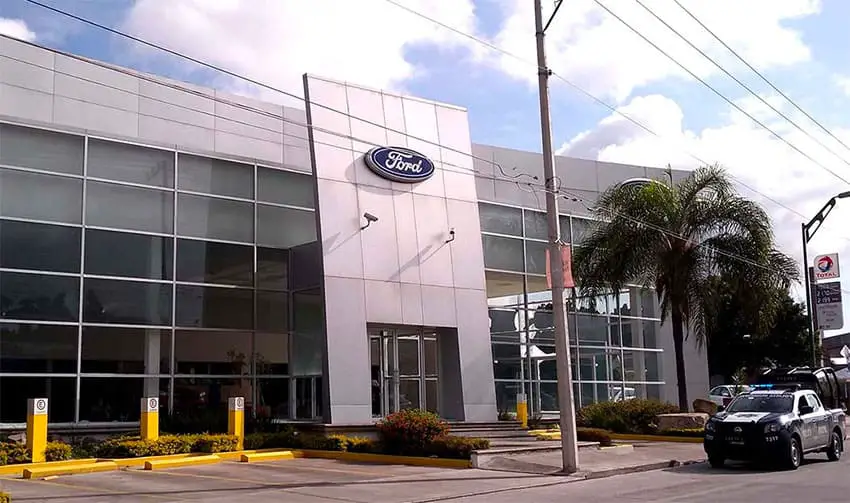
An armed attack that forced the closure of a Ford dealership in Celaya, Guanajuato, is believed to have come after the owners refused to comply with extortion demands.
A commando opened fire on the Ford Montes dealership in the central Mexico city in the early hours of September 19, damaging several vehicles and leaving the owners with multi-million-peso losses.
The subsequent closure of the dealership has left about 85 people without a job.
The newspaper Periódico Correo reported that the employees were aware that a criminal group had in recent months demanded extortion payments known as cobro de piso from the owners. But they refused to pay.
The owners haven’t officially announced the closure of their business but all vehicles have been removed from the dealership, which hasn’t opened since the attack.
Both large and small businesses in Celaya have been the target of extortion demands from criminal groups.
Jorge Rincón Maldonado, the president of a Celaya business group, said it is unclear exactly how many businesses have closed as a result of extortion but he acknowledged that there is a problem. Not all business owners report the extortion demands and threats they receive to authorities, he added.

Earlier this month, the local president of the Business Coordinating Council appealed to Guanajuato Governor Diego Sinhue Rodríguez Vallejo to address the problem that has led some business owners not only to close shop but leave Celaya altogether.
“There are businesses that are in crisis, they’re closing their doors, leaving people unemployed. After so much effort to create jobs, business owners . . . are worried. It’s not fair that they have to leave the city, it’s not fair that they have to leave their business, not due to a lack of planning or strategy or a bad decision but something [insecurity] they can’t control,” Jesús Torres Ramos said on September 11.
Five days later, Guanajuato Attorney General Carlos Zamarripa Aguirre announced that a local extortion racket had been broken up and that 12 suspects had been arrested.
But the crime remains an ongoing concern in Celaya and many businesses that closed due to extortion remain shuttered, Periódico Correo said.
Magdalena Rosales Cruz, a lawmaker who represents Celaya, called on the governor and Mayor Elvira Paniagua to submit a report to Congress to explain the actions they are taking at the state and municipal level to strengthen the police presence in the city.
Speaking in Congress, the Morena party deputy said that Guanajuato has one of the worst police shortages in the country, claiming that the state has only just over half the officers it needs.
Rosales also claimed that Paniagua has refused to acknowledge the extortion problem in Celaya.
“Celaya is today one of the most violent cities in the world and we can’t forget that in the middle of one of the worst extortion crises the city has gone through, the mayor refused on repeated occasions [to acknowledge] the situation,” she said.
“People of Celaya are living in a constant state of fear and despair. Even though the state authorities made the sensationalist declaration that they arrested an [extortion] ringleader, the people feel the same.”
In August, dozens of tortilla makers closed in protest over extortion.
Source: Periódico Correo (sp)