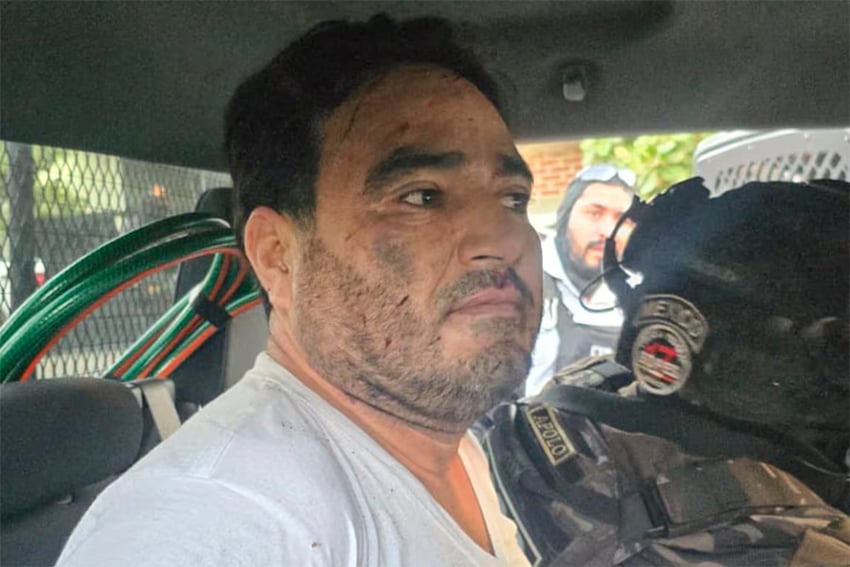
Security Minister Omar García Harfuch announced on Thursday the arrest of a man in connection with the murder of Bernardo Bravo, who led a lime growers’ association in Michoacán.
At President Claudia Sheinbaum’s morning press conference, García Harfuch said that “an individual nicknamed El Botox” had been detained “a few minutes ago” in an operation carried out by federal and state security forces in Michoacán.
En un operación conjunta de @Defensamx1 @SEMAR_mx @SSPCMexico @FiscaliaMich y autoridades del estado de Michoacán fue detenido el Carlos Alejandro N “Botox” objetivo prioritario y generador de violencia en Michoacán. Principal extorsionador de limoneros y responsable de varios… pic.twitter.com/HlpOlEqwVt
— Omar H Garcia Harfuch (@OHarfuch) January 22, 2026
“El Botox” is César Alejandro Sepúlveda Arrellano, alleged leader of Los Blanco de Troya, a crime group described in media reports as the armed wing of Los Viagras, a criminal organization affiliated with the Jalisco New Generation Cartel.
García Harfuch said that Sepúlveda is “responsible” for extorting lime growers and other agricultural producers, and for homicides, including that of Bravo, who was killed last October.

He said that the suspect attempted to escape from the address authorities raided on Thursday morning, but a female security agent detained him. The arrest reportedly took place near Apatzingán, a municipality in the notoriously dangerous Tierra Caliente region of Michoacán.
García Harfuch said that “a woman very close to” Sepúlveda was arrested around midnight on Thursday. He noted also that three people within Sepúlveda’s “close circles” were detained last week.
On social media, García Harfuch wrote that “El Botox,” who has previously spent time in prison, was a “priority target” of authorities and a “generator of violence in Michoacán,” one of Mexico’s most violent states.
The Michoacán Attorney General’s office accuses Sepúlveda of both planning the murder of Bravo and carrying it out. A warrant was issued for his arrest before he was taken into custody on Thursday morning. The Milenio newspaper reported that Sepúlveda recently posted videos to social media in which he asserted that he didn’t murder Bravo and that he was in fact a defender of the citrus industry in Michoacán.
The arrest of the suspect came three months and one day after Bravo, president of the Apatzingán Citrus Growers Association in Michoacán, was found dead in the front seat of his pick-up truck, killed by a bullet to the back of his head.
The next day, García Harfuch announced that a man identified as Rigoberto “N” had been detained.
“As a result of investigative work following the homicide of Bernardo Bravo, leader of citrus growers in the region, an operation was carried out in Michoacán … during which Rigoberto “N” was arrested,” he wrote on social media on Oct. 21.
“The detainee is identified as one of those responsible for collecting extortion payments from lime producers in Apatzingán,” García Harfuch wrote.
Though Rigoberto “N” was not charged with the murder of Bravo, he is suspected of playing a role in his death.
Before he was murdered, Bravo had been urging lime growers in the Tierra Caliente region of Michoacán to resist the extortion scheme that has long plagued producers in the area.
The US Treasury Department announced sanctions against ‘El Botox’ last year
Last August, the U.S. Department of the Treasury’s Office of Foreign Assets Control announced that it was “sanctioning two notorious Mexican cartels — Carteles Unidos (a.k.a. ‘United Cartels’) and Los Viagras — and seven affiliated individuals linked to terrorism, drug trafficking, and extortion in Mexico’s agricultural sector.”
One of the sanctioned individuals was Sepúlveda.
“César Alejandro Sepúlveda Arellano, a.k.a. ‘El Botox,’ is a Los Viagras leader responsible for the killing of a citrus producer,” the Treasury Department said in an Aug. 14 statement, released more than two months before Sepúlveda allegedly murdered Bravo.
In the same press release, Treasury wrote that “Los Viagras has extorted avocado and citrus growers, cattle ranchers, and entire towns to generate revenue.”
Highway blockades reported after arrest
Highway blockades set up by armed civilians were reported at three different points in the Tierra Caliente region of Michoacán following the arrest of Sepúlveda. Two of the blockades were set up in Apatzingán and one in the neighboring municipality of Buenavista.
It is relatively common in Mexico for crime groups to set up highway blockades in response to arrests, and to hinder additional actions against their members. Sometimes the blockades include burning vehicles, but that didn’t appear to be the case in the Tierra Caliente region on Thursday morning.
With reports from Reforma, El Universal, Milenio and Latinus