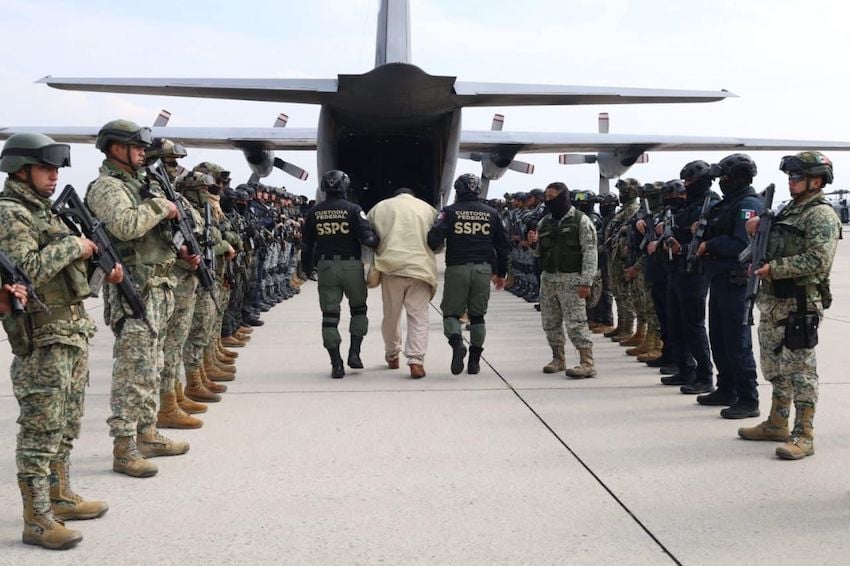
Relatives of drug cartel suspects have accused Mexico of breaking the law after authorities transferred nearly 100 alleged criminals to the United States, circumventing the formal extradition process established by treaty between the two nations.
At a Jan. 26 press conference, lawyers for the accused claimed that their clients were denied due process because they were sent to the U.S. without an extradition order, leaving them with virtually no legal means in Mexico to challenge their transfer. Some family members have described this as a kind of “banishment” or exile.
“Mexico is currently facing significant pressure from the United States regarding security and cooperation,” said Yarey Sánchez Lagunas, the lawyer for two individuals who were extradited to the U.S. last year. “This compels us to ask, with all seriousness and responsibility, whether these types of decisions are being used to demonstrate political gains, even at the expense of due process.”
Since February 2025, Mexico has sent 92 people linked to organized crime to face trial in the U.S. — the most recent prison transfer having occurred just two weeks ago.
Mexico sends 37 alleged criminals to US in third major prisoner transfer
Analysts have described the transfers as an offering by Mexican authorities to counter growing threats of military intervention against cartels from the Trump administration.

The transfers are central to a legal debate that has intensified following January’s extraditions, which included Juan Pedro Saldívar Farías, a regional leader of the Zetas cartel who faces charges of drug and weapons trafficking. His partner, Vanesa Guzmán, filed a criminal complaint against high-ranking Mexican government officials, particularly Mexico’s Security Minister Omar García Harfuch, who has spearheaded a heavy offensive against the cartels.
In her complaint filed Monday with the Attorney General’s Office, Guzmán accused García Harfuch and other security officials of “treason.”
The Mexican government has said that the extraditions were legal and carried out for national security reasons. The United States asserts that the detainees were wanted for crimes in the U.S. and many of them had outstanding extradition requests.
Mexico’s former attorney general Alejandro Gertz Manero — who led the first handover of cartel figures — said that such a decision was not based on the extradition law.
“Remember that this is not an extradition law being applied. This is a national security request justified by the U.S. based on the criminal conduct of these individuals in that country, which coincides with the procedures and our knowledge of the evidence of their conduct,” he stated.
Indeed, the U.S. Attorney General’s Office has said that the first handover of criminal leaders by Mexico was in accordance with Executive Order 14157, by which five Mexican cartels were declared terrorist organizations.
Mike Vigil, former head of international operations for the DEA, downplayed the complaints and praised U.S. authorities for “speeding up” a legal process that often gets bogged down for years as lawyers file appeal after appeal in an attempt to slow law enforcement.
With reports from The Associated Press and El País