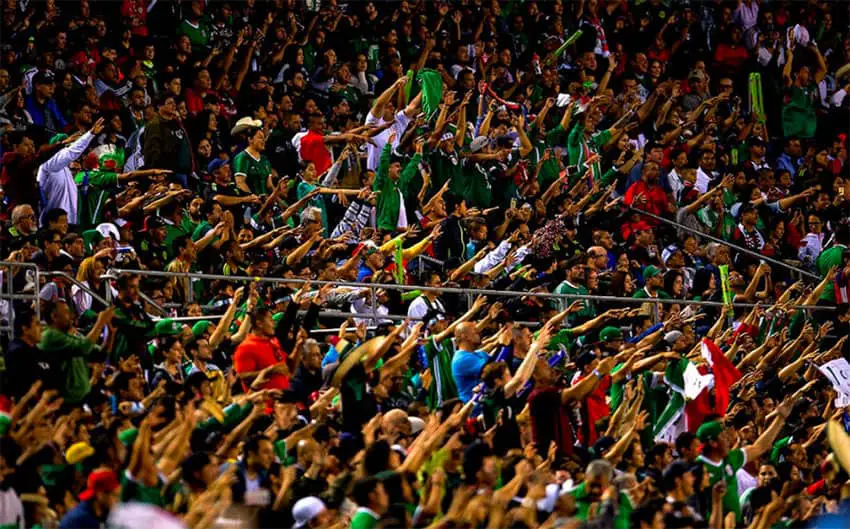
Despite efforts to counter the practice a chant considered anti-gay is still common in Mexican soccer, but the Mexican Football Federation (FMF) is hoping to change that with the help of its players and the cooperation of fans.
The FMF will be enforcing a three-step anti-discrimination protocol developed by FIFA, the international governing body, in the men’s national team matches this summer, ESPN reported.
The controversial “Eh, puto” chant is often directed at opposition goalkeepers as they run up to take a goal kick. It has been heard in FMF matches as well as games around Latin America.
FMF president Yon de Luisa said FIFA has fined Mexico 11 times for the chant, noting that it is not the image Mexico should be projecting to the world.
“This has been something that we have struggled with for the last years, and not only in the U.S. but almost everywhere where our national team plays,” De Luisa said. “We saw it a little bit [at the 2018 World Cup] in Russia and other places where we have played. This is a challenge for us. This has become one of our important challenges for our federation.”

Several Mexico national team players took part in a 2019 video asking fans to stop using the chant.

“We need the players to send a clear message — that this [chant] cannot happen, that we are playing with our jobs … and that we are affecting our idols directly,” De Luisa said.
He added that FIFA has threatened to apply additional sanctions.
“The FIFA [threat] on not only stopping the match, losing points or kicking the national team out of the competition, it’s real,” he said. “We are not playing with that. I think that when we understood that — everybody, players, coaches, clubs, people from the media — then we change our approach.”
When the chants are heard, the first step of FIFA’s protocol is to stop the match, make a stadium announcement and eject any offenders that can be identified. This can happen multiple times if the chants come from different parts of the stadium. If they continue, teams must return to the locker rooms and wait until the behavior has subsided. If that does not work, the referee has the authority to end the match.
“We are doing everything in our hands to never get to step 3,” De Luisa said. “… This will be a terrible decision to make. However, if it is needed, it will be done.”
The FMF’s efforts began in 2019. In a game against Panama, 35 players were ejected for the chant. The push to change fan behavior took a hiatus in 2020 due to the coronavirus pandemic, but has started again in preparation for the summer 2021 season.
Earlier this year, a Mexican professional soccer match had to play behind closed doors after fans repeatedly chanted the slur. It was also heard at the CONCACAF Olympic qualifying tournament in March.
De Luisa expressed his hope that by beginning now, Mexico could avoid discriminatory acts in the 2026 North America World Cup.
Source: ESPN (en)