The Mexico City government will leave five large infrastructure projects unfinished when its six-year term ends next week.
The Secretariat of Public Works and Services (Sobse) cited a shortfall in federal funding and opposition from residents as the main reasons for the failure to complete the projects, in which a total investment of 29.5 billion pesos (US $1.4 billion) was anticipated.
The incomplete works, which will be inherited by incoming mayor Claudia Sheinbaum, are extensions to line 12 of the subway system and line 5 of the Metrobús network, construction of section III of the Mexico City-Toluca passenger train, a new hospital in the western borough of Cuajimalpa and a children’s museum in the eastern borough of Iztapalapa.
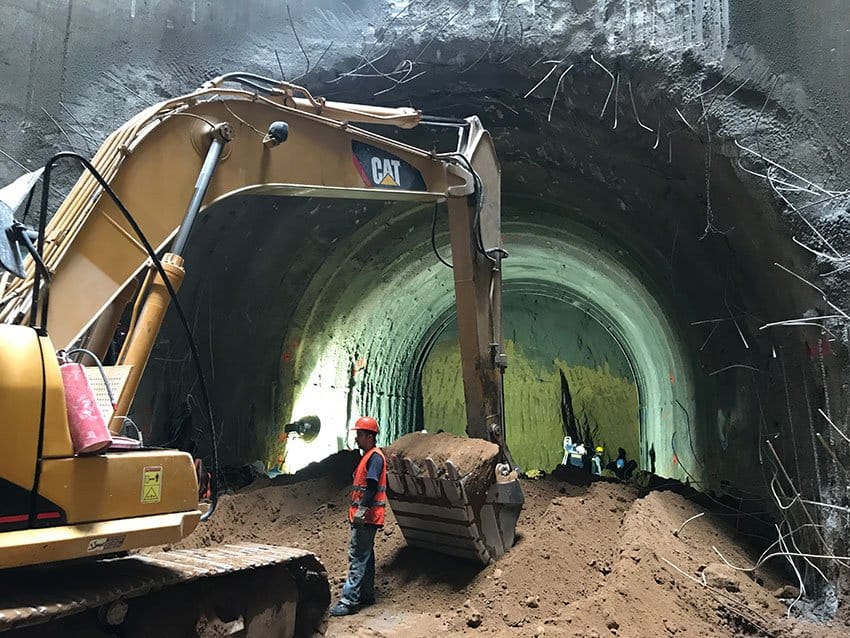
According to Sobse data, the projected cost of extending line 12 of the Metro so that it links to Line 1 at the Observatorio station was just under 9.5 billion pesos (US $462.9 million) with full funding supposed to come from the federal government.
However, city authorities have so far only received just over 5.5 billion pesos.
In addition to the lack of funding, Public Works Secretary Gerardo Báez told the newspaper El Universal that the project had been held up because authorities in Álvaro Obregón refused to grant permission for a tunnel to run beneath their borough headquarters.
Nevertheless, almost 2,000 meters of the 3,000 meters of tunnel required to connect the two subway lines has been built, he explained.

“Why didn’t we make more progress? Firstly, [a lack of] resources from the federal government and another factor was the release of the right of way. There are 54 buildings that have to be purchased but there are no resources . . . obviously that doesn’t allow us to advance,” Báez said.
He added that the project was also delayed due to the time and money spent on repairing an existing section of the so-called golden line which was found to have construction problems and consequently closed soon after opening in late 2012.
“. . . If that 1.1 billion pesos [US $53.6 million] and the time the redevelopment took had been allocated to the extension, [the project] wouldn’t have stopped,” Báez said.
With regard to section III of the Mexico City-Toluca train project, whose terminus in the capital will also link with the Observatorio subway station, the Sobse chief said that constant changes to the railroad’s route was one of the main reasons why it hadn’t met the scheduled timeframe.
Landowners in Cuajimalpa obtained court orders that prevented the seizure of 1,111 square meters of land on which the elevated line was intended to run while protests against the logging of trees in the same borough also forced a modification to the route.
Federal funding for section III has fallen almost 4 billion pesos short of the 16.8 billion pesos the Mexico City government was expecting.
A 20-kilometer extension to line 5 of the Metrobús system was delayed, Báez said, because state-owned petroleum pipelines had to be rerouted on a three-kilometer stretch of the extended line and residents in the borough of Coyoacán have opposed the route.
Despite the delays, the new government will be in a position to open the line extension, which includes 35 new stations and was funded by the World Bank, within its first 100 days in office, the outgoing secretary said.
The fourth project facing delays is the Cuajimalpa Hospital.
After a gas explosion at the Cuajimalpa Maternity Hospital in January 2015, which killed five people and left at least 72 injured, the city government announced that a new general hospital would be built at the site with an expected opening date of mid-2017.
However, the project has been opposed by community groups who have filed six amparos, or injunctions, against it, the most recent of which resulted in an indefinite suspension of work.
“We don’t know the reason why there is amparo after amparo,” Báez said. “It’s illogical, it’s a hospital that [already] existed. From my point of view, there are vested interests.”
Finally, the secretary said that the Iztapalapa Interactive Children’s Museum is around 40% complete and is expected to be finished by the end of next year. Construction delays were related to problems with the museum’s design, Báez said.
Sheinbaum, who will be sworn in as mayor on December 5, has committed to investing 10.2 billion pesos (US $498.3 million) next year to improve and expand public transportation in the capital.
Source: El Universal (sp)