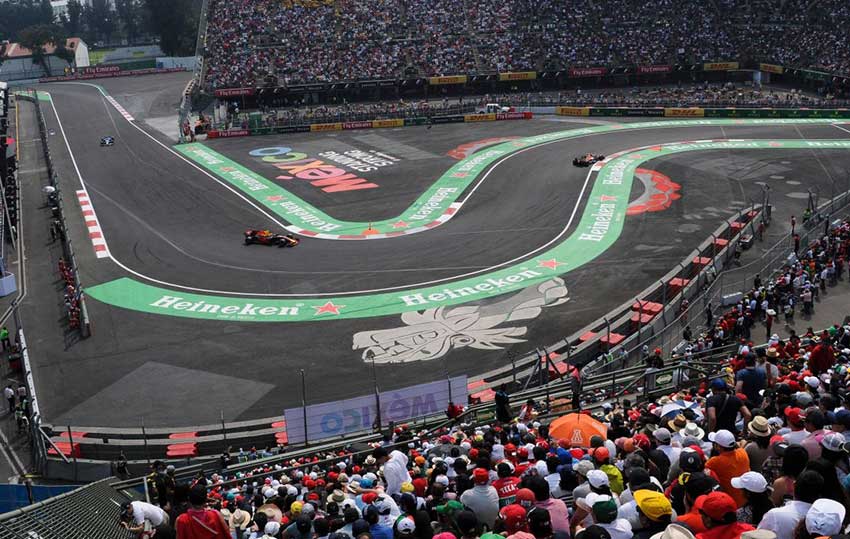
The future of the Mexican Formula One Grand Prix is in doubt because the federal government intends to allocate its funding to an ambitious rail project in the country’s southeast.
The mayor of Mexico City, which hosts the race, told a press conference last week that as of next year, most of the 400 million pesos (US $21 million) the government puts up annually for the event would go instead to the Maya train project.
“For 2020, the federal government is no longer contemplating this spending as most of it has been set aside for the Maya train,” Claudia Sheinbaum said.
The mayor, who is a close ally of President López Obrador and governs for his Morena party, described hosting the Gran Prix as “onerous,” stating that “the issue is how much public funds are invested in this when there are so many needs in the city.”
However, Sheinbaum said that there is no doubt that the 2019 edition of the race, scheduled for late October, will go ahead and explained that her government has entered into talks with the company that organizes the event to look at alternative funding arrangements.
“We’ve sat down with Ocesa, which has the concession for this spectacle, to see if it can reduce the amount [of funding] or if there are any other alternatives,” she said.
The federal government’s decision to pull the plug on funding for the F1 race is in keeping with López Obrador’s frequent criticism of anything he considers “fifí” — frivolous or snobbish.

On Friday, he said he was prepared to shift his government’s policy of “republican austerity” up a notch to “Franciscan poverty” in order to “transfer money to the people so that there is development, work and well-being.”
The leftist political veteran, who took office on December 1, has already cancelled the US $13-billion Mexico City airport project, disbanded the Tourism Promotion Council (CPTM) and enforced pay cuts for public officials.
But cancelling the F1 race, which returned to Mexico in 2015 after a 23-year absence, would be counterproductive, a former Mexico City sports chief argues.
Horacio de la Vega said the event brings a lot of money to Mexico, including that spent on accommodation, and that it projects a positive image of the country.
“There is no other event that compares to it,” he said.
Alejandro Soberón, chief of Ocesa parent company CIE, said the economic spillover effect of last year’s race, including money spent in Mexico and media rights, was 14.8 billion pesos (US $774 million).
The Mexican Grand Prix, held at the Autódromo Hermanos Rodríguez race track, attracts around 33,000 motorsports enthusiasts, among whom are a large number of foreigners.
Last year, fans from the United States were expected to make up 22% of all spectators at the race, according to data from StubHub, an online ticketing company,
Source: El Financiero (sp), Financial Times (en)