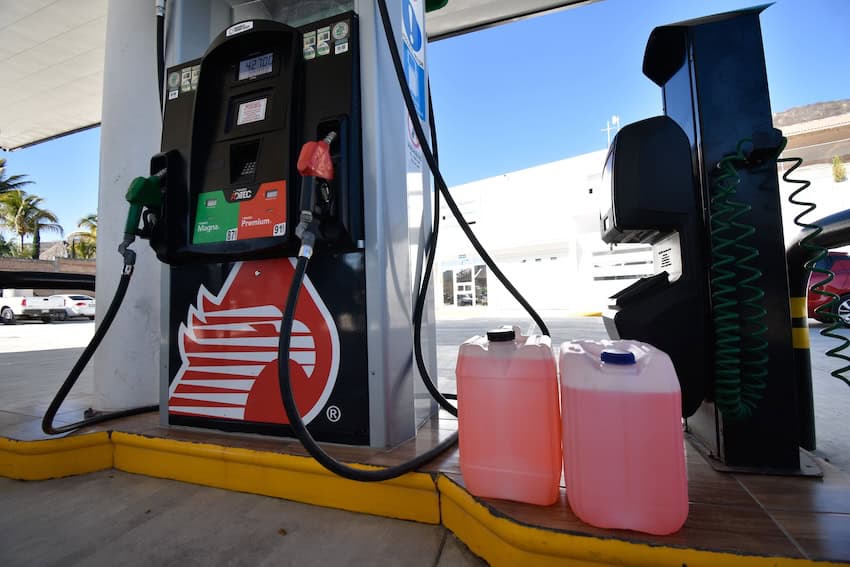
A criminal network that was smuggling up to 1.5 million liters of fuel per week has been dismantled after a lengthy investigation by Mexico’s Security Cabinet that led to more than 20 raids in several Mexican states.
Ulises Lara, a special prosecutor in the Federal Attorney General’s Office in charge of the case, and Security Minister Omar García Harfuch said authorities seized more than 100,000 liters of LP gas, dozens of tanker trucks, tractor-trailers, weapons, drugs, cash and high-tech equipment. They also shut down an illegal tap.
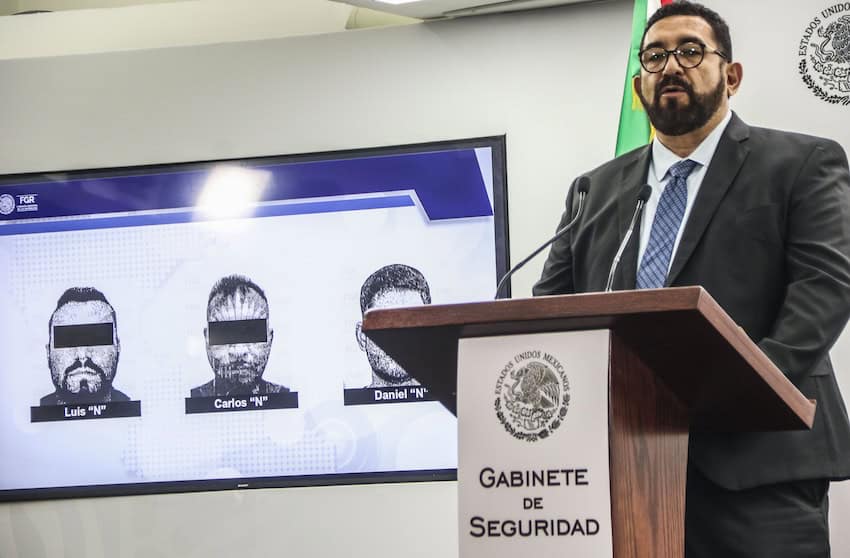
Harfuch told reporters that 10 raids were carried out in México state and 10 others in the state of Hidalgo, resulting in the arrest of seven suspects, including the alleged ring leader, Mauricio Gamboa, aka “El Burras.” Gamboa is said to have links to the Jalisco New Generation Cartel.
Additional raids in Chihuahua and central Mexico, including Mexico City, resulted in seven other arrests as well as the seizure of materials valued at 126 million pesos (US $7.2 million).
In a related action, authorities busted an organization operating 40 front companies involved in creating forged petro-invoicing.
The joint investigation — carried out by the Specialized Prosecutor’s Office for Organized Crime and the Criminal Investigation Agency and the Security Ministry — dates back to a twin bust in March 2025 that netted more than 17 million liters of stolen diesel and hydrocarbons.
In September 2025, the government announced the arrest of 14 people, including high-ranking members of the Navy.

A few months earlier, the authorities had disrupted a part of the network in Querétaro — arresting 31 people — but Harfuch said a new cell emerged to replace it.
Since then, “various lines of inquiry were developed making it possible to identify and dismantle one of the most important fuel smuggling networks operating in Mexico,” Lara said.
The year-long probe led to the identification of additional companies engaged in fuel smuggling by simulating legitimate commercial operations.
Lara explained that these companies used forged documents and false declarations, while also utilizing “front companies” to take advantage of “areas of opportunity in control systems.” The shipments were typically labeled as additives, lubricants or oils by means of apocryphal invoices.
“This allowed them to build a smuggling network, as well as evade tax and regulatory obligations,” he said
The criminal network reportedly began operating in June 2023 and managed the illegal entry into Mexican ports of at least 564 million liters of fuel on 69 oil tankers at four different customs offices. Lara said the value of the smuggled fuel exceeded 23 billion pesos (US $1.3 billion).
The network operated through a highly coordinated multimodal logistics scheme that combined maritime, rail and land transport for the introduction, transfer, storage and illegal marketing of hydrocarbons.
With reports from Infobae, La Jornada, El Universal and Milenio