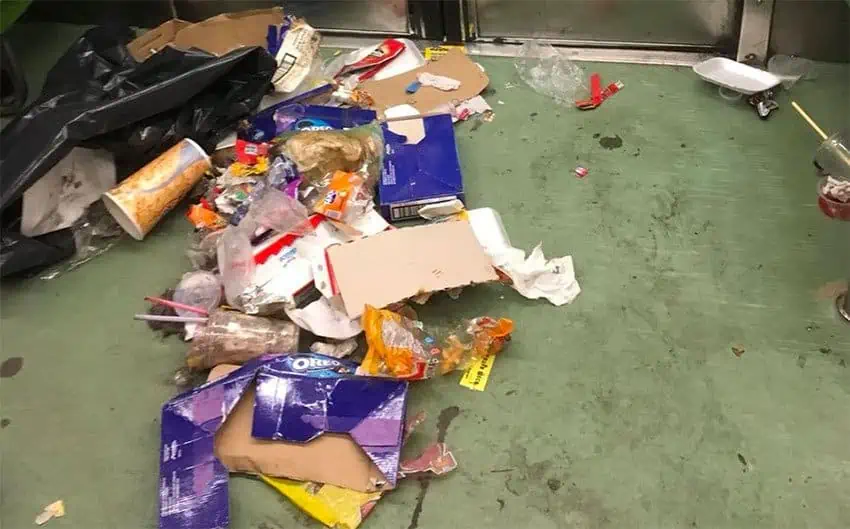
Mexico City Metro officials say the system’s five million daily users leave behind one very conspicuous sign of their passage: 270 tonnes of trash every month.
So in a controversial move to reduce the overwhelming accumulation of garbage, authorities removed all trash cans from the system’s 195 stations, and the city’s Metrobús stations followed suit.
Metrobus director Roberto Capuno said that although some users have expressed their displeasure, the measure has been carefully studied and proved to be effective. Moreover, he said that much of the garbage in the systems’ trash cans was from households and businesses.
“When we opened the trash bags, we found egg shells, orange peels and bottles of laundry detergent.”
Metro director Florencia Serranía said the bins previously found in most Metro stations were never intended to be used as trash cans, but as ashtrays.
“. . . there were ashtrays located at the [turnstiles] that people began to use for trash, and since they’re small, they quickly overflow.”
Evidence has mounted in recent months that that the Metro’s garbage problem had reached a breaking point. In May, garbage triggered a short circuit at Chabacano as a train arrived at the station, leaving three passengers with first-degree burns.

At the time of the incident, Serranía said that authorities were considering the removal of the trash cans.
“We are currently deciding whether or not to leave the trash bins in the Metro because we believe that people shouldn’t produce it [in the first place]. We urge users to realize that the tracks are not a place to throw it away.”
After carrying out repairs to the escalators in several stations, authorities revealed they had found mounds of accumulated trash and even full trash cans underneath, especially on Lines 3 and 7.
Authorities also cleaned drainage pipes in 115 stations to avoid the floods sometimes provoked by downpours during the rainy season. Photos have been published showing tonnes of cigarette butts, plastic bottles, gum and plastic wrapping removed by the operation.
Since Serranía’s comments, authorities have followed through on the idea of removing the Metro’s trash bins, and Capuno did not take long to decide to implement the measure in the Metrobús system, as well.
“We removed the trash bins from almost the entire system following the Metro’s example. Where there are no trash cans, there tends to be no trash. This is controversial, but it has been studied.”
Source: Milenio (sp), Economía Hoy (sp), Excélsior (sp)