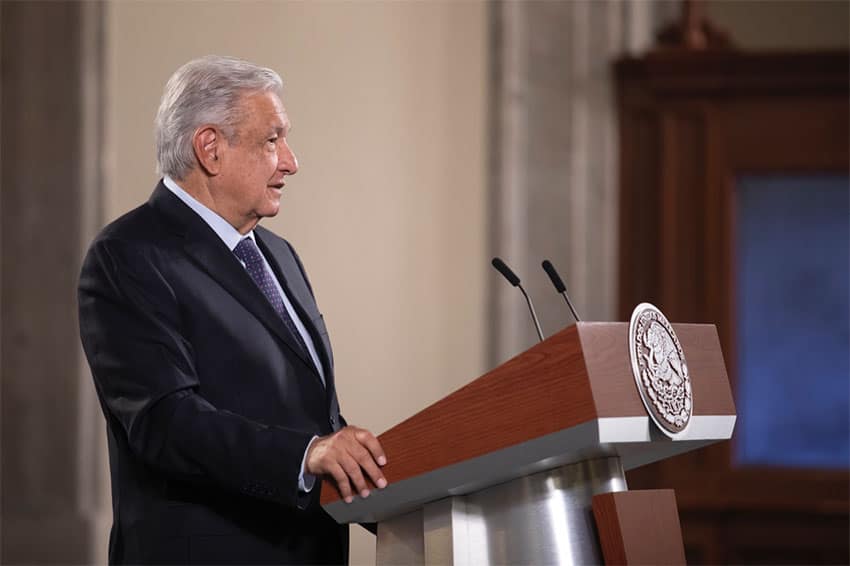
President López Obrador confirmed Monday that gasoline subsidies have been reinstated in the northern border region.
The Finance Ministry (SHCP) said Saturday that there would be no subsidies between April 2 and 8 in 40 municipalities in Baja California, Sonora, Chihuahua, Coahuila, Nuevo León and Tamaulipas.
In a separate statement the same day, the SHCP said there was a shortage of gasoline in the border region due to United States motorists coming into Mexico to take advantage of lower prices.
But the ministry said Sunday that supply wasn’t a problem after all and that the government was committed to keeping gasoline prices stable in the northern border region.
“Despite the international price of gasoline increasing in recent days due to the conflict in eastern Europe, the government of Mexico is committed to keeping the price of gasoline stable throughout Mexico, including the border region,” the SHCP said.
“… Pemex has maintained gasoline supply and has [sufficient] national production inventory to meet demand in the north and all regions of the country.”
López Obrador said Monday that the decision to remove subsidies – which caused gas prices in the northern region to increase by up to 5 pesos over the weekend – had been corrected.

The issue has been “fixed,” he told reporters at his regular news conference, claiming there is enough gasoline supply to meet demand even with subsidies in place.
The subsidies – among which are the lowering, and recently the complete removal, of the IEPS excise tax on fuel – help people a lot, López Obrador said.
“In the case of the border they help Mexicans who have dual nationality and also Americans, who are our neighbors and who come to fill up in Mexico because gasoline is cheaper,” he said. “It’s an act of solidarity toward them as well.”
One person who crosses the border to purchase gasoline is Adrián, a resident of Chula Vista, a city that is part of the San Diego metropolitan area.
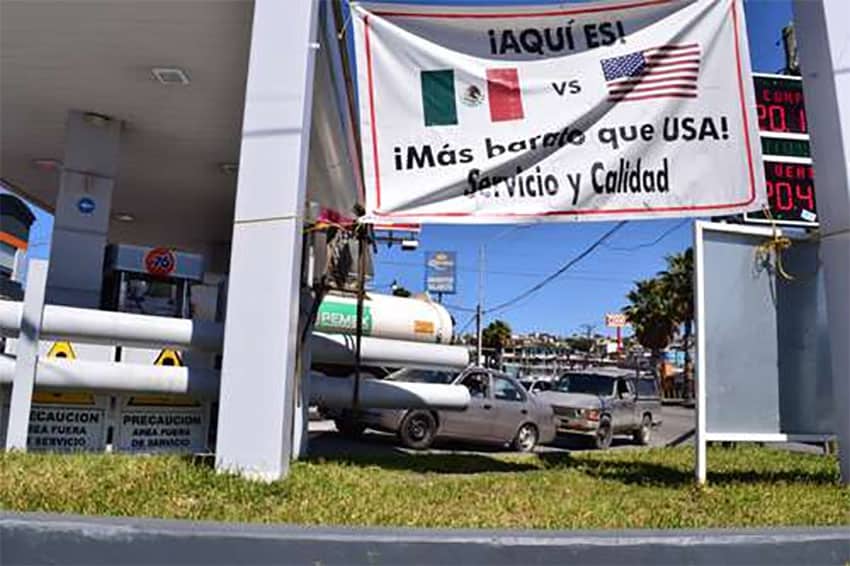
“From one moment to the next, the price [of gasoline in the United States] went crazy,” he told the newspaper El Universal late last week.
“Rents are expensive, things cost more … [and] now having to pay between US $7 and $8 for a gallon of gasoline is simply crazy,” said Adrián, who crosses into Tijuana at night to fill up his car.
According to the website Gasolina México, the average price of a liter of regular gasoline in Tijuana was 21.02 pesos (US $1.06) at midday Monday, or US $4 per gallon. The average price across Mexico was 21.5 pesos.
According to the AAA gas prices website, the average price in California was US $5.85 per gallon, or 46% higher than the Tijuana price.
Although the SHCP and López Obrador asserted that Pemex has enough gasoline to supply gas stations in the north of the country, there have been reports of shortages. Some gas stations in Tijuana and Mexicali are among those that have recently run out of fuel due to increased demand.
The Finance Ministry said Saturday that supply problems had also been caused by private importers ceasing to purchase gasoline. Energy sector experts said in February that gasoline retailers were effectively being forced to purchase fuel from Pemex because the federal government wasn’t renewing import permits and has shut down some privately owned fuel storage terminals.
The government is determined to keep fuel prices down as much as it can as high inflation causes the prices of many products to surge. The determination to keep prices down this week could be even stronger given that López Obrador’s popularity will be tested in a revocation of mandate, or recall, referendum this Sunday.
The Mexican Institute for Competitiveness, a think tank, published an analysis last month that found that the net cost to the government of subsidizing fuel prices could be as high as 205.5 billion pesos (US $10.4 billion) this year.
With reports from Excélsior, El Heraldo de Chihuahua, Milenio, El Universal and El País