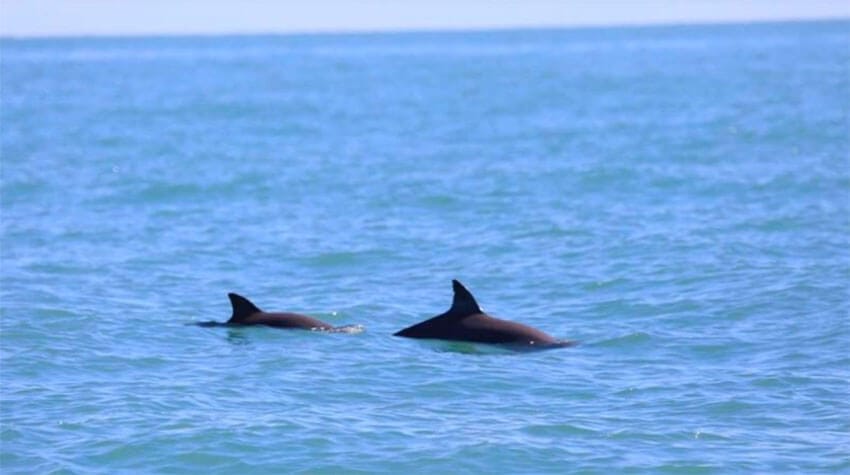
Three federal ministries announced a new agreement with NGOs Saturday to define cooperative efforts to save the endangered vaquita porpoise.
Although no NGOs were named and the announcement was thin on detail, the Ministries of Environment, Navy and Agriculture said in a joint statement that the accord would bring about improved collaboration in conservation efforts and avoid aggressive acts by people engaged in illegal fishing.
Last December, there was a clash between small fishboats and a vessel operated by the Sea Shepherd Conservation Society. A fisherman died after one boat collided with the vessel.
The agreement states that authorities will focus their efforts on inspection and monitoring in a so-called “zero tolerance” zone in the upper Gulf of California, where gillnet fishing had been declared illegal to protect the vaquita. The porpoise is a bycatch in the illegal totoaba fishery, made lucrative by strong demand for that fish’s swim bladder, a delicacy in China that has been referred to as the “cocaine of the sea.”
Like the drug, its trafficking has drawn drug cartels to participate.
While the government will attempt to control illegal fishing, a responsibility it has been unable to carry out successfully in the past, civil society organizations will remove abandoned nets and work to raise awareness about vaquita conservation among fishermen.
The accord comes three weeks after the Mexican government relaxed restrictions in the no-fishing zone, triggering a wave of accusations by conservationists that Mexico was abandoning the vaquita.

The most recent of those came from U.S. actor and environmentalist Leonardo DiCaprio, who criticized the government on his Twitter account last Thursday. “The vaquita porpoise is the most endangered marine mammal in the world. Yet, the Mexican government has lifted the ban on fishing in its habitat, effectively ensuring that the remaining 10 or so porpoises will die in gillnets.”
DiCaprio signed a memorandum of understanding in 2017 with then president Peña Nieto and businessman Carlos Slim to protect the vaquita, at which time there were still some 30 remaining. The intention was to make a temporary gillnet ban permanent in the Gulf of California.
But like most efforts at saving the mammal nothing was accomplished due to lack of enforcement, the growing involvement of cartels and protests by unhappy fishermen deprived of their ability to make a living.
Despite the fact there may be as few as 10 vaquita remaining, not all conservationists have written off the vaquita as a lost cause.
Environmental writer Andrew Revkin of the Climate School at Columbia University wrote last week he saw four reasons for hope after interviewing a marine scientist at the U.S. National Oceanic and Atmospheric Administration.
Barbara Taylor argued that the porpoise has a fighting chance:
- The survivors are wily and elusive, she said, with their scars and behavior showing they are aware of the risk nets pose.
- The estimated presence of three calves – all fat and healthy in 2019 – showed that the remaining females are prolific breeders.
- Recent analysis of the vaquita genome shows they are unlikely to face a genetic bottleneck that sometimes threatens the recovery of deeply depleted species.
- Finally, there are other examples of species, including marine mammals, reviving from tiny numbers after devastating slaughter. She cited the northern elephant seal, which was declared extinct in 1884. A tiny population was later discovered on an island off Mexico’s Pacific coast. Now there are 300,000.
Mexico News Daily