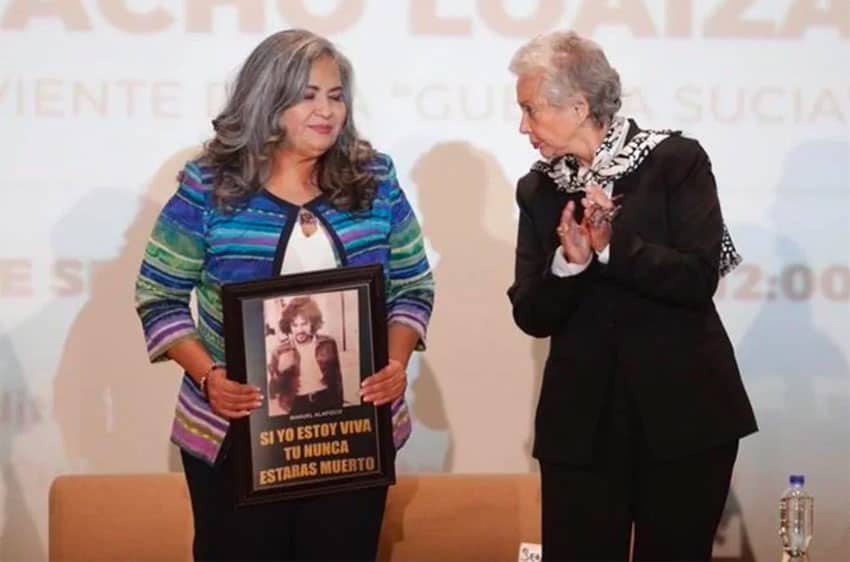
The federal government apologized on Monday to a member of an urban guerrilla movement who was tortured for 49 days in 1977 and forced to watch the extrajudicial killing of her husband.
Martha Alicia Camacho Loaiza and José Manuel Alapizco Lizárraga, who in the 1970s belonged to the Liga Comunista 23 de Septiembre (September 23 Communist League), were detained in Culiacán, Sinaloa, on August 19, 1977 by soldiers, state police and members of the Federal Security Directorate, a defunct intelligence agency.
Camacho, eight months’ pregnant at the time, was not only tortured but forced to witness the torture and execution of Alapizco and give birth under inhumane conditions. She was released after her family paid a ransom to authorities.
Camacho filed a criminal complaint in 2002 against her husband’s abduction and murder and her own kidnapping and torture but 11 years later, in February 2013, the federal Attorney General’s Office said it wouldn’t open an investigation because too much time had passed since the crimes were committed.
The former guerrilla fighter challenged the ruling and a judge subsequently determined in 2014 that due to the seriousness of the crimes, they must be investigated.
While the case has still not been resolved, Interior Secretary Olga Sánchez Cordero said on Monday that the government is committed to paying compensation to Camacho for the harm she suffered during her 49-day ordeal and in subsequent years.
At an event in Mexico City, Sánchez issued an apology to Camacho, her deceased husband – whose body was never found – and her son, Miguel Alfonso Millán Camacho.

“I offer you a public apology in the name of the Mexican state for the transgression of your rights due to the grave and systematic human rights violations that occurred within the context of political violence . . . in the historical period known as the Dirty War,” she said.
“You were detained and tortured . . . acts perpetrated by the judicial police of Sinaloa, the Federal Security Directorate and the army.”
Human rights undersecretary Alejandro Encinas also issued an apology on behalf of the Mexican state, explaining that it was an “act of justice.”
Camacho responded by saying that the public apology is a starting point but a lot still has to be done to address past injustices.
“What happened to me was hell,” she said, adding that it was “regrettable” that no representative of the Secretariat of National Defense was present to recognize the “atrocities” committed during Mexico’s dirty war of the 1960s and ’70s, a period in which the government tortured and disappeared a large number of students and members of guerrilla groups.
Source: Notimex (sp), El Universal (sp)