
Fancy a tasty, healthy, high-protein, high-fiber snack that is environmentally-friendly and uniquely Mexican?
Lime and chili-flavored churritos made out of finely ground grasshoppers fit the bill.
Two Mexican entrepreneurs, Erika Gil Gutiérrez and Magali Díaz García, are the brains behind Winko, a company that has been selling the crunchy chapulín snacks for the past year.
They recounted the story of how their innovative product came about to the online magazine Tec Review.
“Mexico has a wide variety of edible insects, and they’re also part of our culture. We thought it was a good idea to experiment with them to see how we could offer a product that is healthy, of good quality, tasty and which nourishes . . . people and doesn’t just satisfy their craving . . .” Gil said.
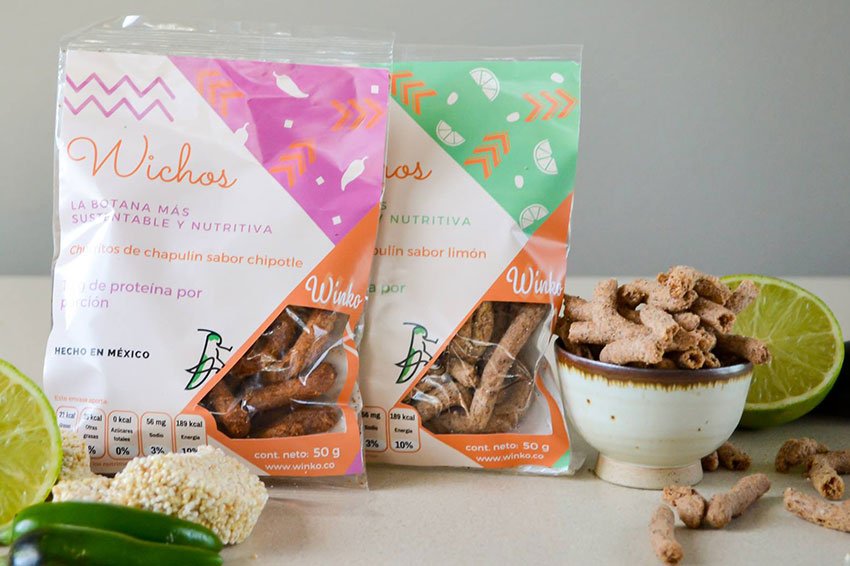
They ultimately decided to develop a product using chapulínes, small grasshoppers belonging to the Sphenarium genus that have been a popular snack in Mexico since pre-Hispanic times.
“Of all the insects we looked at, the grasshopper was the one with the greatest quantity of protein for the lowest cost,” Gil said.

“Besides, it’s the most popular insect that people eat and the one they’re most familiar with,” she added.
Sold under the brand name Wichos, the churritos also contain amaranth – a staple food of the Aztecs – sesame seeds and linseed. In addition to a high protein and fiber content, the snacks contain iron, magnesium and vitamins A, B and C.
“By portion, which is a 50-gram bag, the protein content is 10 grams. That’s quite high in comparison with other products on the market,” Díaz said.
She explained that Winko originally sourced its grasshoppers exclusively from Oaxaca but now also uses insects from Puebla, Tlaxcala and México state.
“When we started we used the Oaxaca chapulín, which is the best known. Afterwards . . . we realized that the insect also lives in the central part of Mexico. In the Valley of Texcoco there are a lot of chapulínes, that’s where there is currently the largest population . . .”
Díaz added that satisfying protein needs by eating grasshoppers is more environmentally-friendly than the consumption of farmed meat.
“The chapulín is very efficient in producing its protein . . . if we compare it to a cow or pig. Those animals need a lot of land, water and food to produce a kilogram of protein [and] they also emit a lot of greenhouse gases,” she said.
Lime and chipotle-flavored Wichos can be purchased on Winko’s website for delivery in Mexico and the United States.
Source: Expansión (sp)