Businesses and residents of Guanajuato are in shock after learning on Tuesday that the annual International Cervantino Festival (FIC) will be an online event this year.
It was expected that the festival would revive the city’s economy and tourism sector this October.
“We are very sad about what is happening because it is a hard blow for the tourism sector, especially here in the capital, but health comes first,” said Liliana Preciado Zárate, president of the Guanajuato Hotel and Motel Association.
Local authorities and businesses agree that the absence of the festival this year will have potentially dire consequences for the city’s economy, affecting hotels, bars, restaurants, cafés, artists and others in what is already a vulnerable climate.
The news hit the city’s bars “like a bucket of cold water,” said Bar Association president Enrique Nieto Acevedo. Guanajuato’s 70 bars had been looking to El Cervantino, as it is popularly called, as a way to recuperate at least some of the losses suffered during four months of closure due to the coronavirus pandemic.
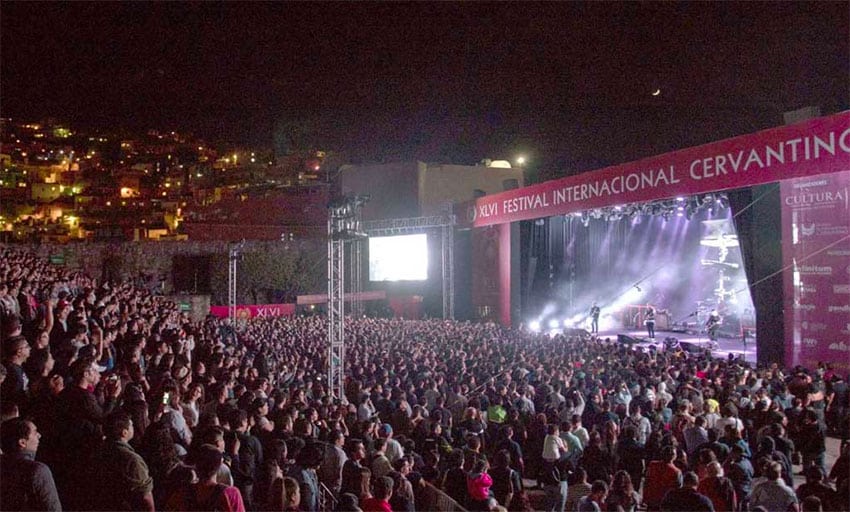
With 2020 being its 48th year, El Cervantino has become one of Latin America’s biggest cultural events. Celebrating the life and work of Spanish writer Miguel de Cervantes, the author of Don Quixote, it has hosted plays, dance, concerts, film screenings, workshops, readings, book releases and more.
Performers have included Ray Charles, Lila Downs and Rudolf Nureyev.

Last year Guanajuato hosted 2,969 artists and performers and 414,000 festival attendees who spent 617,700,00 pesos, nearly US $27.5 million.
The city’s 147 hotels and hostels, which normally fill up during El Cervantino are now operating at between 3% and 5% of capacity. The economic loss to the hospitality sector due to the festival’s going online is expected to reach 40 million pesos (nearly US $1.8 million).
Olga Padilla, president of the Canirac restaurant association in the city, speaking for 120 restaurants, said “the news of the format change left us in shock, we are all in shock.”
Mayor Alejandro Navarro pointed out that by holding the festival virtually, and only over four days, the organizing committee will come in under budget, and he hopes that the surplus can be used to help businesses that are most affected.
“The Cervantino represented a great opportunity for the economic recovery of the capital and in the face of these changes we cannot stand idly by,” Navarro said.
The FIC’s director, Mariana Aymerich, assured that artists, businesses and others who regularly work the festival will be taken care of.
“There are 400 people who work with us, we want them to have support from us; the artistic groups that had already been selected will have our support and the option of participating in something virtual, or that they may be asked back next year,” she said.
Exactly how that support will play out is being analyzed, she said, as they review the festival’s 84-million-peso (US $3.7-million) budget.
Source: El Universal (sp), El Sol de León (sp), Periódico Correo (sp)