Mexico’s most-wanted criminal and head of the Cartel Jalisco Nueva Generación (CJNG) was killed Sunday morning following a violent military operation aimed at his capture.
Nemesio Rubén “El Mencho” Oseguera Cervantes, 59, reportedly died en route to Mexico City following his arrest and injury in Tapalpa, an otherwise quaint town located some 130 kilometers from the capital city of Guadalajara in the Jalisco highlands.
The wave of blockades and attacks recorded on Sunday is interpreted, in the context of the day’s news, as the operational response of the CJNG to the fall of its leader.
But why did El Mencho’s death generate such a large-scale retaliation? Here’s what you need to know.
Who was ‘El Mencho’?
El Mencho engineered a seismic shift in the landscape of organized crime in Mexico. Under his leadership, the CJNG began to employ three strategies: accelerated national expansion, large-scale diversification of criminal businesses (drugs, human traffic, robbery, extorsion and more) and brazen violence that openly defied the Mexican government.
Born on July 17, 1966, in a poor and rural community associated with drug production in the state of Michoacán, El Mencho became involved in the drug business in his adolescence.
In the 1980s, he illegally migrated to California — one of the world’s leading illicit drug markets — where he was twice arrested and deported for drug-related crimes. After spending three years in prison and following his release on parole, he stayed in Mexico and reportedly worked as a police officer in Jalisco.

Soon after, he joined the now-extinct Milenio Cartel as a hitman, where he oversaw the organization’s security and operational violence until the fall of his bosses in the early 2000s.
After he split from the Milenio Cartel, he joined forces with his brother-in-law Abigael González Valencia — leader of a criminal organization known as Los Cuinis — to form a new drug organization.
With González’s initial financial aid, El Mencho began to build what would become one of the most powerful and ruthless criminal organizations in Mexico.
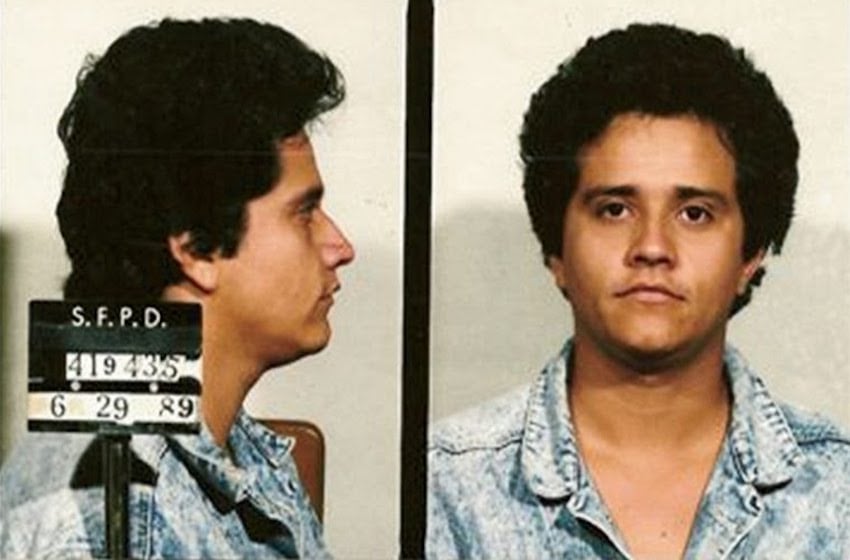
But despite his organization’s size, El Mencho was always characterized for keeping a very low personal profile. The U.S. Drug Enforcement Administration (DEA) only possessed three pictures of him from when he was an illegal immigrant in the U.S.
However, his modus operandi made him well-known for extreme violence, including massacres, attacks on federal forces, the downing of a military helicopter and coordinated blockades across several states.
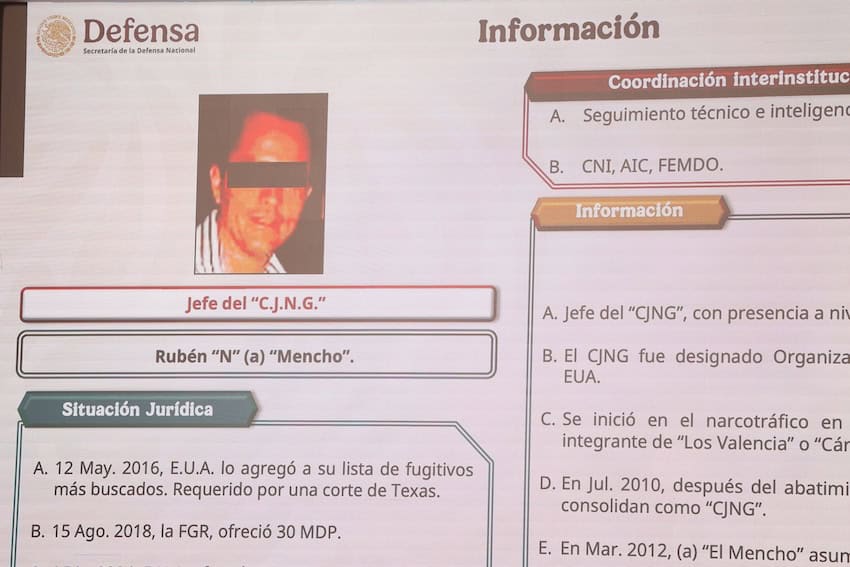
Mexican authorities and the DEA regarded him as one of the world’s most wanted criminals, offering a reward of up to US $15 million for information leading to his capture.
The rise of the CJNG
Security experts agree that in barely a decade, the CJNG managed to surpass all other criminal organizations in terms of scale and control.
“There has never been a more powerful organization than CJNG, and [El Mencho] was its top leader,” security analyst Eduardo Guerrero Gutiérrez said in an interview with N+. “In a decade, it managed to surpass, by a wide margin, all other criminal organizations in terms of presence, territorial control, and penetration into the spheres of power and business,” he said.
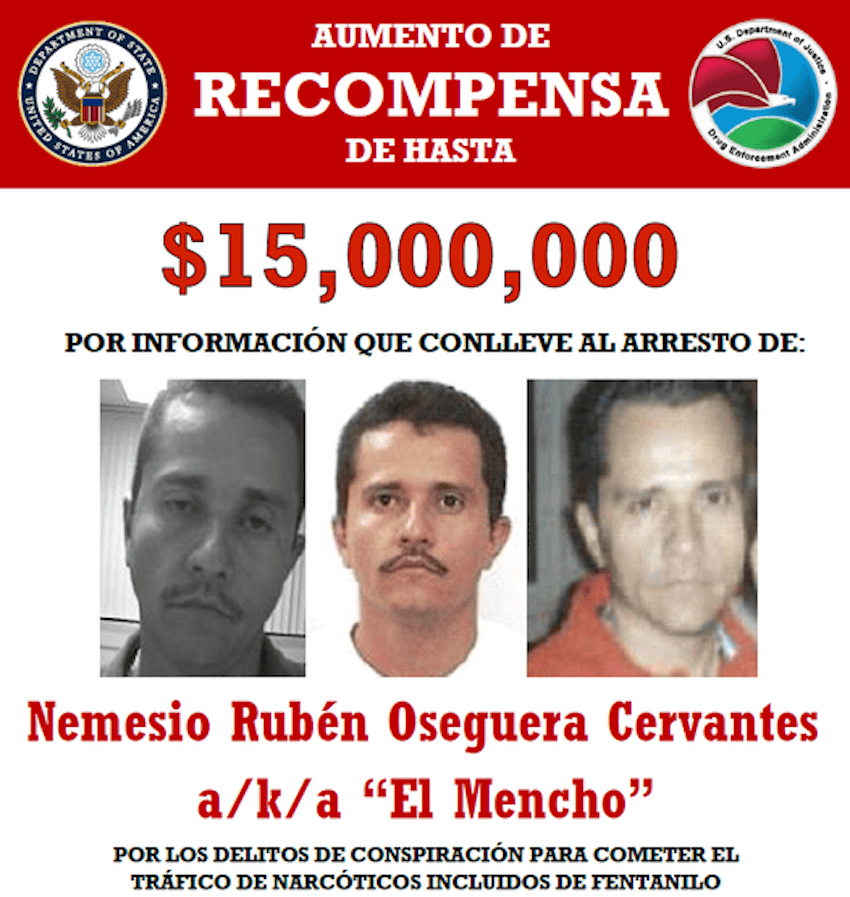
As this 2024 Spanish-language reward poster indicates, El Mencho was a wanted man on both sides of the border. (U.S. DEA)
Experts agree that the CJNG managed to exploit the vacuums left by previous cartels to build its criminal network in Mexico and abroad. From its stronghold in Jalisco, the CJNG expanded its influence to multiple states across the country, especially along the Pacific coast, displacing traditional cartels through local alliances and the strategic use of violence.
Due to its vast nationwide presence, the CJNG was identified by the Mexican government as the key factor in the rise in violence in different areas of the country.
One of the strategies contributing to the cartel’s rise was its control of transportation corridors. For instance, it built a strong presence in border cities like Tijuana, key to accessing the U.S. market. It controls maritime routes in the Pacific, and operates a trafficking network spanning almost 10,000 kilometers of coastline from South America to North America.
Moreover, it created connections to networks in the U.S. and Canada, and operates global routes to Europe, Asia and Oceania through operations at strategic ports and air terminals for drug trafficking.
Due to the international reach of the CJNG, its violent tactics and its ease of flooding the U.S. market with lethal substances, U.S. President Donald Trump designated the drug cartel as a foreign terrorist organization last year.
What will happen next?
The death of El Mencho has created a power vacuum in an organization that had never experienced an internal succession process. Since its foundation, the cartel has had one consistent and powerful leader: El Mencho.
Experts note that the most likely outcome doesn’t necessarily include the disappearance of the CJNG. Rather, they anticipate more violence in key areas, changes in command and an even more fragmented and volatile criminal landscape within Mexico.
With reports from Animal Político and El País