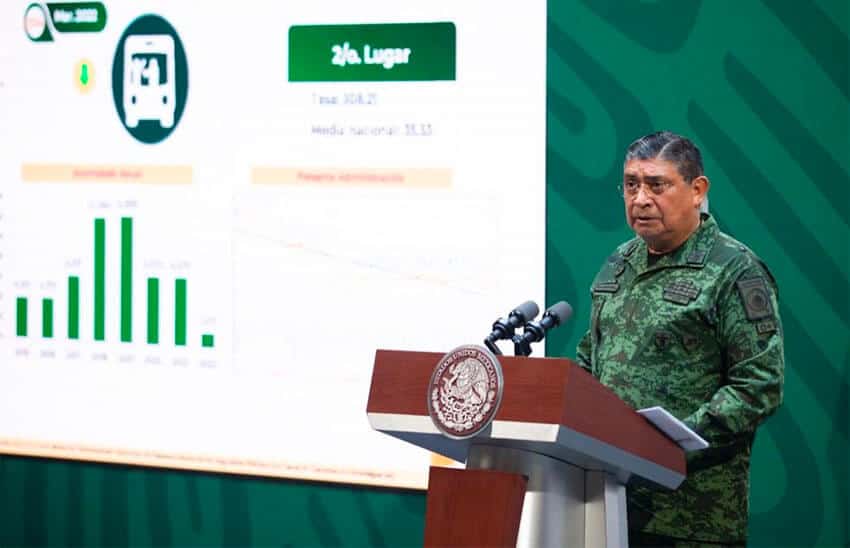
A range of high-impact crimes have declined in Mexico City since the current federal government took office in late 2018, National Defense Minister Luis Cresencio Sandoval reported Tuesday.
The army chief presented a graph at President López Obrador’s morning press conference that showed that human trafficking, robberies on public transit, kidnappings, vehicle theft, extortion, home burglaries and homicides all declined between December 2018 and March 2022.
Referring to the most recent data, Sandoval said there were 7,856 reports of high-impact crimes in Mexico City in March.
He presented another graph that showed there were 1,396 homicides in the capital in 2019 – the first full year that both López Obrador and Mexico City Mayor Claudia Sheinbaum were in office – before murders declined to 1,128 in 2020, a 19% drop, and 919 last year, an 18.5% year-over-year drop.
The trend is on track to continue this year, with 145 homicides in the first three months of 2022.
Sandoval noted that Mexico City ranks 10th among the 32 federal entities for total homicides between December 2018 and March of this year with 3,681 murders.
Guanajuato ranked first with over 9,500 followed by Baja California and México state, which recorded almost 8,500 and nearly 8,000 homicides, respectively.

On a per capita basis, Mexico City – which has a population of some 9.2 million people across its 16 boroughs – was the 22nd most violent entity with 40 homicides per 100,00 people. Colima ranked first in that category with 248 murders per 100,000 residents followed by Baja California and Chihuahua, with 225 and 184, respectively. The national average was 79.
Sandoval also presented data that showed that 44% of homicides, vehicle thefts and drug trafficking offenses in Mexico City since the federal government took office occurred in just three boroughs.
Iztapalapa, a sprawling, densely populated borough in eastern Mexico City, registered 9,874 reports of those crimes between December 2018 and March 2022, or just over 20% of the total. Gustavo A. Madero, the capital’s northernmost borough, recorded 6,488 incidents of the three crimes, while Cuauhtémoc, which includes the historic center, registered 5,084.
A 2017 investigation found that there were some 20,000 locations in Mexico City where illegal drugs are bought and sold.
Sandoval reported that Mexico City currently has over 80,000 police and that the boroughs with the highest crime rates have the highest number of officers. He said that 3,777 soldiers and air force officers, 2,094 marines and 2,840 National Guard members operate in the capital as well.
Their efforts have resulted in cocaine confiscations totaling 5,713 kilograms, easily ahead of the second most seized drug, which was marijuana with 1,236 kilos taken off the market.
Among the other drugs seized were methamphetamine, fentanyl and heroin, while 431 firearms have been confiscated since López Obrador was sworn in as president.
Sandoval also highlighted that over 1,800 people were arrested in drug busts in Mexico City between December 2018 and the middle of this month.
The president welcomed the decline in crime rates in the capital.
“The security results here in Mexico City are very good,” López Obrador said. “I’m pleased because of the tranquility, the peace that is guaranteed in the capital of the republic.”
Mexico News Daily