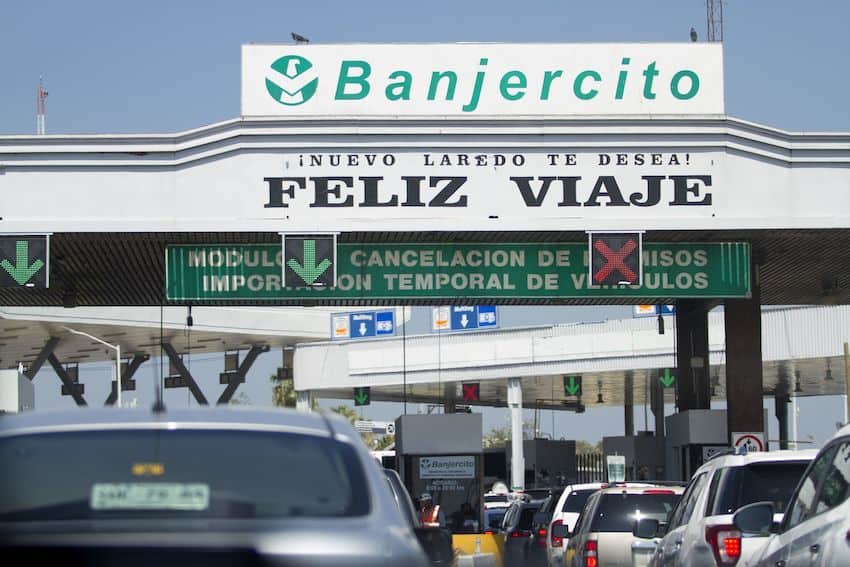
Every year, thousands of Mexican immigrants in the United States return to their places of origin in Mexico to reunite with their families for the holiday season.
Estimates suggest that over 20,000 Mexican immigrants are expected to cross the Texas border this December. Most of them are traveling to the area surrounding Jalpan de Serra, a municipality that serves as the access point to communities in the Sierra Gorda de Querétaro, a region with high levels of migration to the U.S.
These Mexicans living in the U.S. make a yearly plan to meet in Laredo, Texas, at the southern border of the U.S., to advance as a group toward Mexico. Many told the news agency EFE that traveling as a group makes them feel secure and at home.
Ariadna Tapia, an immigrant who has been traveling between the U.S. and Mexico for seven years, told the news agency EFE that there is not a single moment when a person feels alone during the trip. She also said the group is escorted by the National Guard.
“You must consider where you are going to depart from and the requirements to register, but there is support staff all day long (…) It is a safe group. We are protected by the National Guard. From the moment one leaves, one is protected,” she said.
Cars and trucks full of gifts, suitcases, clothes, tools and other items parade through the entrance to Jalpan de Serra to reunite with their loved ones who live in Mexico. At the town’s entrance, they are greeted with a Mexican flag.

Political climate adds stress to annual holiday return
This year, the migrants’ arrival to Mexico happened amidst recent statements by President-elect Donald Trump promising to carry out a massive deportation of irregular migrants in the U.S.
Some families in the group, including those with proper documentation, fear that when they leave the U.S. to visit Mexico for Christmas, they may face challenges on their way back.
Más de 25 mil vehículos de paisanos han cruzado por #NuevoLaredo en esta época decembrina, eligiendo nuestra frontera como su cruce favorito. #JuntosLoHacemosPosible✨ @heroespaisanos @INAMI_mx @Claudiashein @GobiernoMX @Dr_AVillarreal @gobtam pic.twitter.com/l46s9XsAvI
— Carmen Lilia Canturosas (@Carmenliliacrv) December 22, 2024
Aristeo Olvera, one of the organizers of the Christmas convoy, told EFE that authorities on both sides of the country have consistently collaborated and supported efforts to protect the status of Mexican immigrants upon their return to the U.S. following the holidays.
One of those efforts is the mechanism of a sanctuary city. A sanctuary city or state is a policy that discourages local authorities from reporting the immigration status of individuals unless it involves an investigation of a serious crime.
The city of Laredo was a sanctuary city until Governor Greg Abbott signed legislation banning sanctuary cities in Texas.
Despite the ban, “The government of Laredo, Texas, along with the Tourism Ministry, has always been willing and has made an effort to support us,” Olvera said.
In November, Los Angeles, California, declared itself a sanctuary city, meaning that it now prohibits the use of city resources to assist federal immigration enforcement in response to President-elect Donald Trump’s mass deportation plans. With this declaration, Los Angeles joined 560 cities, counties and jurisdictions in the United States that are “sanctuaries” for migrants.