Why were journalists and other people able to gain access to cabins in Jalisco where Nemesio Rubén “El Mencho” Oseguera and members of his security detail were staying before the Jalisco New Generation Cartel (CJNG) leader was fatally wounded in a Feb. 22 military operation?
Because it was too dangerous to secure the properties immediately after the operation targeting “El Mencho” took place, according to the Federal Attorney General’s Office (FGR), which acknowledged that the “scene” of the operation was altered and contaminated.
Consequently, it appears, journalists — for a certain period at least — were able to enter unimpeded to accommodation used by one of the world’s most wanted drug lords and his CJNG henchmen.
The FGR issued a statement on Monday in which it said it was aware that “several people entered various cabins” in “a club” in Tapalpa, Jalisco, where it is believed Oseguera was hiding prior to the Feb. 22 military operation.
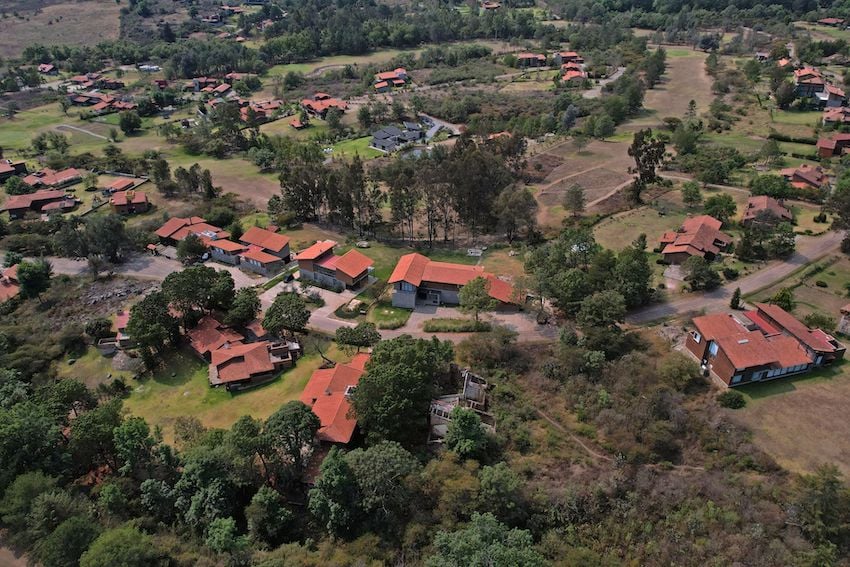
Among the people who entered a house that is said to have been the CJNG leader’s final hideout were journalists from the newspapers Milenio and El Universal. They entered the Tapalpa Country Club home on Feb. 23, the day after the operation against “El Mencho.”
Other journalists entered cabins in the nearby La Loma estate, where CJNG gunmen reportedly stayed before Oseguera died on the last Sunday in February.
Inside El Mencho’s last hideout in Tapalpa, Jalisco

A New York Times journalist reported on Feb. 25 that she and a photographer “stumbled across Cabañas La Loma, a residential compound and cabin rental business on the outskirts of Tapalpa that was sanctioned by the U.S. Treasury Department as far back as 2015 for its Jalisco cartel ties.”
“From a distance, the development looks like a perfect picture mountain sanctuary. … But up close, it was a crime scene frozen in time,” wrote Paulina Villegas.
“The streets, driveways and doorsteps were littered with dozens of spent shell casings, including jackets of .50-caliber rounds used for military weapons. Fires burned just beyond the homes. We didn’t know if they were set by the cartel or someone else,” the report stated.
“The neighborhood bore signs of a panicked exodus: Front doors left open and windows shattered. … The walls of several homes were pocked with the jagged craters of bullet impacts. Yet, despite the markings of extreme violence, the scene was stunningly unsecured. No law enforcement guarded the compound or the roads to it,” Villegas wrote.
The FGR said that the “place” where the operation against “El Mencho” took place — an operation that included “armed clashes” between military personnel and CJNG operatives — “did not offer [the] minimum security conditions [required] for the protection of ministerial and expert personnel.”
Consequently, an “immediate securing of the properties” — i.e., the cabins where Oseguera and other CJNG members were staying — didn’t occur after the operation against “El Mencho” took place, the FGR said.
The securing of the properties only occurred when the situation was “contained” and “minimum security conditions in the area” were reestablished, the FGR said.
The Federal Attorney General’s Office said it requested a search warrant from “a judicial authority” in order to “legally enter six properties” of interest.
“Prior to that, it came to light that, without any authorization from those legally empowered to grant it, various individuals entered said properties, thereby altering and contaminating the scene,” the FGR said.
“Consequently, this office cannot determine whether the objects or pieces of evidence that have been publicly reported as having been found in those properties were in fact found there,” the FGR said.
Among the evidence allegedly found in a cabin where “El Mencho” had stayed were documents detailing Oseguera’s so-called “narconómina“ (narco payroll) — i.e., the wages of the various people in the employ of the CJNG.
In its statement, the FGR also said it had launched an investigation “to determine whether any public servant committed an irregularity by failing to preserve” the scene where the operation against “El Mencho” took place just over three weeks ago.
On Feb. 23, Defense Minister Ricardo Trevilla Trejo said that Oseguera was fatally wounded by special forces soldiers after the CJNG leader and his “close circle” escaped into a “wooded area” in Tapalpa.
He said that “El Mencho” and two of his bodyguards died while being airlifted by military helicopter to a hospital in Jalisco.
El Universal reveals the CJNG’s operating expenses
On Feb. 26, the newspaper El Universal reported that it had obtained an “improvised” CJNG “narconómina” that detailed the cartel’s multi-million-peso and multi-million-dollar monthly expenses in various municipalities in Jalisco.
“The narco-payroll found in one of the cabins where ‘El Mencho’ was hiding lists accounting records … [detailing] contributions from plaza bosses [and] salaries for halcones (lookouts) and sicarios (hitmen) of the criminal organization,” El Universal wrote.
The newspaper also said the narconómina detailed “bribe payments” to the Attorney General’s Office (FGR), military personnel and municipal police, and payments made to “hackers.”
In addition, it detailed food and fuel expenses, spending on community aid, records of crystal meth, marijuana, and fentanyl sales and revenues from drug distribution inside prisons, according to El Universal.
Citing CJNG narconómina documents, the newspaper reported on Monday that the cartel spent 2.6 million pesos (about US $147,000) in Jalisco in December on Christmas lunches for children, posadas (Christmas parties), candy, piñatas, community assistance, parades, musical groups, masses and flowers. The cartel is known for handing out gifts on occasions such as Mother’s Day and Children’s Day.
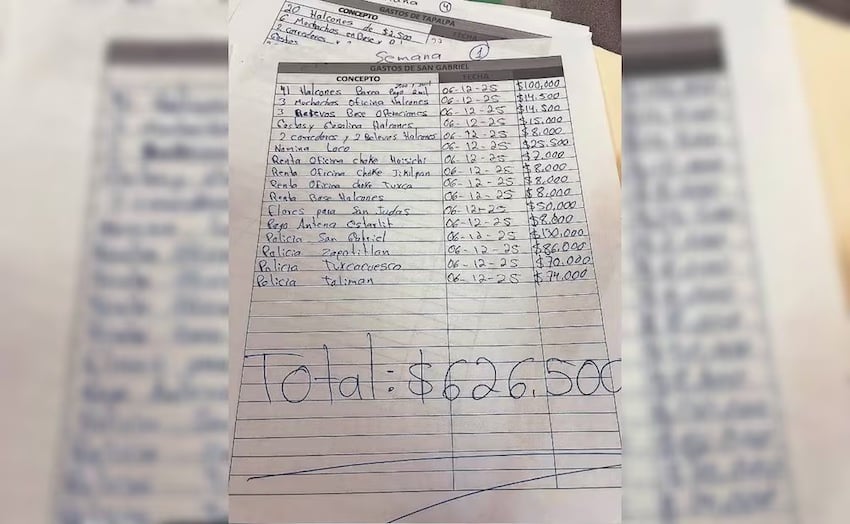
Among the other expenses listed in the narconómina for December were amounts of 100,000 pesos ($5,660) to support a woman who had suffered a stroke and 8,800 pesos (US $500) to pay for dialysis for an unidentified person. Oseguera himself suffered from kidney disease.
El Universal wrote that “the criminal organization founded by ‘El Mencho’ has the deficiencies and needs of the people in the municipalities it controls in the state of Jalisco well-identified.”
The CJNG narconómina serves to show just how integrated the cartel is in the social fabric of certain municipalities in Jalisco. It also demonstrates how the CJNG contributes to the local economy and supports local citizens, while simultaneously committing serious crimes, sowing terror among the population — including with its violent response to the death of “El Mencho” — and deterring would-be tourists from visiting Jalisco and many other parts of Mexico.
By Mexico News Daily chief staff writer Peter Davies (peter.davies@mexiconewsdaily.com)