The United States National Hurricane Center (NHC) announced at 4 p.m. Monday that Hurricane Agatha had made landfall in Oaxaca about 10 kilometers west of Puerto Ángel with maximum sustained winds of 165 kilometers per hour and higher gusts.
A hurricane warning remains in effect between the port city of Salina Cruz and the Lagunas de Chacahua national park, and a hurricane watch is in effect for Salina Cruz eastward to Barra De Tonalá, the NHC said.
Agatha was a Category 2 hurricane (maximum sustained winds between 154 and 177 kph) when it struck land.
The NHC’s warning area for Agatha takes in the popular tourist destinations of Huatulco and Puerto Escondido and smaller beach towns such as Mazunte and Zipolite.
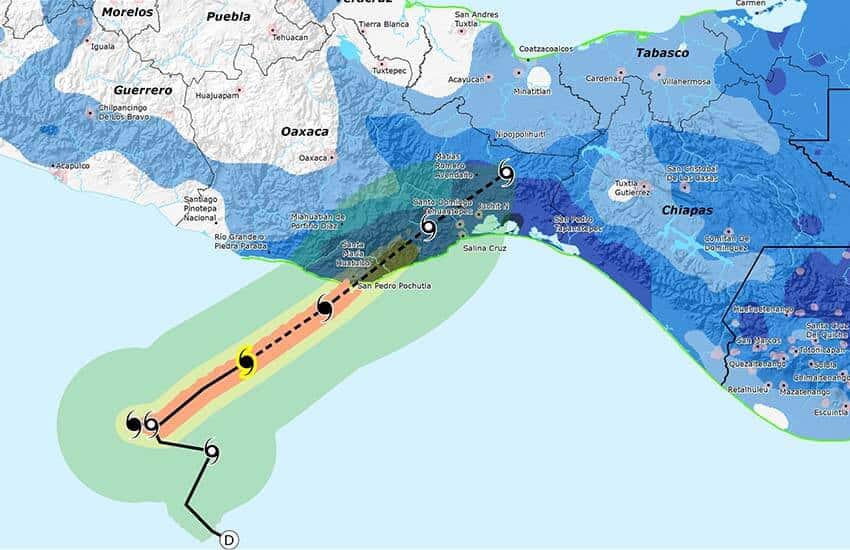
The NHC said that Agatha’s northeast trajectory is expected to continue through Tuesday.
“Maximum sustained winds are near 105 mph (165 km/h) with higher gusts,” the Miami-based center said, adding that rapid weakening is forecast after landfall and that Agatha is expected to dissipate over southeastern Mexico by late Tuesday.
Agatha’s storm surge is expected to cause extremely dangerous coastal flooding near and to the east of where the hurricane made landfall. The center also warned of large and destructive waves. “Large swells generated by Agatha will affect the coast of southern Mexico during the next day or so. These swells are likely to cause life-threatening surf and rip current conditions,” the NHC said.

Heavy rain is expected in Oaxaca as well as Chiapas, Veracruz, Tabasco and eastern Guerrero. Oaxaca will receive the heaviest falls, with 250 to 400 millimeters (10 to 16 inches) of rain predicted as well as isolated maximum amounts of 510 mm (20 inches).
The NHC said that life-threatening flash flooding and mudslides may occur in both Oaxaca and Chiapas, where rainfall of up to 380 mm (15 inches) is possible.
Agatha is the first named storm in the Eastern Pacific this year. Since it reached the Oaxaca coast as a Category 2 hurricane, that makes it the strongest ever to make landfall in the Eastern Pacific in May.
In addition, it is just the third hurricane in recorded history to make landfall in Mexico in May after Barbara crashed into Chiapas in 2013 and Agatha struck Michoacán in 1971. Both those hurricanes were Category 1.
The Associated Press reported Monday that threatening grey skies and blowing sand had cleared beaches in destinations such as Puerto Escondido and Huatulco. Over 200 shelters are offering refuge from the hurricane and more than 9,000 emergency personnel are poised to respond to Agatha’s arrival. Schools were closed in Oaxaca and parts of Guerrero on Monday.
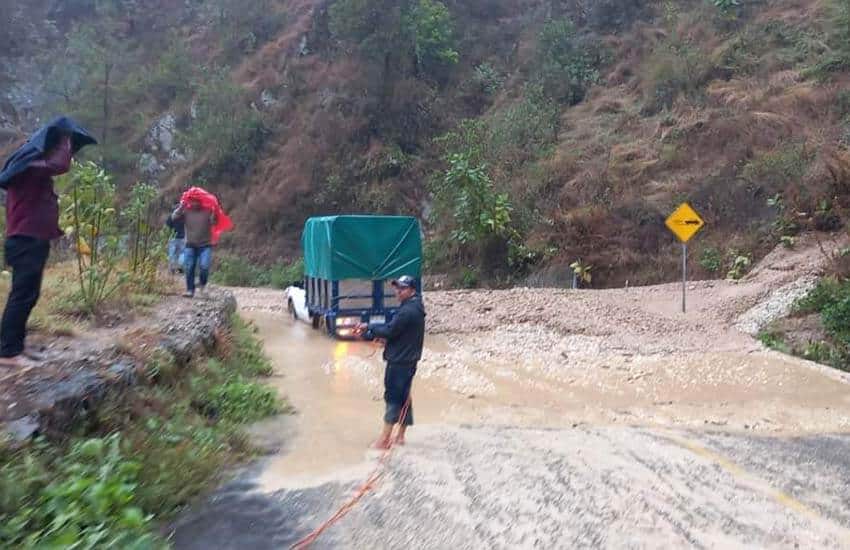
Before the hurricane even made landfall, Oaxaca’s state Civil Protection had reported a landslide due to Agatha’s effects as it approached the coast. Heavy rains caused washed out a highway connecting Pochutla to Oaxaca city near the municipality of Miahuatlán, making travel between Pochutla and Miahuatlan impossible, Civil Protection said.
“Don’t take the risk,” the Oaxaca Civil Protection’s Twitter account advised around 3 pm.
Dan Pydynowski, a senior meteorologist at AccuWeather, warned of the risk of property damage and trees and power lines coming down. “Flooding rainfall is expected to be one of the biggest impacts across southern Mexico and parts of Central America,” he added.
“The heaviest rain will fall across the Mexican states of Oaxaca and Chiapas, causing flash flooding, mudslides and road closures.”
The last hurricane to strike the Oaxaca coast was Carlotta, which made landfall near Puerto Escondido at Category 2 intensity in June 2012. Seven people were killed and at least 29,000 homes and 2,500 businesses were damaged, mostly in Oaxaca.
There is a risk that Agatha could regain strength after entering the Gulf of Mexico in the coming days. It could thus become the first named storm of both the Pacific and Atlantic hurricane seasons.
With reports from AccuWeather, Milenio, AP and USA Today