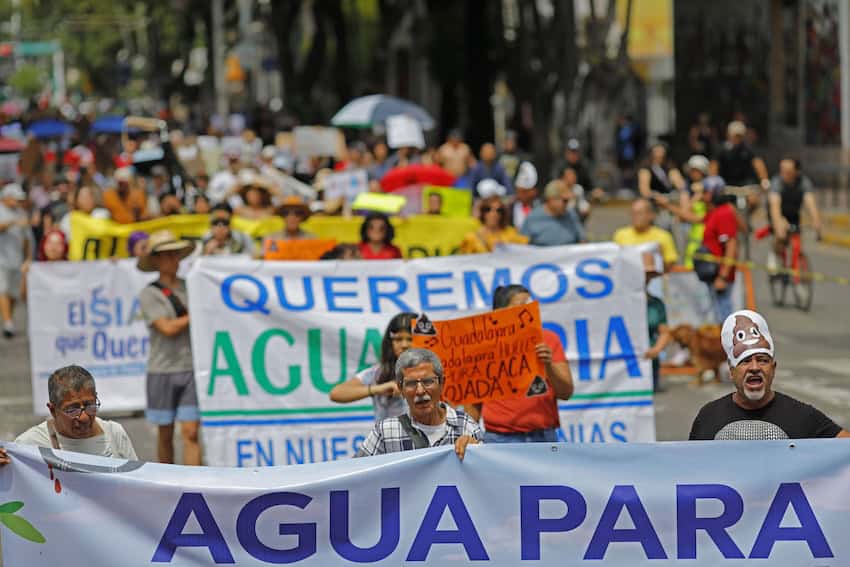
Jalisco Governor Pablo Lemus has announced a water-rationing plan for the Guadalajara Metropolitan Area (ZMG) amid growing concerns over citywide water contamination.
“The city is going through an unprecedented drinking water crisis,” Lemus said in a video posted on his official social media channels. “And like in any crisis, the first step is to acknowledge it in order to solve it.”
The temporary measure, expected to last approximately six months in its first stage, will involve withdrawing up to 2.5 cubic meters per second from the distribution network by no longer using water from the Las Pintas dam and the old Chapala system.
According to the newspaper La Jornada, water consumption in the ZMG stands at between 10 and 11.5 cubic meters per second, so the decrease would represent around a quarter of the supply.
Gov. Lemus acknowledged in his video announcement that the move means less water during the rehabilitation project — hence the rationing — but what flows will be cleaner.
The plan does not mean that homes will be without water for six consecutive months. Rather, service rotations, low-pressure episodes, and interruptions during one or two days are expected in the most affected areas.

Further details about how the program will operate will be announced by the Intermunicipal Potable Water and Sewerage System (SIAPA) and the municipalities on Oct. 12.
State Chief of Staff Alberto Esquer told the newspaper El Informador that authorities are analyzing the volume of water that can be distributed without drawing from the Las Pintas source. This calculation will make it possible to determine service rotations and conditions while the planned works are being carried out.
“We call on residents for patience; we are working on this, and we acknowledge the problem,” Esquer said.
Poor water quality affects at least 342 metropolitan neighborhoods. Lemus attributed the problem primarily to the aging Chapala supply system and illegal discharges into the Las Pintas canal, where the water coming from Chapala mixes with the drainage from the south of the city.
To restore the supply, authorities will fast-track the La Calera diversion aqueduct and the first phase of the expansion of Water Treatment Plant No. 1 in Miravalle. They will also establish a permanent working group with metropolitan mayors to monitor water supply and quality.
As a long-term solution, Lemus proposed building a replacement Chapala–Guadalajara aqueduct, with an estimated completion time of two years. He added that President Claudia Sheinbaum agreed that the federal government would carry out and fund the outstanding works required for the El Zapotillo system to operate at full capacity.
Lemus said that the announced measures would not entail public debt, increases in SIAPA rates or privatization of the water service.
Mexico News Daily