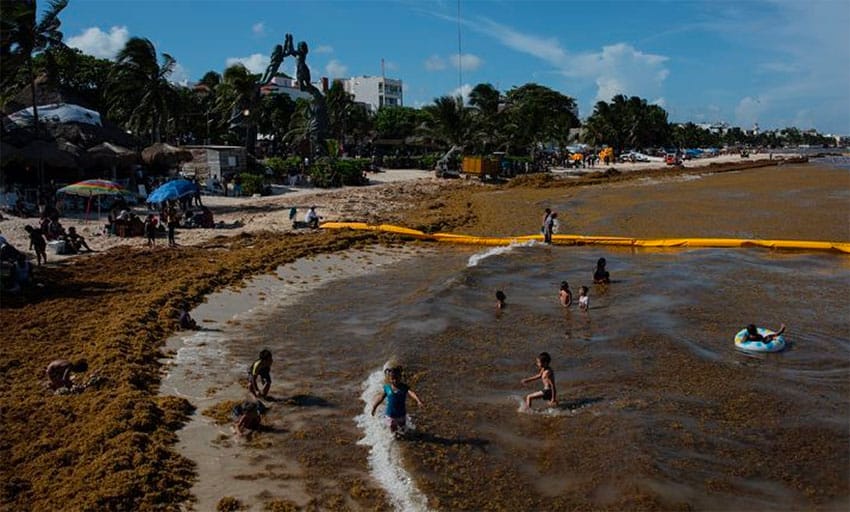
Scientists in Yucatán have developed a laboratory prototype of a system that converts sargassum into a biogas that could be used in the home or to generate clean energy.
Raúl Tapia Tussell, head researcher in the renewable energy unit at the Yucatán Scientific Research Center (CICY) in Mérida, told the newspaper El Economista that work on the project began in 2017 after large quantities of sargassum began washing up on the Yucatán coast.
“The problem wasn’t as big then as it is now but from that time . . . we started to work with the seaweed that arrived at the port of Progreso,” he said.
Tapia explained that once the sargassum is cleaned and dried, it is mixed with a fungus that breaks down the lignin in the seaweed and generates methane.
The biogas could be used as a fuel source for stoves and heaters or to generate electricity using a process that is less contaminating than that powered by fossil fuels.
The CICY researchers are applying for a patent for their prototype system from the Mexican Institute of Industrial Property.
The next challenge, Tapia said, will be to develop the infrastructure needed to generate the sargassum biogas outside the laboratory, and to store and distribute it.

“That is one of the most complex parts of the project because it requires economic resources . . .” he said.
“It’s methane gas and it could even be used for motor vehicles but . . . its use . . . depends . . . on having the molecular transformations systems and storage [capacity] . . .” Tapia explained.
The researcher said that other benefits of using sargassum to generate biogas are that it is free and it arrives on the coastline naturally. Tapia also said that the use of a seaweed as a fuel source would get it out of the sea and off the beach, where it can cause environmental problems and discourage tourism.
The massive arrivals of sargassum on the Caribbean coast of Mexico have led to the development of a variety of uses for the macroalgae such as making shoes, paper, a Mother’s Day message and even houses.
The masses of sargassum on the beaches of Tulum also inspired an impromptu nude photoshoot last year by renowned New York photographer Spencer Tunick.
Source: El Economista (sp)