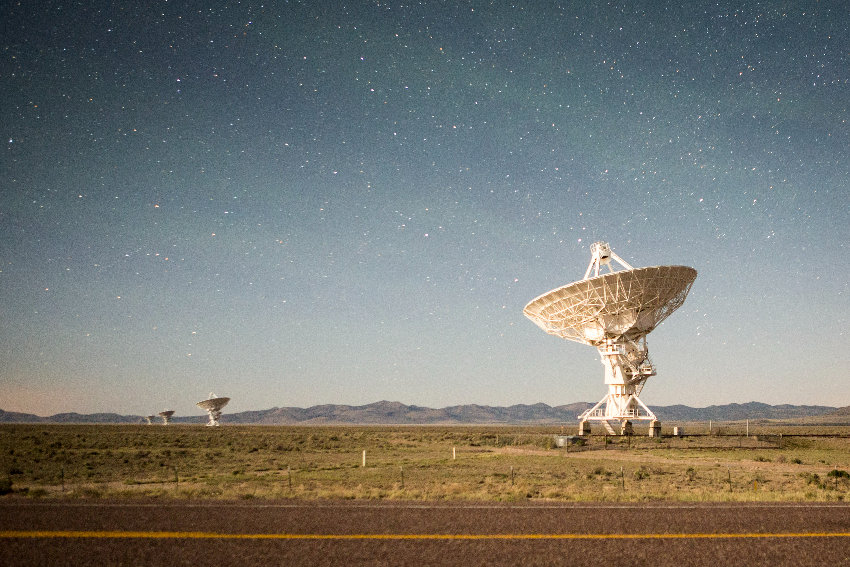
Three Mexican astronomers have discovered an exoplanet or extrasolar planet (not in our solar system) using observations gathered from the Very Long Baseline Array (VLBA), a system of ten radio telescopes with observing stations located across the continental United States (and Hawaii) that captures radio signals from space and digitizes them.
The team of astronomers, led by Salvador Curiel Ramírez from Mexico’s National Autonomous University (UNAM) created the first 3-dimensional model of two stars in a binary system, with a Jupiter-like planet orbiting one of them. Combining over 80 years of data gathered through optical observations and VLBA observations, the astronomers said they have discovered something that might assist scientists with the mysteries of our own solar system.
“Since most stars are in binary or multiple systems, being able to understand systems such as this one will help us understand planet formation in general,” said Curiel in an interview.
The two stars are about 20 light-years from our solar system, relatively close in terms of space. The larger star, which is orbited by the planet, has about 44 percent of the mass of our sun, and the smaller one has 17 percent of the mass of our sun. They orbit each other about every 229 years. The exoplanet cannot be seen directly but its existence is inferred by tracing the larger star’s movement, allowing astronomers to detect a slight wobble caused by the gravitational pull of the planet.
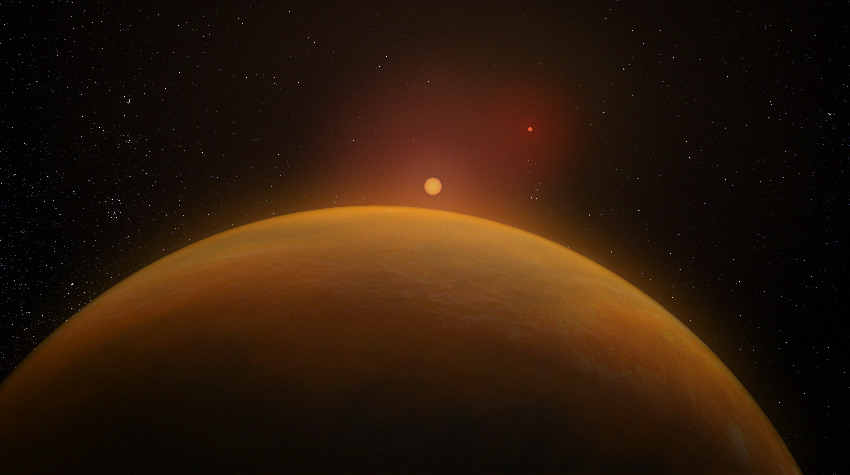
“We are looking for planets that have similar characteristics as earth, ” said Curiel, “with orbits appropriate for life, to try and answer the question, is there life on other planets?” He added that within the next ten years, the number of planets like this found outside of our solar system could triple or quadruple in number. To date, 5,000 exoplanets have been discovered.
Curiel says the group received pushback from the National Radio Astronomy Observatory that manages the VLBA, who said they wouldn’t find any new information by reviewing the data and adding new observations.
“But we finally got the time, and then we noticed with new observations, that after five or six years, the signal was still there. That meant they were real.”

With Reports from Reforma and The National Radio Astronomy Observatory.