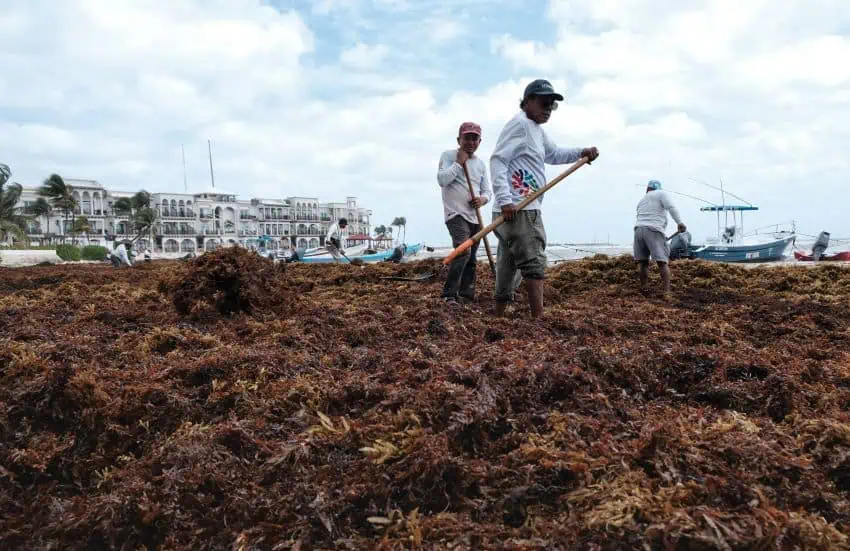
Sargassum, the brown seaweed notorious for its negative effects on ecosystems, tourism and public health, might have a redemptive use as a common construction material, according to a groundbreaking study by National Autonomous University of Mexico (UNAM) researchers.
Dubbed the “sargapanel,” the material was developed by a group of researchers led by scientist Miriam Estévez González from UNAM’s Center for Applied Physics and Advanced Technology in Juriquilla, Querétaro. Estévez explained that the material resembles drywall, the only difference being that its core and coating are made out of seaweed.

“Each unit is manufactured with five kilograms of dry algae, equivalent to 50 or 60 kilograms of wet organic material,” Estévez said, adding that the new material supports the circular economy by utilizing non-toxic and recyclable resources.
Furthermore, it addresses an environmental issue by preventing the decomposition of sargassum on beaches. In 2023, Mexico’s navy retrieved approximately 22,000 tonnes (22 million kilograms) of sargassum from the beaches of the Mexican Caribbean.
How is sargapanel made?
To make sargapanel, the algae is first collected at sea after which it is subject to a solar drying treatment. Once dry, it is packed and sent to Estévez’s team in Querétaro where they remove impurities from the raw material including salts, sand and plastics.
Once the algae is clean, it is ground, crushed and sifted to obtain a powder that, once combined with organic fibers and other components, forms the pulp used to manufacture the sargapanel cover. Containing up to 70% algae, this flexible cover is then placed on both sides of a solid core made from sargassum and plaster.
How is sargapanel used?
Scientists say these panels can be used like any traditional building panel for walls and ceilings, as they also allow for electrical and hydraulic installations.
One sargassum panel can support loads of up to 10 kilograms without anchors. According to UNAM, sargapanel has been successfully installed in a house in Querétaro, proving its efficiency as a construction material.
“We want companies to know about our product so that it doesn’t just remain on paper,” team member Rodrigo Alonso Esparza Muñoz told Gaceta UNAM. “We already [have] a competitive [product], but once the panel is on the market, it will be a very good option,” he said.
When does sargassum season begin in the Mexican Caribbean?
In the Riviera Maya, sargassum season usually lasts from May to November, although it can vary depending on the climatic and oceanographic conditions of each year. In 2024, the season officially ended on Nov. 14.
Mexico News Daily