Two days after two elderly Jesuit priests were murdered in Chihuahua, heads of Jesuit universities slammed past and present governments for failing to combat violence in Mexico and called on citizens to pressure authorities to act.
Speaking during a panel discussion on “justice with peace and reconciliation” at the Jesuit university system’s annual meeting in León, Guanajuato, on Wednesday, one university rector described Mexico as a failed state where the law of the jungle prevails.
“When the state doesn’t have control of territory and allows private armed groups to control it, we call that a failed state,” said Juan Luis Hernández Avendaño, rector of the Ibero-American University in Torreón, Coahuila.
Due to the absence of the state, many neighborhoods and towns across Mexico have been controlled by big and small criminal groups for years, he said.
“In many parts of Mexico, [authorities] left a long time ago, so the people are alone, abandoned, subjected to the law of the strongest, subjected to the law of the jungle, the law of kidnapping, extortion and murder because federal and local governments aren’t interested in protecting us,” Hernández said.
The removal of the bodies of the two slain priests from the church where they were killed is a sign that “narcos can do whatever they want,” he added. “They feel they are the owners [of Mexico], and we can’t continue allowing that.”
Mario Patrón, rector of the Ibero-American University in Puebla, charged that eight of nine violence-prevention and peace-building measures included in a national peace plan presented by Andrés Manuel López Obrador when he was president-elect have not been fully implemented.

“Eight measures were watered down, and only the National Guard was left,” he said. “A militarized police force … [is] the only measure to pacify the country. Today, we have to say that strategy failed.”
Alexander Paul Zatyrka Pacheco, rector of the Jesuit University of Guadalajara (ITESO), accused governments at different levels of blaming each other for the high levels of violence that continue to plague Mexico while failing to address the problem. “It’s clear that these political collectives won’t act if there isn’t pressure from civil society,” he said.
The director of México state’s Chalco Valley Technological University took aim at the federal government’s so-called abrazos, no balazos (hugs, not bullets) security approach, a non-confrontational strategy that purports to address the root causes of violence through the delivery of social programs. The government is trying to achieve peace simply by transferring money to people, Óscar Castro said. But those transfers are no match for the pressure criminal groups exert on people who live in the areas they control, he said.
Cartels can lure young people with salaries that far exceed payments the government makes to students with scholarships or participants in social programs such as the Youth Building the Future apprenticeship scheme.
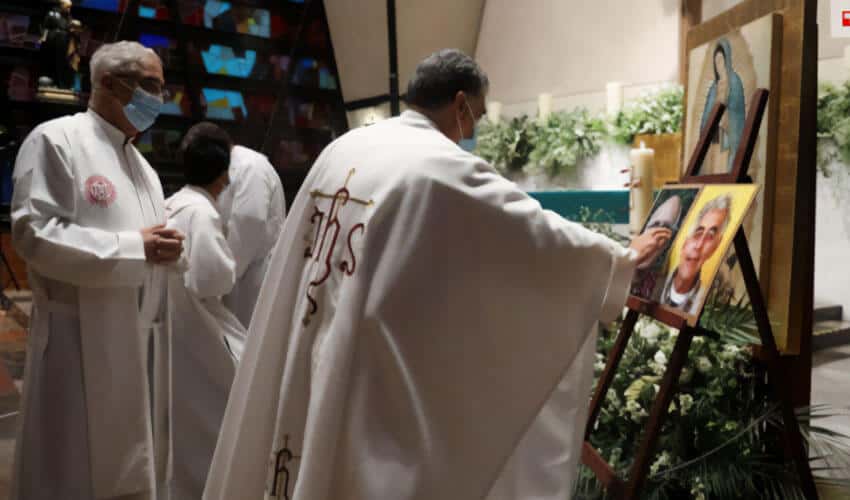
All of the university leaders who participated in the panel discussion lamented the deaths of Joaquín César Mora Salazar and Javier Campos Morales, veteran priests who were gunned down in a church in the Tarahumara region of Chihuahua on Monday. A tourist guide was also killed in the attack, which was allegedly perpetrated by a drug gang member known as El Chueco (The Crooked One).
Luis Alfonso González, rector of the Ibero-American University in León, said the murders occurred within a “framework of exacerbated violence that harms … our society daily and reveals the ineffectiveness of the state security policy at all levels.”
With reports from El Universal and Reforma