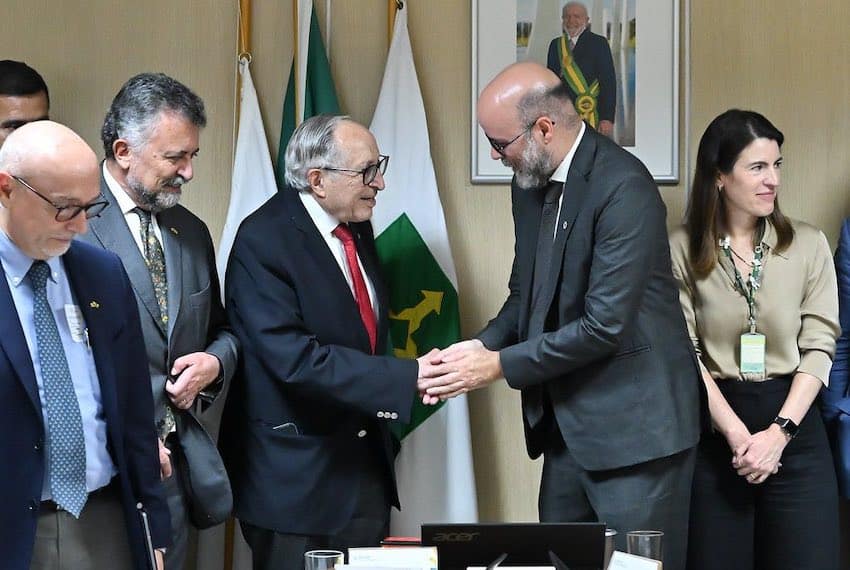
Mexico and Brazil have announced the signing of a Memorandum of Understanding to boost technical, scientific and institutional cooperation in the healthcare sector while expanding citizens’ access to services, technologies and medicines.
The agreement was signed during Health Minister David Kershenobich’s work trip to Brazil within the framework of the wider healthcare cooperation agenda that both countries began last year at the 78th World Health Assembly in Geneva, Switzerland.
Este encuentro entre Brasil y México en materia de salud, ofrece oportunidades para fomentar el desarrollo de la industria farmacéutica, la formación de recursos humanos y conocer referencias claras para la implementación del Servicio Universal de Salud de nuestro país. https://t.co/QnNA45VXtR
— Dr. David Kershenobich S (@DKershenobich) April 14, 2026
Key agreements include the creation of a bilateral analysis committee focusing on the healthcare systems of Mexico and Brazil; the exchange of information and best practices between Brazil’s Farmácia Popular (Popular Pharmacy) and Mexico’s Farmacias del Bienestar (Well-being Pharmacy); and the implementation of a joint technical team for telemedicine and telehealth.
The agreement prioritizes technical, scientific and institutional cooperation in health surveillance and disease control (such as dengue and other infections), as well as epidemiological exchange and collaboration to develop new platforms such as messenger RNA. Other actions include cooperation on new platforms such as local production of supplies and the strengthening of clinical research.
To boost education, the agreement also aims to facilitate training exchanges between the two countries and enhance the capacities of healthcare professionals.

During the signing of the memoranda, Kershenobich said Mexico wants to continue developing “joint initiatives with Brazil, especially in the areas of pharmaceuticals, vaccines and innovation.” Previous bilateral agreements between the two countries include those signed in August last year to accelerate regulatory processes and strengthen regional production of vaccines and medicines.
Brazil’s Health Minister Alexandre Padilha celebrated the strategic nature of the bilateral collaboration and highlighted Brazil’s universal healthcare system — known as the Unified Health System (SUS) — whose model, he said, can contribute to Mexico’s goals.
“The SUS is a concrete example of inclusion and can contribute to the transformation process of the Mexican system, as we move forward together in innovation, drug production, and responding to common health challenges,” he stated.
Recently, President Clauda Sheinbaum announced her administration will transform the public system (IMSS-Bienestar and Health System for Well-being) towards a program that offers free health care for citizens and legal residents regardless of their social security status.
Mexico launches Universal Health Service registration, starting with elderly
During his trip, Kershenobich held meetings with medical management teams to draw on their experience under SUS ahead of Mexico’s transition, which is expected to begin in January 2027.
“Mexico sees the SUS as an important source of inspiration for advancing the construction of a more integrated and accessible system,” Kershenobich said, adding that their collaboration with Brazil seeks to strengthen Mexico’s “capacities and guarantee more access to health for our populations,” he said.
With reports from Milenio