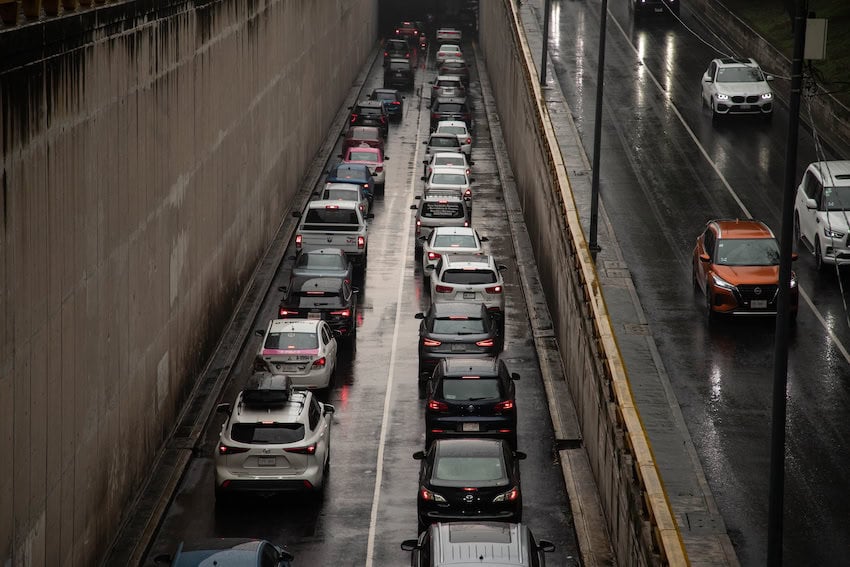
Mexico City residents spend on average 152 hours — nearly a week — stuck in traffic every year, according to the latest TomTom Traffic Index, a Dutch transport monitoring firm that ranked Mexico’s capital as the city with the worst traffic in the world.
After comparing traffic congestion in more than 500 cities globally, the study revealed that residents of Mexico City waste on average hours in traffic per year than any other, with automobile trips taking 52% longer than they would under optimal conditions.
🇲🇽🚗💨 La capital de México tiene la mayor congestión vehicular a nivel mundial, según estudio
De acuerdo con el informe de TomTom Traffic Index, las personas que circulan en la Ciudad de México pierden alrededor de 152 horas al año atrapados en el tráfico. Aunque la capital… pic.twitter.com/bzHWe632NW
— Sputnik Mundo (@SputnikMundo) November 15, 2025
“Mexico City is the city in which traffic has the greatest impact on the deterioration of journey times compared with ideal traffic conditions,” the TomTom report said. “This means that on all routes surveyed throughout the year on the entire road network, journey times are 52% longer than those recorded in Mexico City when traffic was free-flowing.”

During peak hours, the average speed can drop to 5 kilometers per hour on main thoroughfares such as Eje Central, Constituyentes, Viaducto and Periférico. The report pointed out that in the best-case scenario, average speed can go up to 15 kilometers per hour.
Slow traffic not only wastes time for Mexico City residents and visitors, but it also has a significant impact on air quality and the economy. The report revealed that motorists generate approximately 983 kilograms of carbon dioxide per year due to congestion. The extra cost of gasoline is equivalent to filling a vehicle’s tank eight times.
The world-leading congestion is not directly connected to the city’s number of automobiles. In fact, huge as it is, Mexico City ranks just 17th globally among cities with the most vehicles on the streets. (According to the National Institute of Statistics and Geography, or INEGI, the capital has 5.5 million vehicles in circulation.)
Researcher Dante Pérez Méndez, from the Institute of Research in Applied Mathematics and Systems (IIMAS), told the UNAM Gazette that the capital’s traffic problems are due in a large part to the disorganized manner in which it has grown, along with a highly transient population and insufficient infrastructure in many areas.
Furthermore, employment centers and tourist attractions are mostly concentrated in specific areas, causing high demand for transportation in certain parts of the city.
Other factors hampering traffic flow include construction work, demonstrations, slow-moving trailers, cranes and heavy trucks, and the frequent boarding and alighting of passengers by buses, large and small..
In addition to the capital, two Mexican cities made the top 100: Guadalajara (No. 28) and Monterrey (No. 72). According to the report, Guadalajara’s residents spend 102 hours in traffic, while Monterrey residents spend 80 hours.
In the global ranking, following Mexico City is Bangkok, Thailand, with a congestion rate of 50%, and Davao City, Philippines, with 49%.
With reports from Infobae and El Independiente