This summer, there won’t be any shortage of fútbol-themed events and experiences around Mexico. The country is no stranger to throwing parties, after all — and as a host nation of the World Cup for the third time, with thousands of visitors expected to pour in, it’s set to be a full-blown summer of soccer and celebrations.
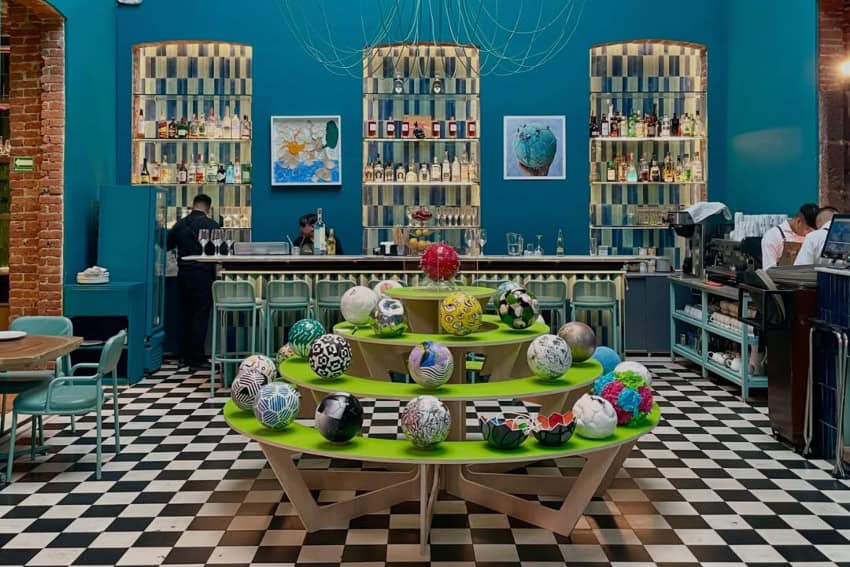
Mexico City is especially eager to showcase its internationally acclaimed offerings and venues. Among them, Magda — a restaurant and cultural space inside a 400-year-old building in San Ángel, located merely 20 minutes by car from Estadio Banorte (formerly Estadio Azteca) — has capitalized on the moment with a thematic display of Mexico’s creativity. Their World Cup-inspired exhibit is playfully titled “A Lot Of Balls.”
Ballsy and creative
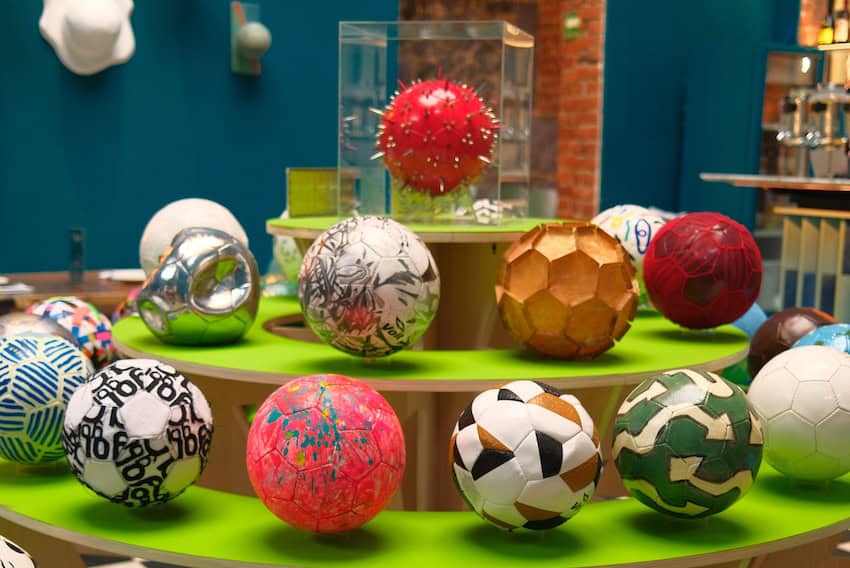
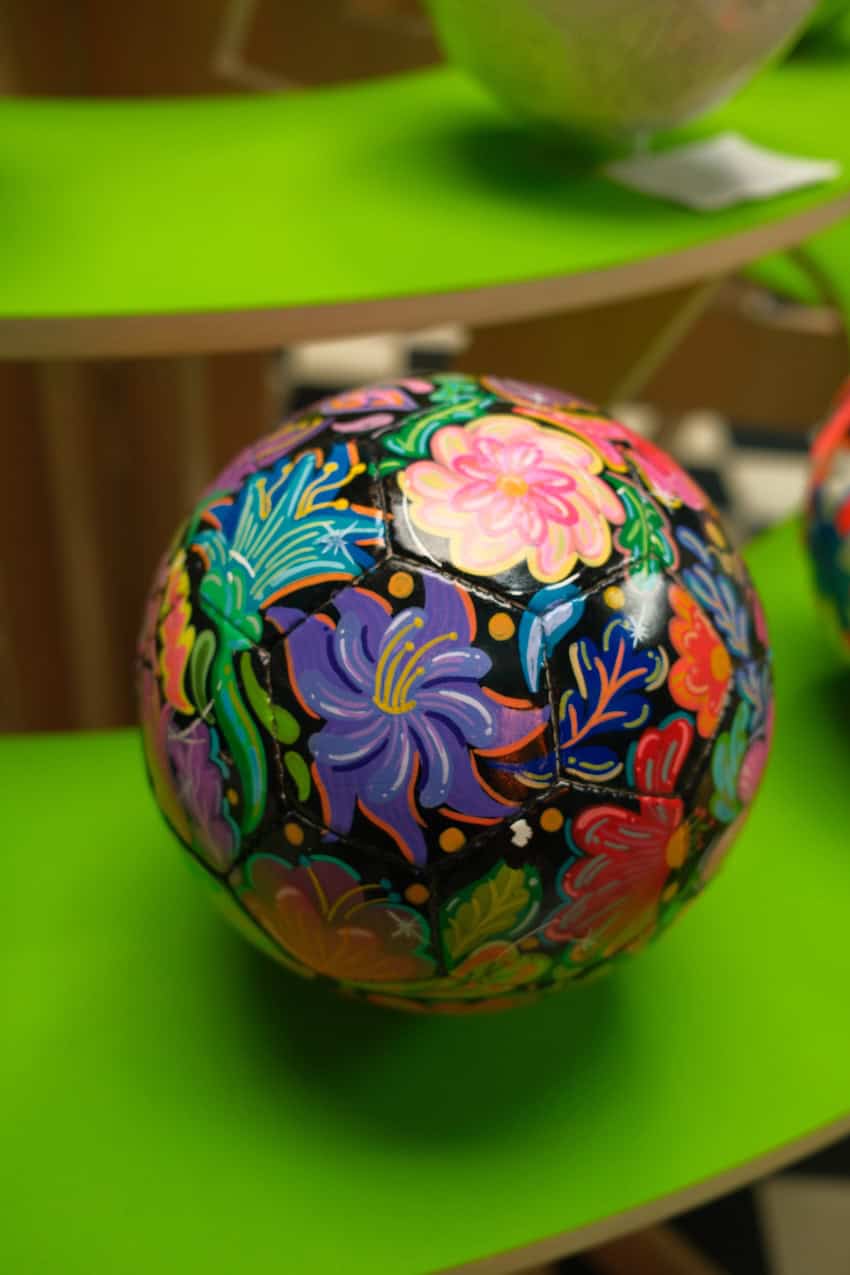
The months-long exhibit opened in April and showcases 100 multidisciplinary Mexican artists and creators in a large-scale effort that invited each participant to submit a soccer ball of their making, interpreted in a way that presents a part of their identity, community and views, without restriction. The cadre of makers — which includes visual artists, painters, illustrators, architects, fashion designers, writers and more — used the circular ball as a blank canvas to tell their story, and it’ll all be on display at Magda until July 19, when the World Cup ends with its final match.
Of the 100 artists asked to contribute, Atrapaluz (real name Adan Days) — known for his sports fandom and for his prior work with NFL Mexico in designing their “Hasta La Muerte” collection — expressed his thoughts on the FIFA World Cup by papier-mâchéing a soccer ball with a collage of hand-drawn dollar bills from different countries, representing the international greed and corporatized elements of the tournament and sport. His ball art is titled “Fútbol Actual,” or “Current Football.”
“Each face on the banknotes represents or refers to a person or executive who has somehow influenced soccer to be experienced more as a business than as a game,” Atrapaluz tells Mexico News Daily. “Meanwhile, all these banknotes surround a single golden segment where two children are playing soccer without a care in the world.”
What matters during the World Cup, according to artists
Atrapaluz says he is a passionate, lifelong soccer fan and grew up with the sport as his primary athletic interest. For him, being able to experience his country as a host nation of the World Cup is exhilarating, despite his awareness of and criticism against the profit-making vortex it’s inevitably a part of.
“It will be a different World Cup due to the media attention and how it will be consumed now with social media,” he admits. “I felt a bit repulsed, and then I thought that’s how football feels today, like something you want to enjoy, despite the 300 commercials, brands, influencers and shady dealings behind it. In the end, what matters is the game, but I think we’ve forgotten that.”

His commentary is one out of a literal 100 on display at Magda. The architect Adán Cárabes used a perfectly plain and white ball and painted the silhouette of a rabbit in red paint in the center, and then built a circular steel sculpture with rays emitting from its outer ring, and titled it “El Conejo de la Luna.” It emits a mixture of minimalism, indigenous symbology and industrial techniques, perhaps reflecting Mexico’s many — and often opposing — realities.
Balls, reinterpreted
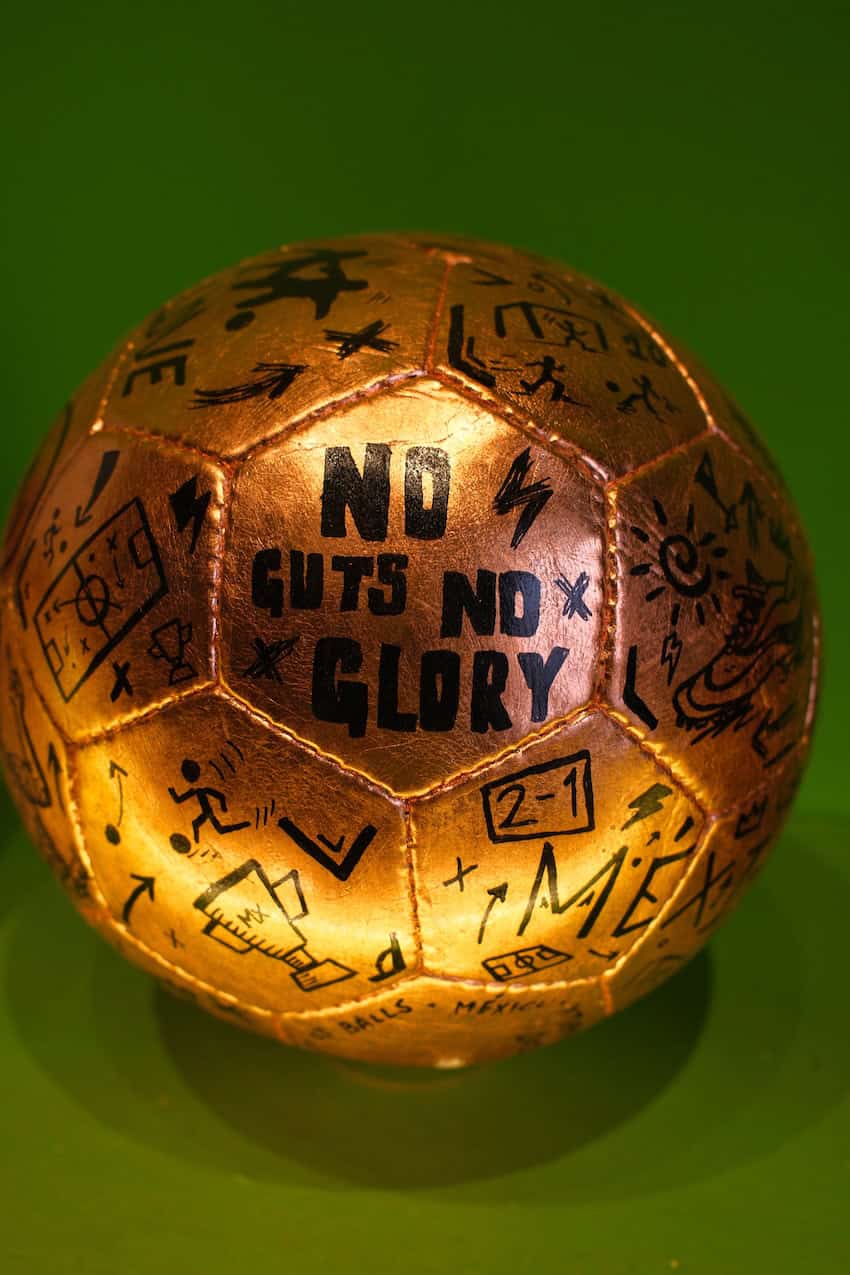
One designer, Alexis Del Toro, made a colorful piñata in the shape of a large soccer ball; the fine artist APKO (real name Ana Paula Kuri) submitted a partially deconstructed balón covered in bronze hues, and is named “Tonalli” after the Nahuatl word for heat and sun, which is believed to represent a human’s vigorous spirit at birth. The interpretations are vast — in both medium and materials, but also in philosophy and global perspective — ranging from acrylic spikes, stitched-together wood, a replica time bomb, metal baskets, a faux globe, a deflated ball on glass and even a soccer ball-turned-lampshade.
There are whimsical versions (like a plain white soccer ball with a childlike handwritten message that simply reads, “I should’ve been a fucking athlete”) and highly inventive and imaginative ones (such as “Three with everything,” which reutilizes the discarded materials of a deconstructed soccer ball, but arranged in the shape of tacos al pastor, with a napkin holder and salt shaker beside it that read “Tacos Campéon,” in homage to the famous Japanese anime, “Supercampeones.”
A collaboration built around the World Cup and Mexican values
“Our restaurant has always been a place that enjoys collaborating with artists,” says Ricardo Casas, the creative director at Magda. The multiuse restaurant joined forces with Condesa’s Galeria Ricardo Reyes to curate the exhibit; in the past, they’ve teamed up with them and other artists in the city to display a rotation of various artworks and artifacts.
“Obviously, with the international spotlight, and with visitors coming from all over the world (for the World Cup), we hope to make San Ángel an epicenter of tourism where the games can be enjoyed,” Casas continues. “We decided to organize this special exhibition with 100 artists as a universal symbol. It has the pretext of football and the World Cup as a certain motive, but it’s important to reflect our values, to demonstrate who we are as Mexicans in terms of our sense of design, architecture, art, style and illustrations. This is about who we are and what we are about, and the things we produce beyond foreigners’ perceptions and stereotypes, or names like Frida Kahlo.”
Art at the intersection of football and flavor
Of course, the restaurant is more than just about displaying art and culture. It’s also about consuming Mexico’s flavors through its local gastronomy. The interior of the space is well designed, with aqua blue walls arching high into the ceiling above checkered floor tiles. The artful, elegantly understated decor reflects the spirit of the restaurant’s broader vision: to be an intersection of Mexican art, food and culture. Simple, classic dishes like tacos de chamorro and empanadas de plátano can be ordered alongside more upscale takes on Mexican cuisine, like the Chimalistac-style goat rib eye, slow-cooked in pulque and piloncillo sauce and served over mashed potatoes. To close out, a housemade cheesecake served with papaya compote that is infused with cardamom, and accompanied with helado de vanilla, should do the trick.
Waving the Mexican banner
It’s a ballsy proposition, as Casas might say, to unite 100 Mexican artists under one restaurant’s roof. But it’s tasteful, and its timing couldn’t be better, especially for those looking to get their supply of Mexico’s spontaneous, ever-refreshing creativity and soulful nourishment this summer. So if you couldn’t snag a ticket to any of the games (see: historically unprecedented spikes in demand and prices), you can still snag a seat at Magda or many of the other countless spaces around the city that will be proudly waving Mexico’s tricolor banner in more ways than one.
Alan Chazaro is the author of “These Spaceships Weren’t Built For Us” (Tia Chucha Press, 2026), “Notes from the Eastern Span of the Bay Bridge” (Ghost City Press, 2021), “Piñata Theory” (Black Lawrence Press, 2020), and “This Is Not a Frank Ocean Cover Album” (Black Lawrence Press, 2019). He is a graduate of June Jordan’s Poetry for the People program at UC Berkeley and was selected as a Lawrence Ferlinghetti Poetry Fellow at the University of San Francisco. His work can be found in NPR, The Guardian, SLAM, GQ, L.A. Times, and more. He is currently based in Veracruz.