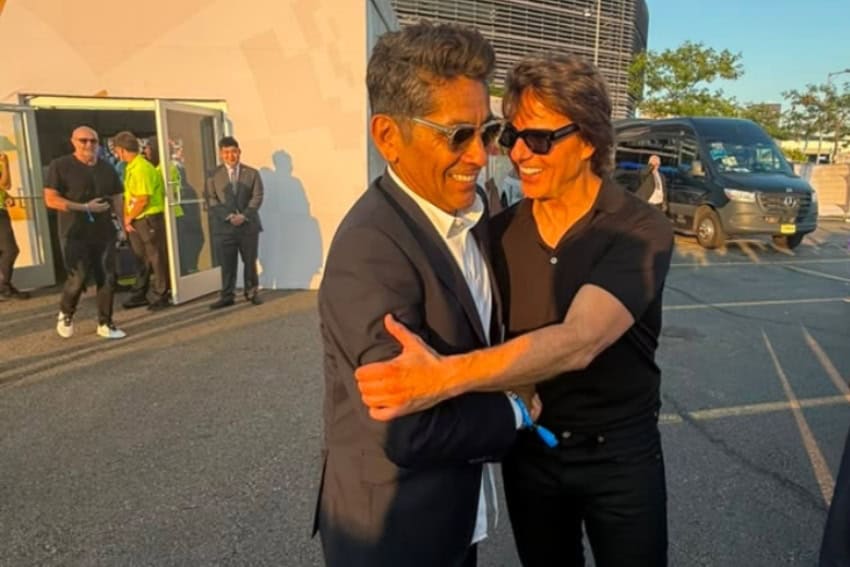
You don’t have to be a futbolero to know the national icon that is Jorge “El Inmortal” Campos.
The former Mexican national team goalkeeper, who stood a mere 5-foot-6, dominated throughout the 1990s as a stalwart between the goalposts, supplying acrobatic dives and theatrical saves that have been compiled into countless highlight reels by a zealous fanbase. On the field, he helped popularize the role of an attacking goalie — the rare archetype of a goalkeeper who would leave his own goal to become an offensive weapon against opposing defenses (Campos famously played striker at times, netting over 35 goals in his career).
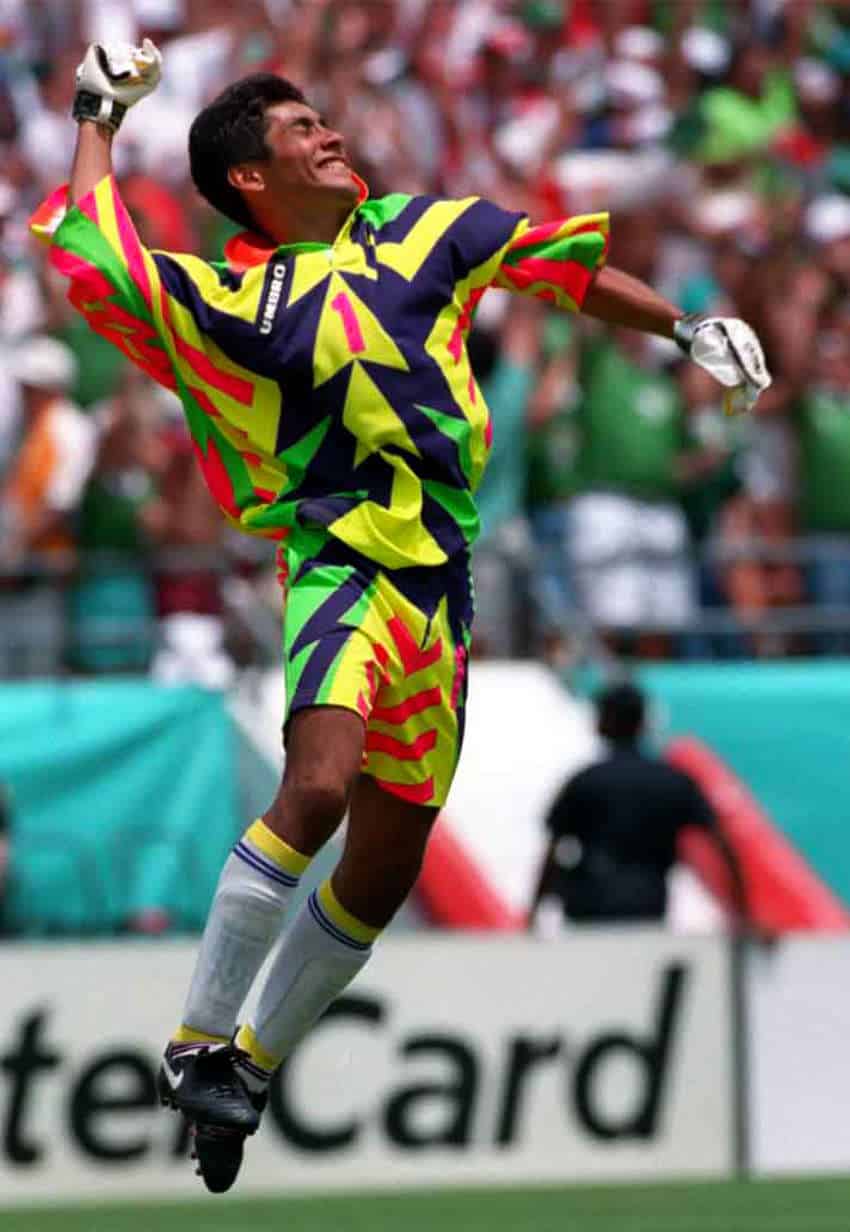
In fact, Campos developed such a prolific and unprecedented style as an offensive-minded goalie that FIFA was prompted to investigate its own rules about a player who switches positions mid-game.
‘A cult hero for his flamboyant apparel’
From 1988 to 2004, Campos — who grew up near Acapulco, Guerrero — transformed into a larger-than-life force during his prime, playing in Mexico and the United States for teams like UNAM, Atlante, LA Galaxy, Cruz Azul, Chicago Fire, Tigres and Puebla.
But perhaps more than the game itself, Campos became a cult hero for his flamboyant apparel. Bright neon shades and quirky geometric designs highlighted his loud sense of fashion on the pitch and, decades later, he remains one of soccer’s most iconic global personalities. At his zenith, Campos designed his own kit (inspired by Acapulco’s culture) that he wore in the 1994 World Cup. Campos’ creativity inspired other goalkeepers of the decade to follow suit, as a few of his contemporaries would also go on to create their own flamboyant style modeled after his example.
In total, Campos is credited with 130 national appearances for Mexico and over 100 custom uniform designs. In his own words, “I’m not sure if I played that well, but everyone remembers me.” Indeed, they do.
This summer, Campos recaptured the hearts of soccer fans worldwide with his playful personality, generous spirit and the announcement of a new soccer endorsement deal with Nike — a rare feat for a long-retired veteran. Here’s how the immortal Campos further embellished his colorful legacy at the 2026 World Cup.

Nike’s ‘Campos x Jorge’ collection
In his biggest splash, Campos revealed his collaboration with Nike for the “Campos x Jorge” release. Though the exact dates of the drop haven’t been confirmed yet, the sportswear giant teased the clothing line throughout the World Cup. (A few months ago, Campos joined forces with Nike and the Houston rapper Travis Scott, who is a frequent Nike collaborator himself, to release a custom jersey under the BadFriend skate apparel brand, perhaps foreshadowing Campos’ own line.)
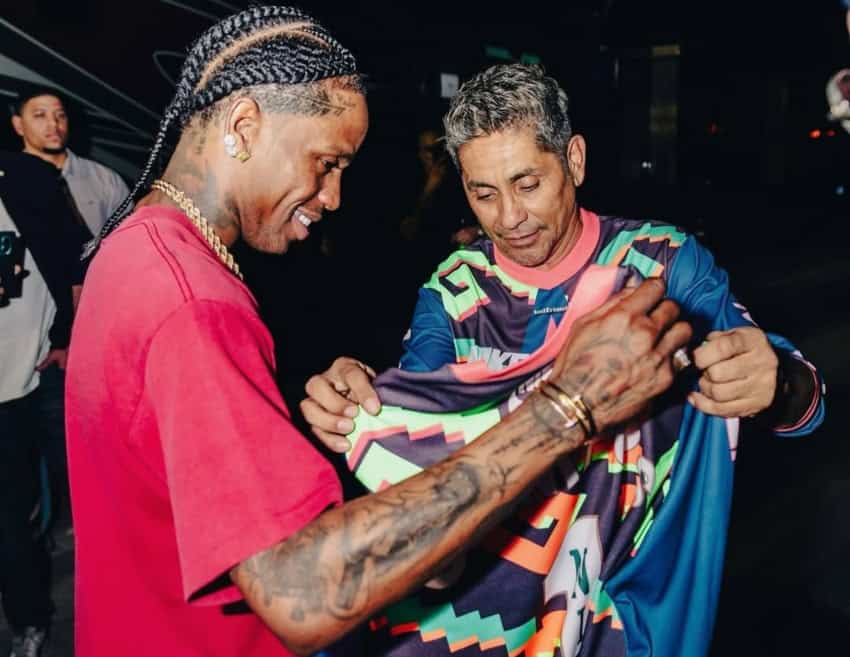
The clothing will utilize Campos’ legendary patterns, designs and colors. Best of all, Nike unveiled a Michael Jordan-esque silhouette for the brand, in which the outline of a diving Campos punching a ball away from the goalpost serves as a makeshift “Jumpman” logo.
Images of conceptual sketches have emerged online, generating tons of fan excitement around the clothing line. References to palm trees, Acapulco, beaches, surfing (a hobby that Campos acquired while growing up on Mexico’s Pacific coast) and, of course, soccer are at the forefront.
The collection will honor Campos’ ongoing tradition of converting the soccer field into a fashion runway.
Campos’ role as a cultural ambassador for Mexico
Nowadays, Campos is a versatile diplomat for the game’s universal appeal, a goalkeeper who transcended the sport to become an avatar of Mexico’s vibrancy and warmth beyond the penalty box.
For the 2026 FIFA World Cup, hosted in his native Mexico, Campos was in a uniquely opportune position to represent the sport as an official FIFA World Cup ambassador — along with other soccer notables like David Beckham, Mia Hamm, Ronaldo Nazário and Ronaldinho Gaúcho. Throughout the Cup, Campos was seen inside VIP boxes and attending high-profile events in various host cities, rubbing shoulders with the biggest stars in the sport. He was even given a seat in the presidential box with FIFA President Gianni Infantino.
In addition, Campos served as a World Cup television commentator for Mexico’s Azteca Deportes, providing analysis of in-game action, which he has done for over 20 years since his retirement in the mid-2000s. He is known for being goofy, off the cuff and rather unserious — albeit sincere and endearing — in a way that brings levity to the commentator’s booth.
View this post on Instagram
His face was seen everywhere, especially in Mexico: on limited-edition children’s juice boxes on Boing!, in Visa advertisements and in television commercials alongside other Mexican celebrities like El Hijo del Santo, Julio César Chávez and Pedro Infante.
‘A meeting of legends’
Beyond the gimmicky commercialism of it all, which admittedly has become an increasingly diluted part of the sporting industry at large in the modern age, Campos helped bring unity across cultures and generations in genuine, organic ways.
Most memorably, Campos brought René “El Loco” Higuita — a famous Colombian goalie from the 1990s known for his daredevil saves and infamous “scorpion kick” — together with Vozinha, who became Cape Verde’s unlikely goalkeeping hero and was considered the fan-favorite goalkeeper of this 2026 tournament. (Vozinha blocked all of Spain’s shot attempts and shut down the eventual World Cup champions with a 0-0 draw in their group stage duel.)
Jorge Campos and the 2026 FIFA World Cup
In a now-viral video, Campos asks Higuita, “Who is the best keeper?” to which Higuita responds, “Jorge Campos.” Campos immediately corrects him with a smile and says, “No, Vozinha,” and calls Vozinha over from across the room, whom Higuita hadn’t yet seen. The trio takes a photo together in a cross-generational meeting of legends. Later, Campos and Vozinha exchanged jerseys, a tradition that represents a sign of mutual respect and admiration between high-caliber players. Campos ends the interaction by telling them all to say “hello to Mexico.”
In Mexico, you can’t mention the 2026 World Cup without mentioning Jorge Campos. And you can’t mention Campos without mentioning Mexico.
Alan Chazaro is the author of “These Spaceships Weren’t Built For Us” (Tia Chucha Press, 2026), “Notes from the Eastern Span of the Bay Bridge” (Ghost City Press, 2021), “Piñata Theory” (Black Lawrence Press, 2020), and “This Is Not a Frank Ocean Cover Album” (Black Lawrence Press, 2019). He is a graduate of June Jordan’s Poetry for the People program at UC Berkeley and was selected as a Lawrence Ferlinghetti Poetry Fellow at the University of San Francisco. His work can be found in NPR, The Guardian, SLAM, GQ, L.A. Times, and more. He is currently based in Veracruz.