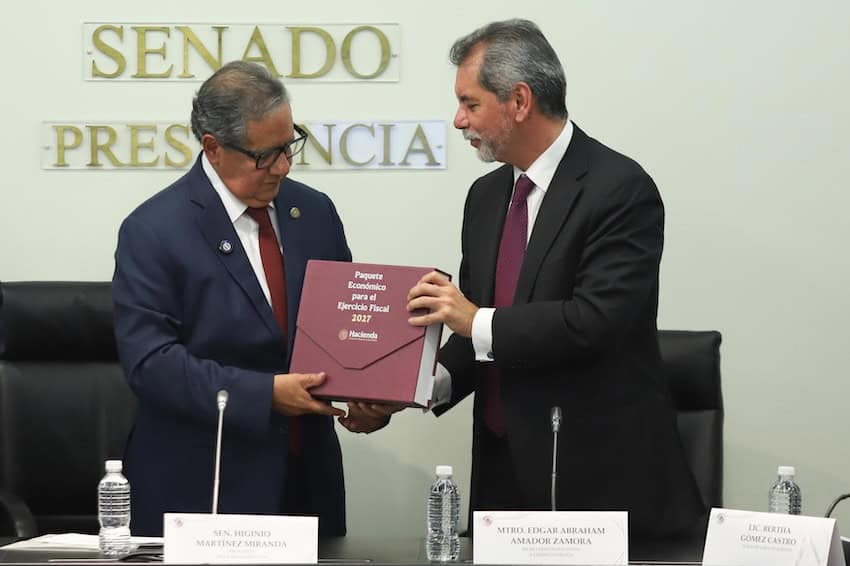
The federal government has proposed a 2027 budget of just over 10.6 trillion pesos (US $627.8 billion), an increase of around 1% in real terms compared to the expenditure approved for this year.
Finance Minister Édgar Amador Zamora submitted the proposed 2027 economic package to Congress on Tuesday night. Congress — which is dominated by the ruling Morena party — will vote on the proposal later this year.
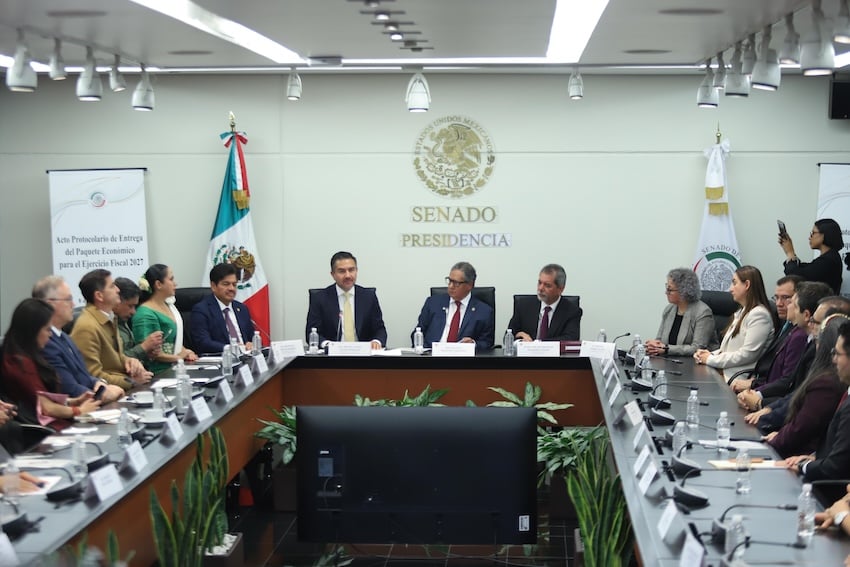
In a speech in the Chamber of Deputies on Tuesday night, Amador said that “public spending in 2027 will continue to be focused on improving the well-being of families and strengthening economic growth.”
He also said that “public resources must be at the service of the people and the development of the country.”
In addition to outlining the government’s proposed spending in 2027, the budget proposal includes various economic projections for this year and next.
Let’s take a look at the key numbers.
The Finance Ministry’s forecasts
- Growth of 2%+ predicted in 2027: The Finance Ministry (SHCP) is officially forecasting growth of 1.5-2.5% in 2027. However, in a statement released on Tuesday, the ministry asserted that Mexico’s economy “will grow at least 2% in 2027 … supported by consumption dynamism, the strengthening of public and private investment and a greater contribution from the external sector in an environment of greater trade certainty and more favorable financial conditions.”
- Weaker growth forecast in 2026: The SHCP downgraded its growth outlook for this year to 1-2% from a previous prediction of 1.8-2.8%.
- Budget deficit expected to decline in 2027: The SHCP is forecasting that the budget deficit will decline to 3.9% of GDP in 2027 from an estimated 4.1% of GDP in 2026. The ministry noted that a deficit of 3.9% of GDP would represent a decrease of 1.8 percentage points compared to 2024, when the deficit reached a record high of 5.7% of GDP.
- Public debt forecast to increase in 2027: The SHCP anticipates that Mexico’s public debt will increase to 55% of GDP at the end of next year, up from an estimated 54% of GDP at the close of 2026.
- Tax revenue forecast to increase in 2027: The SHCP predicts that tax income will increase to 15.9% of GDP in 2027 “without creating new taxes.” The ministry predicts tax revenue will be equivalent to 15.4% of GDP in 2026. Combating tax evasion is a priority for the federal government. Amador said Tuesday that higher tax collection will be possible thanks to the “modernization” of Mexico’s tax “framework” and the “strengthening” of the tax authority SAT, including by equipping it with “new digital and technological tools.”
- Inflation predicted to decline in 2027: The SHCP forecasts that Mexico’s annual headline inflation rate will be 3% at the end of 2027, down from 3.5% at the end of this year. The Bank of Mexico targets 3% inflation.
- Oil prices forecast to fall in 2027: The SHCP anticipates that a barrel of Mexico’s crude export mix will sell for an average of US $61.80 in 2027, down from an estimated $78.40 per barrel this year.
- Peso predicted to weaken in 2027: The SHCP forecasts that the USD:MXN exchange rate will be 17.8 at the end of 2026 and 18 at the end of 2027. On Tuesday, the peso closed at 16.91 to the dollar, according to the Bank of Mexico.
Proposed spending in 2027
Among the key expenditure items in the government’s 2027 budget proposal are:

- 1.1 trillion pesos (US $65 billion) for Mexico’s health care sector, an increase of 10.9% compared to 2026. Amador said that resources will go toward “strengthening infrastructure and guaranteeing the supply of medicine.” The government intends to open thousands of new IMSS-Bienestar healthcare centers to support its universal healthcare initiative.
- 1.3 trillion pesos (US $77 billion) for education, an increase of around 7% compared to 2026. Among the intended use of the resources is the construction of new schools.
- Just over 1 trillion pesos (US $59 billion) for social and welfare programs. Over half of the allocation is earmarked for the payment of pensions to seniors. The remainder of the funds are slated to go to other social and welfare programs, including educational scholarship schemes and employment initiatives such as “Sowing Life” and “Youths Building the Future.” Some 43 million Mexicans are beneficiaries of government social and welfare programs.
- 1.6 trillion pesos (US $95 billion) for interest and debt repayments. Thus, around 1 in every 7 pesos of government expenditure in 2027 is slated to go to the repayment of debt.
- 331.4 billion pesos (US $20 billion) for the Security Ministry, the Defense Ministry and the Navy Ministry, an increase of 11.6% compared to 2026. Around 56% of that amount is slated to go to the Ministry of National Defense, which oversees the Mexican Army. The Security Ministry, Defense Ministry and Navy Ministry all play key roles in the implementation of the federal government’s national security strategy. The National Guard, another key security institute, is slated to receive 31.48 billion pesos in funding in 2027. Homicides have declined significantly during the term of the current government, but serious security challenges remain.
- 150.8 billion pesos (US $9 billion) for passenger rail projects, including lines between Mexico City and Pachuca and Mexico City and Querétaro.
- 81.1 billion pesos (US $4.8 billion) in financial support for state oil company Pemex, a reduction of 69.2% compared to 2026. Pemex, which has debt of around US $80 billion, said last year that it was aiming for financial self-sufficiency in 2027. All told, Pemex is slated to get some 527 billion pesos (US $31.2 billion) in funding next year, a reduction in real terms of 1.3%.
The SCHP also said that public and “mixed” (i.e., public-private) investment will total 5.7 trillion pesos (US $337 billion) between 2026 and 2030, the year President Claudia Sheinbaum’s six-year term will end. That investment, the ministry said, “will boost Mexico’s economic development.”
Amador said that public expenditure has a “double responsibility — build well-being today and raise the capacity to grow tomorrow.”
“This means continuing to strengthen effective access to rights such as healthcare, education and housing. It also means reducing inequalities that for decades limited the development of millions of people and regions of the country,” he said.
At Sheinbaum’s Wednesday morning press conference, the finance minister spoke about the budget proposal’s “five pillars,” namely economic growth; the protection of government priorities; the “strengthening” of government income; more efficient spending; and fiscal discipline.
Sheinbaum stressed that the government isn’t proposing any new taxes, but is aiming to crack down on tax evasion. She also said her administration was “optimistic” that economic growth in 2027 could exceed the Finance Ministry’s forecast.
The budget’s winners and losers
The news outlet Expansión reported that the National Electoral Institute (INE) is slated to be the “biggest winner” in percentage terms, given that its budget is set to increase by 87.5% in real terms in 2027. The SHCP has earmarked 42.27 billion pesos in funding for the INE in 2027. The electoral institute will organize federal, state and municipal elections next year.
The next biggest budget winners, according to Expansión, are:
- The Ministry of the Navy: Its allocation is slated to increase 19.4% in real terms to 81.22 billion pesos in 2027.
- The Ministry of Agriculture and Rural Development: Its budget is set to increase 13.4% in real terms to 88.76 billion pesos next year.
- The Mexican Social Security Institute: Its allocation is slated to increase 9.8% in real terms to 1.8 trillion pesos in 2027.
- The Ministry of Science, Humanities, Technology and Innovation: Its budget is set to increase 9.5% in real terms to 42.21 billion pesos next year.
The biggest budget losers, according to Expansión, are:
- The Energy Ministry: Its budget is slated to decline 69% in real terms to 85.63 billion pesos in 2027.
- The National Human Rights Commission: Its allocation is set to decrease 12.1% in real terms to 1.65 billion pesos next year.
- The Federal Electricity Commission: Its budget is slated to decline 8.5% in real terms to 523.75 billion pesos in 2027.
- The President’s Office: The allocation to Sheinbaum’s office is set to decrease 3.1% in real terms to 800.5 million pesos next year.
- The National Institute of Statistics and Geography: INEGI’s budget is slated to decrease 3.1% in real terms to 11.81 billion pesos.
With reports from El Economista, El Financiero, El Sol de México, Expansión, Reforma and Animal Político