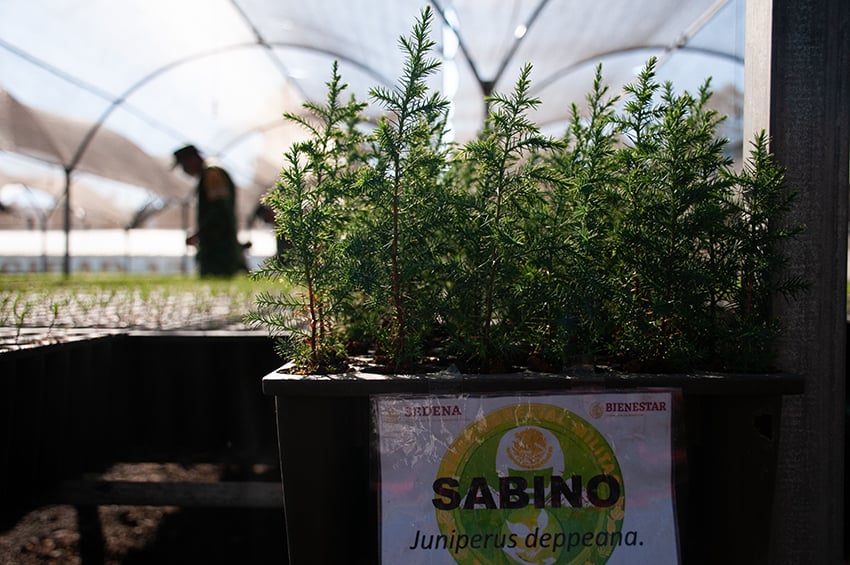
A new alliance between the Sowing Life program and the Environment Ministry seeks to restore 32 natural protected areas in Mexico through the planting of some 300 million trees and other plants in 2026, federal authorities announced this week. The new agreement aims to heal degraded ecosystems while shoring up rural livelihoods.
Sowing Life, a federal tree‑planting and rural welfare program, pays small farmers a monthly stipend to plant and care for fruit and timber trees on their own plots, often in combination with traditional crops. Launched by the López Obrador administration and expanded under President Claudia Sheinbaum, the program now operates across much of rural Mexico, channeling support to some of the country’s poorest communities while aiming to reforest degraded land and promote small‑scale agroforestry.

Under the deal, Sowing Life participants will establish around 18,000 community nurseries to supply native and locally adapted species. Officials say the effort will support soil restoration, improve water infiltration and boost carbon capture, while rebuilding habitat for emblematic wildlife such as jaguars, toucans and white pelicans. In the Yucatán Peninsula, work will focus on creating “biocultural corridors” that connect reserves like Calakmul and Sian Ka’an, echoing the region’s traditional milpa and forest management systems.
The corridors are designed to maintain movement routes for species that draw nature lovers to places such as the Sian Ka’an Biosphere Reserve, a vast mosaic of jungle, wetlands and reef that has become a bucket-list destination for eco‑tourism. Authorities frame the strategy as a way to put rural communities at the center of conservation, combining environmental restoration, agroecological production and income generation.
The announcement comes after years of scrutiny of Sowing Life’s environmental record. Previous reporting has documented how rules that rewarded planting on “unforested” plots encouraged some farmers to clear existing vegetation, leading analysts to warn that the massive tree‑planting program was also contributing to deforestation. The new push inside protected areas, where activities must comply with strict conservation rules, could function as a course correction, tying the social program more tightly to biodiversity goals.
Since 2001, Mexico has lost over 4.6 million hectares of forest according to the National Forest Commission, with a quarter of the losses coming from the Yucatán Peninsula.
Portions of this story were drafted with assistance from Claude. The article has been revised and fact-checked by a Mexico News Daily staff editor.