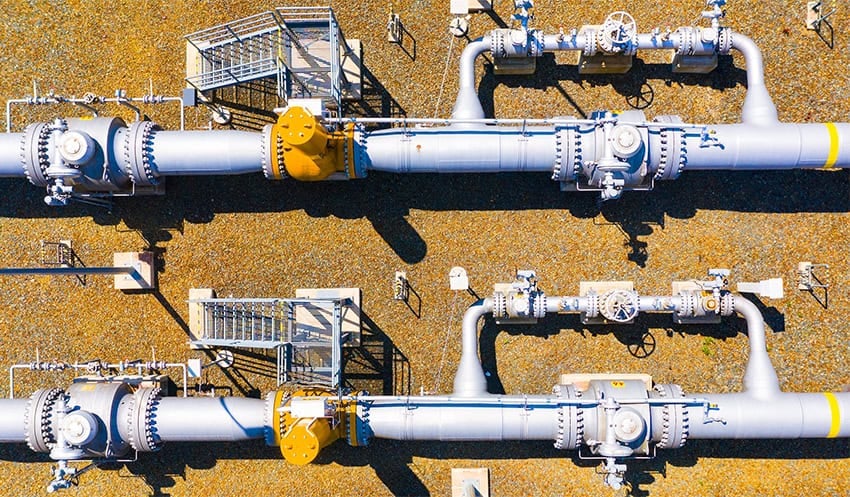
President Claudia Sheinbaum on Thursday announced a 140 billion-peso (US $8.14 billion) investment to expand, modernize and rehabilitate Mexico’s natural gas infrastructure.
“Our goal is energy sovereignty,” Sheinbaum said, adding that the investment will serve “to expand production capacity of fuels and renewable energy sources, so as not to depend on foreign countries.”
The funds — provided by the Federal Electricity Commission (CFE) and National Center for Natural Gas Contro (Cenagas) — will be used to build and maintain natural gas pipeline and distribution networks.
Energy Minister Luz Elena González said Mexico consumes approximately 9 billion cubic feet of natural gas per day, of which only 2.3 billion are produced by state-owned oil company Pemex. As a result, Mexico relies on imports to meet nearly 75% of its natural gas needs, almost all of it (more than 6.5 billion cubic feet per day) coming from U.S. sources.
González said the project seeks to guarantee a “safe, efficient and timely” supply of natural gas for electricity generation (60% of which depends on natural gas), for the 15 economic development hubs that are key to Sheinbaum’s Plan México economic policy and for other industrial activities.
First presented on March 18, Sheinbaum’s energy sovereignty strategy seeks to increase national production and reduce risks derived from external dependence, which creates vulnerabilities to price fluctuations, international conflicts or climate contingencies.
This is especially important since the government projects a 30% increase in the demand for natural gas by the end of Sheinbaum’s six-year term in 2030.

Pemex CEO Víctor Rodríguez has said that Mexico has vast natural gas resources — both conventional and unconventional reserves — that have not been fully exploited. Rodríguez estimates that production could increase to more than 4 billion cubic feet per day by 2030, and approach 8 billion in a decade, bringing the country closer to energy self-sufficiency.
Another key part of the energy sovereignty strategy is the construction of 13 new CFE power plants that are expected to be completed by 2030.
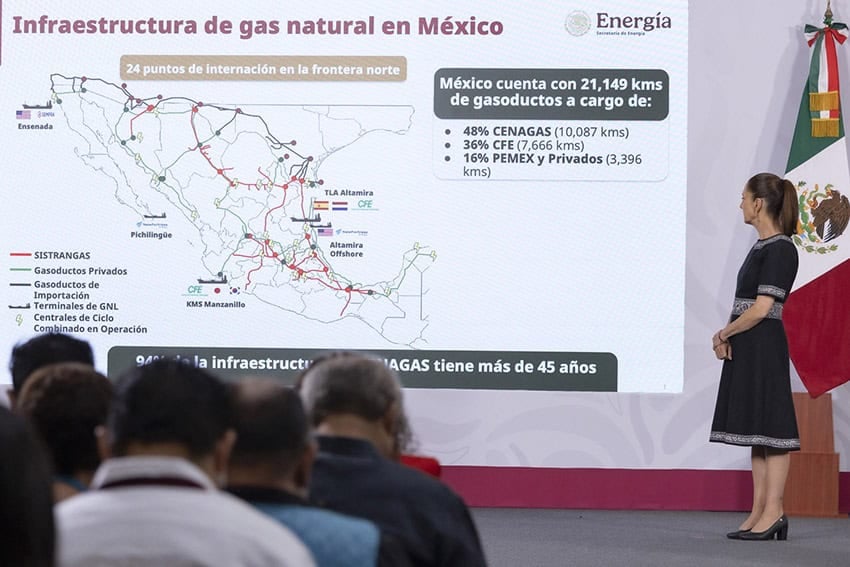
Expanding Mexico’s 21,149 kilometers of gas pipelines is essential to supply these new power plants, and González said more than 39 billion pesos (US $2.27 billion) will be allocated solely for pipeline maintenance and rehabilitation.
The strategy also seeks to increase electricity generation from clean sources and renewable energies from the current 24% to 38% by 2030.
Mexico is also considering the use of fracking, or hydraulic fracturing, to increase domestic production of natural gas.
With reports from El País, EFE and El Economista