Private companies will invest US $4.75 billion to build 20 renewable energy projects across 11 Mexican states, Energy Minister Luz Elena González announced Wednesday. To complement the private initiatives, the government is building or planning three more solar plants and investing nearly $2 billion in transmission infrastructure.
Speaking at President Claudia Sheinbaum’s morning press conference, González said that the 20 private projects — which were rapidly approved by the Energy Ministry (Sener) — will add 3,320 megawatts of electricity generation capacity and 1,488 megawatts of storage capacity.
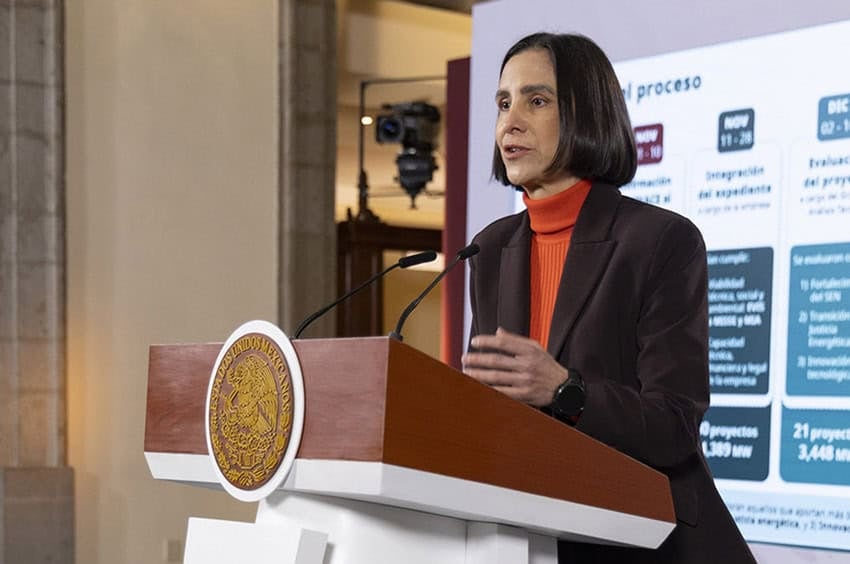
Fifteen of the 20 projects are solar power plants (2,471 MW), while the other five are wind farms (849 MW).
González said that the projects were proposed by private companies in response to Sener’s call for solar and wind proposals in October. She said that a total of 98 proposals were submitted, of which 20 were given the green light.
González didn’t name the companies whose proposed projects were approved.
She said the 20 projects “represent an investment of US $4.752 billion” or “around 90 billion pesos.”
González said that construction will commence “immediately” because land for the projects has been secured and permits have been issued.

She noted that the approval process was completed much more quickly than is usually the case, but asserted that “technical rigor” in the evaluation of the projects wasn’t sacrificed.
“It was an extremely careful and impartial process, aligned with [our] planning, that resulted in 20 projects in various regions of the country,” González said.
She said that the projects will be built in Campeche, Hidalgo, Yucatán, Guanajuato, Oaxaca, Tamaulipas, Quintana Roo, Puebla, Veracruz, Zacatecas and Querétaro.
Gónzalez said that the “vast majority” of the projects will commence operations in 2028, with the remainder to be ready either in 2027 or 2029.
A second call for proposals
Via its call for proposals in October, the Energy Ministry was seeking to find private companies to build renewable projects that together would add around 6,000 additional megawatts of generation capacity.
Given that the 20 approved projects will only add just over half that amount, Sener will put out another call for proposals next month.
“On the instructions of the president we will be putting out a second call for proposals at the end of January because we believe it is possible to align in a transparent way the country’s [electricity] generation needs with the possibility of private investment,” Gónzalez said.
By law, the state-owned Federal Electricity Commission (CFE) has a 54% share of electricity generation in Mexico, while private companies are limited to producing the remaining 46% of the country’s power supply.
CFE will invest $4.3 billion in 5 new power plants
In a separate presentation at Sheinbaum’s Wednesday morning press conference, CFE general director Emilia Calleja Alor spoke about the state-owned company’s electricity generation projects.
She said that the CFE will invest US $4.32 billion to build five new combined cycle power plants. They are:
- A $1.38 billion, 1,013-MW plant in Tula, Hidalgo.
- An $804.8 million, 495-MW plant in Salamanca, Guanajuato.
- An $804.2 million, 583-MW plant in Altamira, Tamaulipas.
- An $856.6 million, 581-MW plant in Mazatlán, Sinaloa.
- A $473.9 million, 240-MW plant in Los Cabos, Baja California Sur.
Calleja said that the projects, whose construction is set to begin next year, will provide “greater support to the national electricity system.”
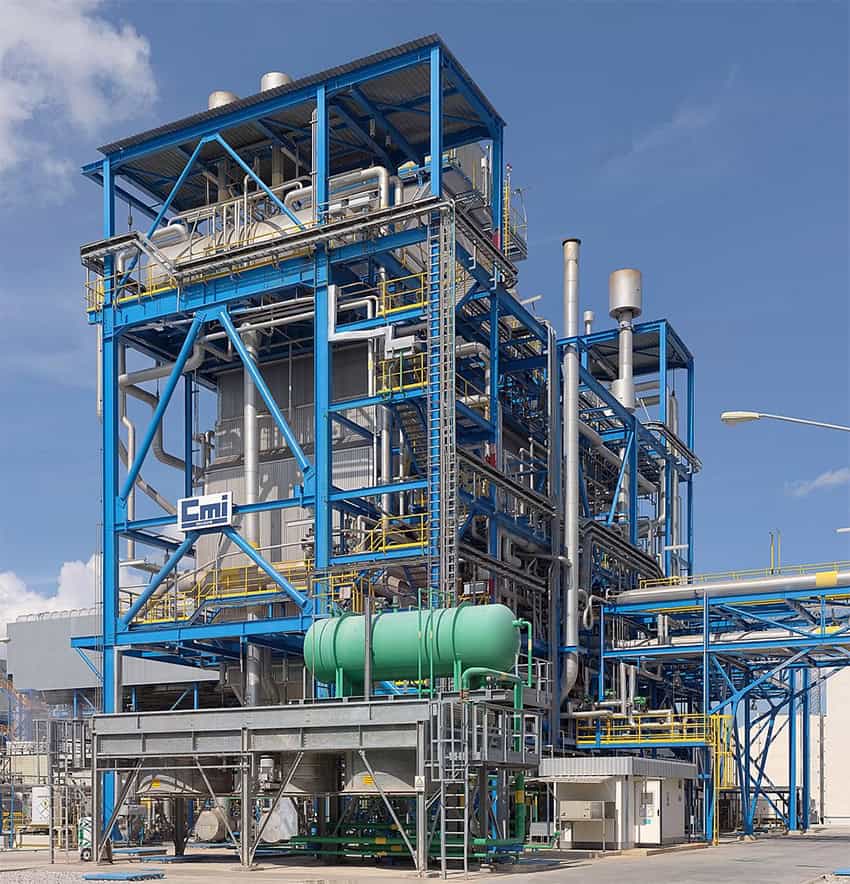
Together they will add 2,913 megawatts to Mexico’s electricity generation capacity.
Calleja explained that “in the majority of the cases” the new “generation units” will be built on properties where the CFE already has power plants.
“This will allow us to take advantage of already-installed infrastructure,” she said.
“… This will expedite development times and reduce technical risks, implementation times and costs,” the CFE chief said.
“… Together these projects respond to a real need of the electricity system and form part of the National Energy Plan, which anticipates the energy transition toward renewable sources,” Calleja said.
Additional investment in Puerto Peñasco solar plant
Calleja also said that the CFE is investing $710 million in stages 3 and 4 of the Puerto Peñasco solar energy plant. She said that construction of the additional stages will add 580 MW of generation capacity, bringing the plant’s total capacity to 1,000 MW.
The CFE chief said that construction of the third stage will begin next week, and construction of the fourth stage will commence in February.
“With these stages, the CFE will complete the largest solar energy complex in Latin America, reaching a total capacity of 1,000 megawatts,” Calleja said.
“This complex will generate enough clean electricity to light up an entire city the size of Guadalajara or Mérida, or the state of Baja California. With this, we will also prevent more than 1 million tons of CO₂ emissions per year,” she said.
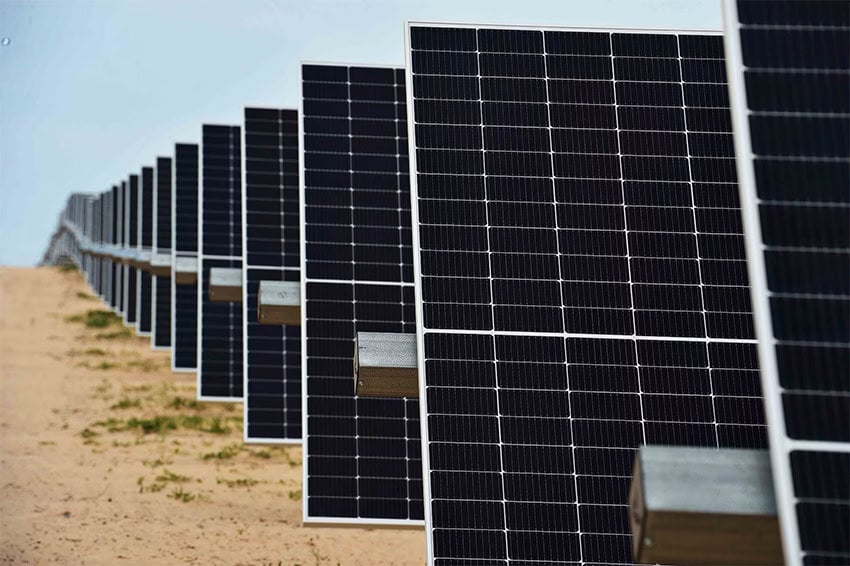
Calleja also presented two new solar energy projects that the CFE will build in the northern border state of Coahuila. A total of $826.2 million will be invested in the two projects, which will have a combined generation capacity of 556 MW.
Construction is scheduled to commence next year, with completion expected in 2028.
Calleja also spoke about 66 “priority” transmission projects, in which the CFE is planning to invest $1.9 billion between the final quarter of this year and the end of 2026.
‘Energy is needed for the development of the country’
Later in the press conference, Sheinbaum stressed that “energy is needed for the development of the country.”
“… Development requires electrical energy. It also requires other types of energy, like gas, for example, but it mainly needs electricity,” the president said.
“… So we’re guaranteeing sufficient electrical energy for the development of the country.”
Sheinbaum also noted that Plan México — the government’s ambitious economic initiative — “needs energy.”
“If we want to produce more in Mexico, we need more energy. So this [investment] scheme allows us to guarantee that there is energy,” she said.
“… In addition to all this, … we’re investing in transmission lines because if you generate [electricity] how do you transmit the energy? How does it get from one place to another? Via the famous transmission lines,” Sheinbaum said.
With reports from El Financiero, El Universal and La Silla Rota