
The Mexican Institute for Competitiveness (IMCO), a Mexico City-based think tank, recently published a report titled “Women in the Economy: 100 Years of Data.”
Mexico News Daily selected two pieces of data from the report as the focus of this “Mexico in Numbers” article, the continuation of a series we resumed last week with this piece on Mexico’s most popular airlines.
Mexico’s fertility rate has plummeted since the 1960s
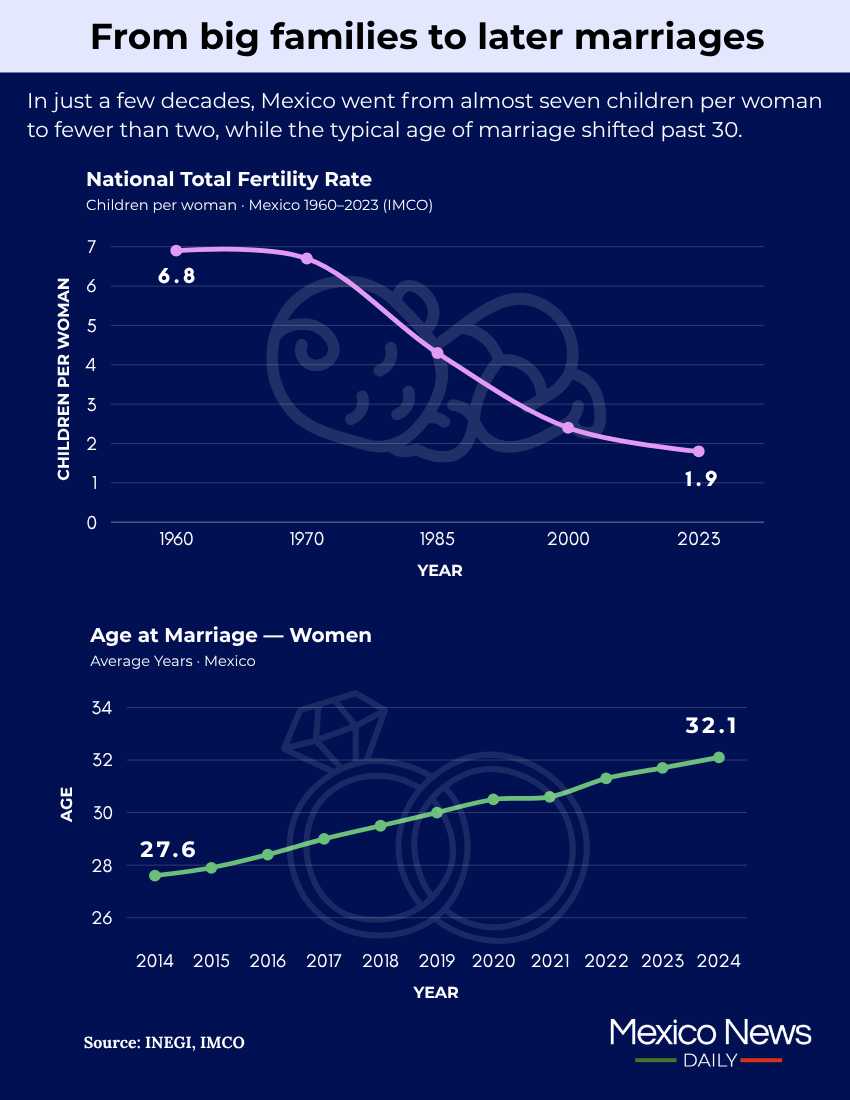
Citing World Bank data, IMCO reported that the fertility rate in Mexico declined from 6.8 children per woman in the 1960s to 1.9 children per woman in 2023.
Thus, a Mexican woman today is having 4.9 fewer children on average than her 1960s counterpart. The decline in percentage terms is 72.%.
In the period between the 1960s and 2023, IMCO reported that Mexico recorded the fourth largest fertility rate decline among OECD countries, behind only Costa Rica, South Korea and Colombia.
The think tank also said that the 1960s were an “inflection point” as before that decade Mexico’s fertility rate was declining by an average of 1.2% per year, but in 1979, the annual reduction reached 4.6%.
IMCO highlighted that during the presidency of Luis Echeverría (1970-76), mass campaigns were run under slogans such as “small families live better” and “let’s make ourselves fewer in order to live better.”

The use of contraception was also heavily promoted during this period.
As things stand, IMCO noted, Mexico’s fertility rate (1.9 children per woman) is below the replacement level fertility rate (2.1 children per woman).
“As a result, Mexico has begun to transition toward a process of population aging with implications for fiscal sustainability, the labor market, and the provision of care,” IMCO said.
Women are getting married later in life
Citing a 2001 academic reported titled “A Century of Marriage in Mexico,” IMCO reported that in 1895, the majority of Mexican women married between the ages of 15 and 19.
Today, the average age of marriage for Mexican women is around 30, according to the think tank. The national statistics agency INEGI provided more specific data last September, reporting that the average age of women who got married in 2024 was 32.1. The average age of men who married in 2024 was 35.
INEGI data shows that the average age of marriage for Mexican women increased every year between 2014 and 2024. The average of marriage for women during each year in that period was as follows:
- 2014: 27.6
- 2015: 27.9
- 2016: 28.4
- 2017: 29
- 2018: 29.5
- 2019: 30
- 2020: 30.5
- 2021: 30.6
- 2022: 31.3
- 2023: 31.7
- 2024: 32.1
Thus in the space of a decade, the average age at marriage of a Mexican women increased by 4.5 years, or 16.3%.
IMCO said that increased access to higher education for women and their greater participation in the labor market are factors that have caused an increase in the average age of marriage for Mexican women.
It noted that women with higher levels of education attainment and income tend to marry later than women who studied less and earn lower salaries. The think tank also said that the increase in the average age of marriage among Mexico woman is linked to the reduction of the fertility rate in Mexico.
Mexico News Daily